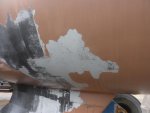
WARNING WARNING. ICI Epoxy Primer Supplied by Coppercoat

The horses mouth got it slightly wrong :D Have now inspected the primer tin and it's a 3M product. It does not do as it says on the tin :D

Details on tin: 3M Scotchkote. Lot No N62711. Manufactured June 2014. GP 120 Black.

Chappies contact is Ewan Clarke on 01258-861059

Hope that helps.

Sandy
 
The horses mouth got it slightly wrong :D Have now inspected the primer tin and it's a 3M product. It does not do as it says on the tin :D

Details on tin: 3M Scotchkote. Lot No N62711. Manufactured June 2014. GP 120 Black.

Chappies contact is Ewan Clarke on 01258-861059

Hope that helps.

Sandy

There should be two tins.

From the data sheet:

The material is a two component material comprising Part A
component and Part B component which must be mixed together
prior to use both components should be thoroughly stirred to
incorporate any slight separation prior to mixing. Whilst continually
stirring Part A, Part B component should be slowly added with
mixing continuing until completely homogeneous. The mixed
material must be used within 50 minutes at 20°C (68°F). This
time will be reduced at higher temperatures and extended at lower
temperatures.

Thorough mixing will be important
 
Last edited:
" The material is a two component material comprising Part A
component and Part B component which must be mixed together
prior to use both components should be thoroughly stirred to
incorporate any slight separation prior to mixing. Whilst continually
stirring Part A, Part B component should be slowly added with
mixing continuing until completely homogeneous. The mixed
material must be used within 50 minutes at 20°C (68°F). This
time will be reduced at higher temperatures and extended at lower
temperatures. "


Thanks for clearing that up - it's what I was trying to say in post 2 before being pedanticised -
 
I assume he is only applying primer to the metal parts
When i did my copper coat the primer was a metal primer not a primer for the GRP
So if it went wrong it would only be the keel to scrape off - But total hassle all the same
 
I have only been reading this thread now after the dust has settled and it strikes me as a perfect example of why, after all, manners should persist, and we might gently say ' erm, are you sure about that ? - instead of a triumphant " See, Nobody knows as much as I do, you're a berk ! "

In fact everyone was trying to help - and everyone was innocent of ' blame ' - but forum point-scoring got in the way.
 
My only experience is with Jotun epoxy type primer. Imitially it worked well hardening quite quickly but by the next winter old age must have set in and it would not go hard. I don't know if it was the epoxy or the hardener that went bad. I would certainly try a test batch for hardening now before doing any big job cos epoxy can fail to harden. good luck olewill
 
Sounds like the same solvent free epoxy I applied in 2011. On the upside there is no danger of trapping solvent under the Coppercoat and it goes on in two coats. On the down side it is less tolerant to weather conditions. Neither the grey or faulty black would dry in a UK December.

The remainder was mixed together to create dark grey and used on the garage floor. For the final batch I simply poured the reminder Part B into the Part A tin ..... clearly in the wrong quantities ... I though I might have to ring the fire brigade!!!

Anyway, the boat and the garage floor look great 5 years on :-)
 
I assume he is only applying primer to the metal parts
When i did my copper coat the primer was a metal primer not a primer for the GRP
So if it went wrong it would only be the keel to scrape off - But total hassle all the same

I was wondering about that. I asked Coppercoat whether I needed to prime my GRP hull before Coppercoating but was advised that it was not necessary.

Richard
 
I was wondering about that. I asked Coppercoat whether I needed to prime my GRP hull before Coppercoating but was advised that it was not necessary.

Richard

Well, I can tell you that this chap has been advised by CC to apply at least two coats of primer before the CC to his GRP hull.

People telling 'porky pies' to make sales in the marine industry? Surely not :D
 
Last edited:
I was only advised to prime the cast iron keel; I was advised that priming the GRP was unnecessary, as long as the surface was clean and slightly abraded. As I had the hull blasted using olivine, I met the conditions.
 
Well, I can tell you that this chap has been advised by CC to apply at least two coats of primer before the CC to his GRP hull.

People telling 'porky pies' to make sales in the marine industry? Surely not :D

That is odd. Normally no priming of a GRP hull before Coppercoat... unless of course you do a epoxy full osmosis protection treatment at the same time. ( Thats sensible while you have the hull clean but it makes a big job into an even bigger job)

The Epoxy primer mentioned is used on steel hulls which have been hand prepared ( ie not grit blasted). IIRC it is a high build coating and one coat is all that is required.
 
Something odd is going on here. I've used epoxies from AMC (the Coppercoat bods), which came in grey and black, like Sandyman's pal's. However, I've no way of knowing who produced it, since it had been re-labelled. It definitely was not specifically a primer, but a high-build epoxy suitable for barrier coating. Primer, as said above, is definitely not required for normal Coppercoat application on sound gelcoat.
 
I'm beginning to feel distinctly sorry for CC. Their stuff undoubtedly works absolutely brilliantly under some circumstances, and equally under others it fails to adhere. This thread may have given us a clue why. Let's consider what we know:

Someone, who is reporting on behalf of a friend he doesn't know well, has apparently been told there's may be a problem with a can of 'epoxy primer' which said friend never tried. No further details - really? wouldn't one have asked?

Manufacturer, and indeed function, of the paint remains unknown. It could very well have be manufactured by ICI as an OEM product sold under a different name since they are still in existence albeit part of akzo-Nobel, but unlikely to be the brand on the tin.

But then it turns out not to be by ICI but by 3M - an equally reputable company. However it's for coating steel wheres it's being used (or proposed to be - the posts are unclear) on an all GRP hull. Weird!

It 'doesn't do what it says on the tin', but Googling this primer shows no active product recalls. This is incredible (ie I don't believe it): 3M could of course have a rogue batch, no one's perfect, but their QA systems would have activated a procedure as per their ISO9000 QMS. They are simply not a fly-by-night concern.

However, armed with two tins, one brown which is fine and one black which has been cast into doubt, said friend rather than starting with the brown finds it better to buy a tin of something completely different, and possibly incompatible, and possibly not designed for the purpose intended, from a Portugese(?) chandlery. That it's past its sell-by date by a quarter of a century doesn't put him off.

You know, with customers like this, it's not surprising that Coppercoat occasionally falls off!


PS: I used to use the terms 'Araldite red tube', 'curing agent', 'hardener', 'activatior' and 'catalyst' more or less interchangeably. As helpfully pointed out in a previous post, it isn't actually a catalyst. I suppose I should have known this, and doubtless it was obvious to all chemists because the necessity to mix fairly precise ratios implies some active participation in the polymerisation process, so it can't, by definition, be merely a catalyst. But I hadn't previously realised that (mis)calling it a catalyst was such a hanging offence.
 
Last edited:
But I hadn't previously realised that (mis)calling it a catalyst was such a hanging offence.

It certainly isn't and it was never my intention to suggest as much. A gentle beating with a lambswool roller is punishment enough.
But in circumstances blighted (as you so astutely point out) by uncertainty, any contribution to accuracy can surely do no harm.
 
I'm beginning to feel distinctly sorry for CC. Their stuff undoubtedly works absolutely brilliantly under some circumstances, and equally under others it fails to adhere. This thread may have given us a clue why. Let's consider what we know:

Someone, who is reporting on behalf of a friend he doesn't know well, has apparently been told there's may be a problem with a can of 'epoxy primer' which said friend never tried. No further details - really? wouldn't one have asked?

Manufacturer, and indeed function, of the paint remains unknown. It could very well have be manufactured by ICI as an OEM product sold under a different name since they are still in existence albeit part of akzo-Nobel, but unlikely to be the brand on the tin.

But then it turns out not to be by ICI but by 3M - an equally reputable company. However it's for coating steel wheres it's being used (or proposed to be - the posts are unclear) on an all GRP hull. Weird!

It 'doesn't do what it says on the tin', but Googling this primer shows no active product recalls. This is incredible (ie I don't believe it): 3M could of course have a rogue batch, no one's perfect, but their QA systems would have activated a procedure as per their ISO9000 QMS. They are simply not a fly-by-night concern.

However, armed with two tins, one brown which is fine and one black which has been cast into doubt, said friend rather than starting with the brown finds it better to buy a tin of something completely different, and possibly incompatible, and possibly not designed for the purpose intended, from a Portugese(?) chandlery. That it's past its sell-by date by a quarter of a century doesn't put him off.

You know, with customers like this, it's not surprising that Coppercoat occasionally falls off!


PS: I used to use the terms 'Araldite red tube', 'curing agent', 'hardener', 'activatior' and 'catalyst' more or less interchangeably. As helpfully pointed out in a previous post, it isn't actually a catalyst. I suppose I should have known this, and doubtless it was obvious to all chemists because the necessity to mix fairly precise ratios implies some active participation in the polymerisation process, so it can't, by definition, be merely a catalyst. But I hadn't previously realised that (mis)calling it a catalyst was such a hanging offence.

Have had a word with chappie. It was he who told me it was an ICI product. I took him at his word and posted a warning. Later someone asked for a batch No. & it was only then that I discovered it was in fact labelled as a 3M product.
The rest I do not know & do not care about. If this thread has saved just one poor bugger from applying a coat of primer that didn't cure then it will have been worthwhile, though I don't now know why I bothered in the first place.
 
Have had a word with chappie. It was he who told me it was an ICI product. I took him at his word and posted a warning. Later someone asked for a batch No. & it was only then that I discovered it was in fact labelled as a 3M product.
The rest I do not know & do not care about. If this thread has saved just one poor bugger from applying a coat of primer that didn't cure then it will have been worthwhile, though I don't now know why I bothered in the first place.

Is this the slightly metallic looking mushroom coloured stuff that all the steel boaters in the yard have been using as a primer?
S
PS Dave?
 
Hi

There is (or was) definitely a problem with the (I believe) 3M product recommended by Coppercoat. My boat was being professionally treated by a recommended yard earlier this year. After blasting to strip back the hull was faired and epoxy coated using the 3m Epoxy they the copper was applied. The Coppercoat was finished and being tidied up when a large section peeled off. It wasn't the Coppercoat but the underlying grey epoxy layer that had not adhered. The yard had followed the correct temperatures, overcoating times etc. The manufacturers agreed the problem was with the product and it was re done.

Apparently there is a known issue with adherence of the grey layer to the black layer.

All sorted out now but a bit traumatic at the time!!

Regards Jim

P1080058.jpg
 
Top