
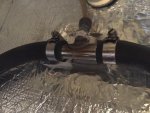
Volvo Penta 2030 engine cooling question

rivertest

Member
Joined
6 Sep 2005
Messages
23
Visit site
image.jpg

Afternoon all,
I would be be grateful if someone could identify the above for me please. I believe it's a pressure relief valve for my Volvo Penta 2030.
More importantly though has anyone had any problems with this device. I assume it has a spring and some kind of ball valve to provide relief if pressures within the fresh water cooling becomes too high.
A small dribble of water came out of the fitting on the side of the hull which is the outlet at the top of the above fitting.

I tapped it a few times with a small hammer and the dribble stopped but starts again once the engine revs rise so it sort of points to a sticking valve.
I should also explain that I have been right through the cooling system to check exhaust valve blockages etc etc
Any suggestions regarding the valve?
 
Is n't it the antisyphon device at the top of the loop in the seawater cooling circuit. (

If its the type which vents overboard there should be a steady pee stream while the engine is running. When the engine is stopped it allows air to enter to break the syphon.

If it were the type with a valve the valve should be closed when running and open to admit air when the engine is stopped , but that would not normally have an overboard discharge.

Over pressurisation of the fresh water cooling circuit is controlled by the pressure cap on the heat exchanger head tank, or expansion tank when fitted
 
Last edited:
Not seen one like that. The 2030 should have an anti syphon valve in the run from the seawater pump to the entry to the heat exchanger, usually on the bulkhead high up to the left of the engine looking at the front. The usual Volvo or Vetus ones are U shaped with the hoses entering and exiting vertically.

Would be useful to know exactly where this valve is.
 
It looks like a bodge job made up of a bit of stainless steel pipe with the valve bit of the original Volvo Penta anti syphon valve welded/brazed onto it. Then I suspect that the valve innards have been removed and a pipe fitted to vent a small stream of water overboard. If it has water exiting when the engine's running, the it's probably doing its job and I'd leave it be.
 
Is n't it the antisyphon device at the top of the loop in the seawater cooling circuit. (

If its the type which vents overboard there should be a steady pee stream while the engine is running. When the engine is stopped it allows air to enter to break the syphon.

If it were the type with a valve the valve should be closed when running and open to admit air when the engine is stopped , but that would not normally have an overboard discharge.

Over pressurisation of the fresh water cooling circuit is controlled by the pressure cap on the heat exchanger head tank, or expansion tank when fitted

Thanks all for your replies and sorry for the tardy response.

Vics, the only pressure relief is the cap on the fresh water side of the heat exchanger. There has always been a piddle of water going over the side but it seems there's a touch more so I was concerned that the setup isn't quite right. For completeness my boat is Westerly Ocean Ranger, 2 owners from new and I'd bet money on it that this is the original set up as its been maintained no expense spared.
 
I've got an Oceanranger too, and I've nothing like that on mine. Where is it on your boat? On mine, the antisyphon device is on the starboard side of the engine compartment about a metre up from the engine bilge and about 600 mm in from the forward engine hatch cover ( the one behind the steps).
Mike
 
I have one of those on a Westerly Discus, albeit mine doesn't look quiet as "bodgy". It's in the hose from the raw water pump to the heat exchanger and it pees over the side of the boat when the engine is running, sometimes but not always.
 
Thanks all for your replies and sorry for the tardy response.


As others have said, that is not an OE Volvo unit, which does not vent over the side, but seems to have been modified by attaching part of the Volvo valve to a piece of pipe and venting over the side. Its purpose is to break the potential syphon in the seawater circuit when you switch the engine off. Nothing to do with the pressurised freshwater system.

Doubt it is original equipment and suggest you replace it with a proper Volvo valve in a loop between the seawater pump and the injection point into the heat exchanger as described by Vegable.
 
Thanks all for your replies and sorry for the tardy response.


As others have said, that is not an OE Volvo unit, which does not vent over the side, but seems to have been modified by attaching part of the Volvo valve to a piece of pipe and venting over the side. Its purpose is to break the potential syphon in the seawater circuit when you switch the engine off. Nothing to do with the pressurised freshwater system.

Doubt it is original equipment and suggest you replace it with a proper Volvo valve in a loop between the seawater pump and the injection point into the heat exchanger as described by Vegable.

Or a Vetus one ??

with the Vetus ones you have a choice between one with a valve on the top or one without a valve that pees all the time.

The valve type must be checked for correct operation from time to time.

The peeing type are Ok all the while you can see them peeing. Some people route the outlet from these into a cockpit drain where they can easily be seen ......... down side is that it makes the crew keep peeing too!
 
Vegable, yes mines in exactly the same place.

Has someone got a picture of the said 'Volvo' genuine article?

this is the older type

875738-Rv1.jpg


this is a later type

26610.jpg


These are the older Vetus types

. ........ click to enlarge

This is a more recent Vetus type

v-asdv_2.jpg
 
I'm not sure why some think this part needs replacing - too eager to spend their hard earned! First, you need to find out whether the assembly contains a valve or not. Simply unscrew the cap and have a look. Whether or not, it is a good idea to clean it out whenever you're in there as they tend to accumulate a build-up of salt which can jam the valve or simply block the outlet, or both. This also gives you an opportunity to clean away all the muck on the outside and make a decent seal when you screw it back on.

If the syphon break contains a valve, then in a perfect world it should not emit any water, though it will when running if the valve sticks open. If there is no valve, then the stream of water from the small hose should be continuous when the engine is running, giving you an instantaneous indicator that you have cooling water flow. Becoming familiar with it and giving it the occasional clean it needs seems more important to me than fitting a new one.

My own syphon break originally had a valve, but when it failed I removed the valve and inserted a restrictor to get the discharge down to an acceptable flow rate or I'd have been swimming round the cockpit! As others have said, the "piddle tube" is directed into the cockpit drains so that a glance down tells me I have flow - much easier than leaning over the taff rail in a heavy swell to see whether water is coming out of the exhaust.

Rob.
 
On my 2040 the original Volvo valve was encrusted in salt and just about fell to pieces as I removed it. Replaced it with a Vetus non-return valve type and recently found the bilge full of sea water. The non return valve had failed and water was discharging all round the plastic nut and into the bilge. It seems the non-return vanes couldn't take the pressure. So I cut the vanes off to convert it into a continous bleed type of valve and piped the discharge out through the back of the cockpit onto the bathing platform.

It seems there is too much back pressure in the sea water system and I suspect that the exhaust elbow is partially blocked. Off to investigate this weekend.
 
If you can wait till next Tuesday evenning, I'm going up to my boat then and I'll photo what I've got. Not very good at posting photos so will probably be a private message with an attachment. Will then be sailing back to Pwllheli so don't expect anything more from me till after the 17th.
Mike
 
DJE;5718141 It seems there is too much back pressure in the sea water system and I suspect that the exhaust elbow is partially blocked. Off to investigate this weekend.[/QUOTE said:
DJE,

Went through similar with my 2030. Exhaust 'high rise' elbow which turned out to be crusted up. Replacement was quoted at £650 . So took out the black tapered thread plugs x4, had it shot blasted outside and inside the best they could, bought a gallon of phosphoric acid
https://www.ebay.co.uk/itm/201564016284
and submerged it in there for 3 days, plenty of grunge came out. Rinsed with water every day and re submerged. Re sprayed and no problems thus far having just returned from a 2 week cruise in the Channel Islands. If I have to do that every 2 years it's worth the bother.
Just a thought.
 
I too have an Oceanranger and the piddle through the small hexagonal hull fitting on the starboard side is, i've always understood, simply a 'tell-tale' giving a visible indication that the seawater cooling system is running fine.
 
I too have an Oceanranger and the piddle through the small hexagonal hull fitting on the starboard side is, i've always understood, simply a 'tell-tale' giving a visible indication that the seawater cooling system is running fine.

Unless your exhaust outlet is underwater isn't the water coming out of the exhaust a much better indicator as, from that, you get a good indication of how much cooling water is actually going through the system?

Richard
 
Top