
Volvo Penta 2000 series panel - strange behaviour

Or an alternator wiring issue somehow back feeding voltage when not running, as I understand from recent panel mods of my own the buzzer takes it's power from the alternator field coil (which should be grounded through it's own winding when not running) to stop it buzzing before the engine starts, once the alternator is activated the alarm buzzer has it's power, one of the diodes in the circuit diagram is a zener diode but not properly shown as such.
It's definately getting power from somewhere before the switch is turned on.

I am thinking along similar lines . . . . Back feeing from the alternator via the warning light circuit.
However this would need a backwards flow though the main rectifier from the battery. This would not normally occur but the rectifier may have damaged by the bad battery connection issue.
It would explain the buzzer sounding but not the warning lights being illuminate AFAICS unless there was also damage to components in the module . . . most likely to the transistor ??????

This schematic diagram of the electronic module is easier to follow than the one in the manual
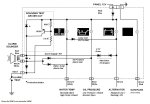
VP electronic module.jpg
 
You can look at the circuit diagram for as long as you like but you won't solve a real life problem in front of a screen or from an armchair. I am sure all the support on here is well-intentioned.

The trouble is you have to de pot the real thing to be able to test any theory of which diode has blown let alone replace it! This will take hours and one slip of a cutter makes the whole excercise futile.

Op this really is a no brainer don't waste any more of your time just bite the bullet.
My choice was to buy a new unit, fit it, forget it and go sailing.
Your wallet will take a hit but you brain won't be fried.

22354203 Logic Control Unit for Alarm Module - Genuine - Keypart

The new replacement unit has the benefit of leds replacing the unsealed incandescent warning bulbs and holders. These can also be a cause of VP control panel malfunction when the bulbs fail or the holders collapse in a heap of damp verdigris and corrosion.

I know others have gone down the DIY pbo panel rebuild route. Nothing wrong with that if you have the time or ability but remember one man's DIY project can become the next owners worst nightmare.
 
Thanks again to everyone for all the advice so far.

Well, another discovery in the meantime: the alternator isn't charging the batteries any more 😟 So is it starting to look like my clumsy battery replacement job has fried something in the alternator, allowing it to back-feed the alarm module... and maybe knackered the module itself?
If that's the case would I be best to start by taking the alternator off and getting it checked/fixed/replaced and then see how the panel behaves? I am very rapidly wishing I'd just decided to live with a crappy battery!
 
Thanks again to everyone for all the advice so far.
Well, another discovery in the meantime: the alternator isn't charging the batteries any more 😟 So is it starting to look like my clumsy battery replacement job has fried something in the alternator, allowing it to back-feed the alarm module... and maybe knackered the module itself?
If that's the case would I be best to start by taking the alternator off and getting it checked/fixed/replaced and then see how the panel behaves? I am very rapidly wishing I'd just decided to live with a crappy battery!
Yes I'd get that fixed. Take it to an auto-electrician who can test it and repair it as necessary

Getting back to the panel there are a couple of checks I would make

Disconnect the power at the fuse on the engine. Item 6 in the engine wiring diagram. See the owners manual for details. If the " strange behaviour " disappears it points towards a wiring fault.

Disconnect the warning light wiring from the alternator. If the "strange behaviour" disappears it points towards an alternator fault.

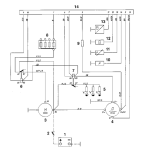
If you end up having to replace the electronic module bear in mind that the LED warning lights in the new ones do not provide enough current for the alternator initial excitation and to overcome that you will have to add an "excitation resistor" to the system to provide the necessary current, like that in the later versions of the MD2010/20/30/40 series of engines. Item 9 in the attached diagram ( I believe it is 30 ohms , rated at 5 watts)

1677666502957.png
 
Last edited:
If you end up having to replace the electronic module bear in mind that the LED warning lights in the new ones do not provide enough current for the alternator initial excitation and to overcome that you will have to add an "excitation resistor" to the system to provide the necessary current, like that in the later versions of the MD2010/20/30/40 series of engines. Item 9 in the attached diagram ( I believe it is 30 ohms , rated at 5 watts)

View attachment 152159

The unit I linked to and used to solve my faulty alarms on a 2001 MD2010D is sold as a direct replacement by asap and others.

It does not need any resistor adding to it to excite the alternator due to the use of led alarm indicators.

I understand some DIY control panel builders have needed additional resistors to match their poorly specified leds.
 
The unit I linked to and used to solve my faulty alarms on a 2001 MD2010D is sold as a direct replacement by asap and others.

It does not need any resistor adding to it to excite the alternator due to the use of led alarm indicators.

I understand some DIY control panel builders have needed additional resistors to match their poorly specified leds.
According to the schematic diagram there would already be an excitation resistor in place therefore no need to add one (See the diagram attached to my previous post)

The same is not true for the earliest version or for 2001/2/3 engines.
 
Thanks again to everyone for all the advice so far.

Well, another discovery in the meantime: the alternator isn't charging the batteries any more 😟 So is it starting to look like my clumsy battery replacement job has fried something in the alternator, allowing it to back-feed the alarm module... and maybe knackered the module itself?

If that's the case would I be best to start by taking the alternator off and getting it checked/fixed/replaced and then see how the panel behaves? I am very rapidly wishing I'd just decided to live with a crappy battery!
There are services such as this one:
Starter Motor Repair Service And Alternators By Auto Parts UK
in most decent sized towns. (No connection)
Back in the days of my youth, when I used to drive clapped out old bangers, (we didn't have vehicle testing in Ireland then), there were companies where you could trade in your faulty alternator or starter in part-exchange fora reconditioned one, but I don't see that kind of service advertised any more.
 
Well, are you ready for the next thrilling instalment?

First of all I swapped the engine panel with another one (which a forumite very kindly sent me to try). The behaviour was identical so I’ve reinstated the original panel for now.

Next I took the alternator to a test/repair place. They diagnosed a diode fault - a (generic brand) replacement wasn’t much more than the repair charge so I fitted a new alternator. Guess what? Same behaviour 🤨

So does it now sound like the wiring has been damaged? Presumably that would be the multi-pin cable connecting the engine to the panel. Does anybody know if replacements are available, or have any other bright ideas?

Thanks again for all the help everyone.
 
Well, are you ready for the next thrilling instalment?

First of all I swapped the engine panel with another one (which a forumite very kindly sent me to try). The behaviour was identical so I’ve reinstated the original panel for now.

Next I took the alternator to a test/repair place. They diagnosed a diode fault - a (generic brand) replacement wasn’t much more than the repair charge so I fitted a new alternator. Guess what? Same behaviour 🤨

So does it now sound like the wiring has been damaged? Presumably that would be the multi-pin cable connecting the engine to the panel. Does anybody know if replacements are available, or have any other bright ideas?

Thanks again for all the help everyone.
Yes the cable harness between the panel and the relay box is available. . . . €156 to €378depending on the length.
The engine wiring harness is also available

See the parts catalogue for details Volvo Penta parts and accessories - MarinePartsEurope.com

But some examination and diagnostic testing is called for before rushing to replace any of the cabling.
 
So here's the latest:

When I said in #29 above that I had fitted the new alternator that was partly true - I had connected everything except the 2 wires that go to the negative terminal (because the negative stud on the new alternator was slightly thicker than the original so I was waiting to crimp new ends on). One of these is a short length of heavy duty cable that attaches to the engine block, the other is a thinner one that goes to the engine wiring module. When I switched on the battery without these wires connected the panel behaviour was indeed as before - warning lights on dim, buzzer sounding - all with the panel turned off.

So today I crimped on the new terminals and connected the negative wires. This time when I turned on the battery switch... smoke, hiss, 'pop' from the shiny new alternator. During the few seconds that the power was on the alternator + and - terminals got pretty hot and the indicated battery voltage dropped from 12.7 to just over 6. I also thought I saw a little bit of smoke from the engine wiring connector module thingy, though I can't be sure because it might just have been wafting up behind the engine from the alternator. But I think I can safely say that (a) I've trashed the new alternator, and (b) there's a pretty major short somewhere.

I took off the engine wiring module for a look and everything seemed ok - I couldn't see any signs of overheating or damage. I did a continuity check of the cable harness connecting the engine module to the panel - all pins connected as they should be and none connected to any others that they shouldn't. The other bits of wiring that I could see all seemed fine too. So, any ideas what could possibly be going on?

I know the engine panel alarm module has been suspected all along, but what failure might result in the kind of dramatic (and probably expensive) outcome I had today?

Looking forward to more advice... please!
 
Or to put it another way, could an alarm module fault possibly cause such a dramatic result, or should I be looking elsewhere for the problem?
 
Its a big guess from me, but reading about your alternator, back feeding, checking diodes and refreshing the alternator all sounds identical to the faults I saw with the dodgy alarm module.

I swapped a VP MD2030 saildrive engine into our moody 336 which had a Perkins Perama M30.

they are based on the same block but there are some subtle differences.

I had to use the perkins engine mounts and because of the mounts and I had to use the perkins alternator as the volvo one did not bolt onto the engine mount like the perkins one had....

Got the engine all in and wired up etc, started her up and she was charging however the buzzer was going off.

I instantly suspected that it was not compatible, so I took both alternators to an expert who told me they are pretty much identical.

he told me which wire to put where and what wasn't needed etc

Wired it all up as he said and the buzzer still rang.

I've still got videos on my phone of me checking resistances etc and video calling him while he was in work with wiring diagrams and we found nothing wrong.

as soon as I swapped in the alarm module it worked flawlessly.

the module I sent you was lying in the shed, I have no clue whether it was good or not but I really think you should find a buddy with one that definately works. that will eliminate it once and for all
 
Ok everybody, we have a result!

I did a bit more dismantling and checking and testing and still couldn't find anything amiss in the wiring. Then I took the new alternator to get checked and it turned out to be faulty. I fitted a(nother) new replacement and now everything is working normally again 😃

I can only assume that the battery arc episode damaged the original alternator so that it was somehow constantly supplying a (low) voltage to the alarm module - it was just bad luck that the replacement alternator happened to have a similar fault which rather complicated the diagnosis!

Thanks so much as always to everyone who took the time to offer advice, diagrams and even engine panels. This forum is a brilliant resource because of the generosity and expertise of its contributors - long may it last.
 
Ok everybody, we have a result!

I did a bit more dismantling and checking and testing and still couldn't find anything amiss in the wiring. Then I took the new alternator to get checked and it turned out to be faulty. I fitted a(nother) new replacement and now everything is working normally again 😃

I can only assume that the battery arc episode damaged the original alternator so that it was somehow constantly supplying a (low) voltage to the alarm module - it was just bad luck that the replacement alternator happened to have a similar fault which rather complicated the diagnosis!

Thanks so much as always to everyone who took the time to offer advice, diagrams and even engine panels. This forum is a brilliant resource because of the generosity and expertise of its contributors - long may it last.
Brilliant
Thanks for the feed back.

You probably realised that I did not believe it was the electronic module that was at fault , but it was Snowbird who first suggested that it could be the due to an alternator fault .
I can see that if one (or more) of the positive diodes in the rectifier had failed to a short circuit you could get a 12 volt feed via it/them , the field diodes and the "no charge" warning light circuit to the panel. The warning light and the oil pressure warning light would come on at reduced brightness because they would be in effect be in series and you'd be able to measure about 6 volts on the red/ blue wiring. The buzzer would sound , without having to press the test button, but the high temperature alarm light would not illuminate. I think that matches the symptoms you described.
I was lost for words when connecting the new alternator caused a dead short circuit. I feared that you may have made some terrible mistake with the connections !
 
Brilliant
Thanks for the feed back.

You probably realised that I did not believe it was the electronic module that was at fault , but it was Snowbird who first suggested that it could be the due to an alternator fault .
I can see that if one (or more) of the positive diodes in the rectifier had failed to a short circuit you could get a 12 volt feed via it/them , the field diodes and the "no charge" warning light circuit to the panel. The warning light and the oil pressure warning light would come on at reduced brightness because they would be in effect be in series and you'd be able to measure about 6 volts on the red/ blue wiring. The buzzer would sound , without having to press the test button, but the high temperature alarm light would not illuminate. I think that matches the symptoms you described.
I was lost for words when connecting the new alternator caused a dead short circuit. I feared that you may have made some terrible mistake with the connections !
Hello,
Thank for the feedback. the same thing happen to my friend on his boat.
He burnt 4 modules and wasted 1 alternator and 1 battery splitter because of this issue. The fuse box over the engine hide a lot of rust bellow it. Even with a voltmeter it was impossible to find out engine off. the soldering cracked causing intermittent connection when the engine was turning. If found a guy in UK selling a conversion kit to 12V meaning change the engine senor too. But he ask the same amount as Volvo aftermarket parts. So price wise, both are not interesting. as for this plexiglass box, it can be replace with any fuse box with 6.3mm terminals. (i would say more reliable and more convenient that the OE part) more photo to come in future.
 
Top