noelex
Well-Known Member
I purchased one of these devices recently.
For those of you who are not familar with the Victron products:
The idea is to attach this small device directly to your house battery terminals. It will then comunicate battery voltage and temperature via bluetooth with Victron solar controllers (and other charge devices).
As it is measuring the voltage directly at the battery terminals, the result will be more accurate than when measured directly via the solar controller, as the latter is subject to voltage drop in the wire and the fuses etc between the solar controller and the batteries. Unfortunately, this voltage drop is dependent on the current in this wire so it cannot be adjusted by altering the charge set points. The magnitude of this voltage drop will vary significantly with the installation, particularly with the distance between the solar controller and the gauge of wire used.
The second function of the Smart Sense is to communicate the battery temperature. Battery temperature is important when charging lead acid batteries, as it alters the recommended charge set points (absorption and float voltage). The solar controllers without any accessories can measure temperature and adjust the charge parameters automatically, but the temperature at the solar controller is often significantly different to battery temperature so without an accurate reading of battery temperature this feature is near useless. The Smart Sense has the ability to convey the correct battery temperature.
The final advantage of the Smart Sense is for people with multiple solar charge controllers. The battery voltage read by each of the charge controllers is generally slightly different due to calibration and manufacturing differences. If the wiring is similar, this tends to be a reasonably constant error and can be partially adjusted for by slightly altering the charge set points. For example, my port solar controller reads 0.02v higher than the central controller. This sounds very little, but unless this is adjusted for, the port solar controller can be counting down the absorption timer for much longer than the other solar controllers. This can be adjusted by altering the charge set points of the port solar controller by 0.02v. The Smart Sense removes the need to do this, and is more accurate, as all solar controllers now recieve voltage information from the same source (the Smart Sense) eliminating any difference.
Finally, Victron have promised that with the next firmware release (1.47), a network with the Smart Sense will allow all solar controllers to coordinate their charge algorithm so they will all drop to float at the same time. This will be help for those with unresolved charge coordination problems.
The Smart Sense is very easy to fit, has only two wires and has its own fuse holder. The other good news is the reasonable price, about $50.
The biggest drawback is the poor range of the Bluetooth communication. There are two versions: normal and the “long range” model. However, in my case even the long range model failed to reliably contact the solar controllers when attached to the batteries. Having read similar user reports from those with a reasonable distance between the batteries and controllers, I expected this. I have an aluminium waterproof bulkhead between the batteries and the solar controllers so the unit did not stand much chance even with the waterproof door open. You might think this renders the unit usless, but this not the case. By feeding some wires directly from the battery the Smart Sense can be mounted remotely. As these wires carry almost no current, providing the wire gauge is reasonable, the reading will still be accurate and the Smart Sense can be placed close to the solar controllers and in direct line of sight. Of course, the battery temperature measurement is no longer accurate so part of the functionality of the unit is lost, but given the low cost, the voltage (and future charge synchronisation) abilities still make the Smart Sense worth considering.
Hopefully the above user report is helpful, although the real test will come after installing 1.47. It is worth noting there are other Victron products that perform the same functions as the Smart Sense. Some of these also measure current entering the battery, which can be used to terminate the absorption phase more accurately. However, these products are more expensive and complex than the SmartSense.
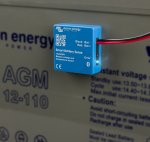
This is what the unit looks like (Victron photo):
For those of you who are not familar with the Victron products:
The idea is to attach this small device directly to your house battery terminals. It will then comunicate battery voltage and temperature via bluetooth with Victron solar controllers (and other charge devices).
As it is measuring the voltage directly at the battery terminals, the result will be more accurate than when measured directly via the solar controller, as the latter is subject to voltage drop in the wire and the fuses etc between the solar controller and the batteries. Unfortunately, this voltage drop is dependent on the current in this wire so it cannot be adjusted by altering the charge set points. The magnitude of this voltage drop will vary significantly with the installation, particularly with the distance between the solar controller and the gauge of wire used.
The second function of the Smart Sense is to communicate the battery temperature. Battery temperature is important when charging lead acid batteries, as it alters the recommended charge set points (absorption and float voltage). The solar controllers without any accessories can measure temperature and adjust the charge parameters automatically, but the temperature at the solar controller is often significantly different to battery temperature so without an accurate reading of battery temperature this feature is near useless. The Smart Sense has the ability to convey the correct battery temperature.
The final advantage of the Smart Sense is for people with multiple solar charge controllers. The battery voltage read by each of the charge controllers is generally slightly different due to calibration and manufacturing differences. If the wiring is similar, this tends to be a reasonably constant error and can be partially adjusted for by slightly altering the charge set points. For example, my port solar controller reads 0.02v higher than the central controller. This sounds very little, but unless this is adjusted for, the port solar controller can be counting down the absorption timer for much longer than the other solar controllers. This can be adjusted by altering the charge set points of the port solar controller by 0.02v. The Smart Sense removes the need to do this, and is more accurate, as all solar controllers now recieve voltage information from the same source (the Smart Sense) eliminating any difference.
Finally, Victron have promised that with the next firmware release (1.47), a network with the Smart Sense will allow all solar controllers to coordinate their charge algorithm so they will all drop to float at the same time. This will be help for those with unresolved charge coordination problems.
The Smart Sense is very easy to fit, has only two wires and has its own fuse holder. The other good news is the reasonable price, about $50.
The biggest drawback is the poor range of the Bluetooth communication. There are two versions: normal and the “long range” model. However, in my case even the long range model failed to reliably contact the solar controllers when attached to the batteries. Having read similar user reports from those with a reasonable distance between the batteries and controllers, I expected this. I have an aluminium waterproof bulkhead between the batteries and the solar controllers so the unit did not stand much chance even with the waterproof door open. You might think this renders the unit usless, but this not the case. By feeding some wires directly from the battery the Smart Sense can be mounted remotely. As these wires carry almost no current, providing the wire gauge is reasonable, the reading will still be accurate and the Smart Sense can be placed close to the solar controllers and in direct line of sight. Of course, the battery temperature measurement is no longer accurate so part of the functionality of the unit is lost, but given the low cost, the voltage (and future charge synchronisation) abilities still make the Smart Sense worth considering.
Hopefully the above user report is helpful, although the real test will come after installing 1.47. It is worth noting there are other Victron products that perform the same functions as the Smart Sense. Some of these also measure current entering the battery, which can be used to terminate the absorption phase more accurately. However, these products are more expensive and complex than the SmartSense.
This is what the unit looks like (Victron photo):