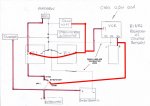
Victron Intelligent Battery Combiner Cyrix-ct 12/24V-120A VCR

tony12345

Member
Joined
8 Dec 2017
Messages
38
Visit site
Hi - I have a Sadler 32 with 2 batteries. They are on a 4 way switch - off/1/both/2
At this time I use one for domestic and save the other for starting the engine.
I would like to use both for domestic but then need a third battery to be sure I can start the engine.
I don't want to try re-wiring a separate battery just for the starter so have an idea to use a VCR to link a small battery with a high CCR and, if the 2 paralleled batteries should go too low I will use it as you would a jump start battery.
As I understand a VCR the two existing batteries will be disconnected from the smaller battery unless a) the start assist function is enabled or b) the two existing batteries are being charged (I have wind/solar/alternator and shore power charger). In this event the smaller battery will be linked until it is 'fully' charged and then disconnect.
I believe that the VCR needs to be installed the correct way round so that the connection is broken when the smaller battery is charged.
One concern is what would happen if the relay failed closed and the smaller battery continued to be charged even though full???
I assume the relay would fail open.

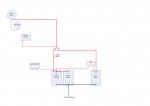
I attach a simplified diagram of how it would look.Cyrix 1.png
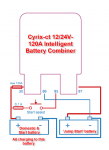
Will this work?

I will appreciate any help/feedback.
 
As I understand a VCR the two existing batteries will be disconnected from the smaller battery unless a) the start assist function is enabled or b) the two existing batteries are being charged (I have wind/solar/alternator and shore power charger). In this event the smaller battery will be linked until it is 'fully' charged and then disconnect.
I believe that the VCR needs to be installed the correct way round so that the connection is broken when the smaller battery is charged.
One concern is what would happen if the relay failed closed and the smaller battery continued to be charged even though full???
I assume the relay would fail open.

Will this work?

No, the Cyrix-ct won't disconnect when the smaller battery is charged; it will stay connected all the time your domestic bank is being charged.
 
As I understand a VCR the two existing batteries will be disconnected from the smaller battery unless a) the start assist function is enabled or b) the two existing batteries are being charged (I have wind/solar/alternator and shore power charger).

This is correct.

In this event the smaller battery will be linked until it is 'fully' charged and then disconnect.

No. The relay will remain closed as long as one bank or the other is on charge.

I believe that the VCR needs to be installed the correct way round so that the connection is broken when the smaller battery is charged.

No. The Cyrix is dual sensing, it will close when either battery is being charged, it does not open again when either battery is charged. The two banks will continue to be in parallel whilst one or the other is being charged.
I attach a simplified diagram of how it would look.View attachment 75383

Will this work?

It won't do what you want.

Best bet would be to ditch the 1-2-B switch and fit separate switches, but i'm guessing you will resist that suggestion. That being the case ;

1) Fit your new engine start battery in place of one of the existing batteries.

2) Connect the removed battery to the other battery, in parallel to form your domestic bank. Connect the positive to one battery and the negative to the other.

3) Connect the solar etc to the domestic bank, leave the alternator on the engine battery.

4) Fit the Cyrix as per your diagram, skip the start assist.

You now have two choices ;

a) Start the engine on it's battery, then change to the domestic bank.

b) Always use the domestic bank, with the engine battery sitting in reserve.

In either scenario you have a backup, you don't need to fiddle with the switch to keep all batteries charged as the Cyrix will do that.

If you would consider the much better system of having independent switches, with an emergency switch, i'll post some details of that for you.
 
Last edited:
Thank you.
I need to think through what you have written and revert. Is there an alternative device that would work as I thought this did?
I could just put in a switch instead and turn it on when I want to use the backup battery?
My aim is to do this with minimal re-wiring.
 
Thank you.
I need to think through what you have written and revert. Is there an alternative device that would work as I thought this did?
I could just put in a switch instead and turn it on when I want to use the backup battery?
My aim is to do this with minimal re-wiring.

Couldn't you simply do it in exactly the same way as you do at the moment? This will involve changing the setting of your 1-2-Both switch at various times. If you've managed to do this in the past, presumably you could continue. However, as the forum's leading opponent of 1-2-Both switches, I can tell you that there are more foolproof ways, involving two simple on/off switches, as PaulRainbow also mentioned.
 
I only have the two batteries at the moment. I want to add a backup so I can use both the existing for domestic instead of keeping one in reserve for starting.
I think I need to post a diagram showing a part of my existing setup.
 
I only have the two batteries at the moment. I want to add a backup so I can use both the existing for domestic instead of keeping one in reserve for starting.
I think I need to post a diagram showing a part of my existing setup.

I think we understand your plan. Just wire your existing start battery in parallel with your existing domestic battery, then wire the new start battery in where the old start battery was.
 
I only have the two batteries at the moment. I want to add a backup so I can use both the existing for domestic instead of keeping one in reserve for starting.
I think I need to post a diagram showing a part of my existing setup.

As i said earlier, replace one existing battery with a new engine battery, so far, no difference to what you have now, no extra parts (except the battery), no new wiring.

You now have a second battery for the domestics. All this needs is a pair of cables to connect it to the existing domestic battery.

If you then add the Cyrix, as per your diagram, all batteries get charged automagically.

Here's a basic diagram, no fuses etc are shown.
 

Attachments

  • Charging 2 Batteries One Engine  VSR and 1-2-B.jpg
    Charging 2 Batteries One Engine VSR and 1-2-B.jpg
    57 KB · Views: 28
I will post a diagram of current setup. The engine can be started from either battery dependent on the battery switch. It is just my decision that I start the engine from no 1 and run domestic on no 2. Could be the other way round.
So neither battery is dedicated to the starter.
At moment I can't see your diagram.
 
I will post a diagram of current setup. The engine can be started from either battery dependent on the battery switch. It is just my decision that I start the engine from no 1 and run domestic on no 2. Could be the other way round.
So neither battery is dedicated to the starter.
At moment I can't see your diagram.

Your setup is common.

But, if you join the two existing batteries together to form a domestic bank, then fit the engine starter battery one position selects the engine battery and the other selects the domestic bank, exactly the same as you do now. The both setting is for emergency use only. So, you can select the two battery bank for engine starting and domestic use and keep the other battery in reserve. You can use it by simply changing the switch position. The Cyrix will keep it charged.

Dunno why you can't see the diagram, i can see it. :confused:
 
I can see the image now - failed on Android Chrome.
I appreciate all the replies but I feel they are more complex and/or require more work than I want to take on at this time - some reasoning below.
Here, hopefully more clearly, is the situation I am trying to achieve:

BTW, The yacht is in Greece, I have only owned it for 1 year and I do not have an exact wiring diagram - a LOT of wires have been attached to the batteries and other changes made to the wiring since 1983.

I have two 100Ah batteries on a 4 way 1/2/both switch. A NASA BM1 battery monitor is fitted.
Neither is a dedicated starter battery but by choice I manually reserve battery 1 for starting. The windlass runs on battery 2 (not switchable)

For charging I have:
100W solar via a Victron MPPT controller
Aeorogen wind generator via its own 2 battery regulator.
Alternator via a Sterling regulator.
On shore power I have a CTEK charger that can be plugged in.
So far as I am aware, with the exception of the Aerogen all charging input goes via the 1/2/both switch to whichever battery(ies) is selected.

This all works fine but using one battery for domestic cannot provide sufficient power for a day if there is insufficient solar and/or wind when I have no shore power unless I keep running the engine. The refrigerater

I want to add a small (say 25Ah) sealed high CCR battery to use to jump start the engine in the event that neither of the 100Ah batteries has sufficient charge. This will allow me to use both 100Ah batteries for domestic supply.
I am working on the basis that if I connect two 100Ah batteries and a 25Ah battery in parallel the 25Ah battery is going to get seriously over charged.

I do not want to get involved in moving existing cables.
There is no room outside of the battery compartment for another large battery so moving an existing 100Ah battery is not viable. The jump start battery needs to be sealed so it can go in any orientation.

I could just use jump leads if a jump start (let's say JS) is needed but I would like to have a way to connect the JS battery as and when needed.
I can achieve this by wiring the JS battery in parallel through a switch i.e.
- link the JS battery with the switch
- start engine
- let alternator charge the 3 batteries for 10 minutes so that the JS battery is probably fully charged
- un-link the battery with the switch.

I had thought, wrongly, that a VCR would take care of this by linking the batteries using the Start Assist function, linking the batteries when the JS battery needed charging, un-linking the batteries when the JS battery is charged.

Is there is a simple way to ensure the smaller JS battery is kept charged but not over-charged other than me switching it in and out manually?
 
You clearly don't understand how it works, which is making it difficult. Your proposals are more complicated than my suggestion.

I am working on the basis that if I connect two 100Ah batteries and a 25Ah battery in parallel the 25Ah battery is going to get seriously over charged.

I keep telling you that won't happen.

I do not want to get involved in moving existing cables.
There is no room outside of the battery compartment for another large battery so moving an existing 100Ah battery is not viable. The jump start battery needs to be sealed so it can go in any orientation.

An Optima battery will be suitable here. You will have to make changes to cables.My diagram shows how to do it, you can fit the "engine" battery wherever you want, but you will have to run a cable from it to the switch, along with a negative cable.

Is it really too much work, or too complicated to run two cables from the new battery ? If it is, i don't see how you expect to be able to use another battery.

I could just use jump leads if a jump start (let's say JS) is needed but I would like to have a way to connect the JS battery as and when needed.
I can achieve this by wiring the JS battery in parallel through a switch i.e.

You can, follow the diagram i posted.

- link the JS battery with the switch
- start engine
- let alternator charge the 3 batteries for 10 minutes so that the JS battery is probably fully charged
- un-link the battery with the switch.

You cannot fully charge a battery in 10 minutes. Again, follow my diagram, the VSR will keep all of the batteries charged, by whatever charging method is available.

Is there is a simple way to ensure the smaller JS battery is kept charged but not over-charged other than me switching it in and out manually?

Erm.... yes, fit the VSR.
 
I hope I'm not appearing argumentative - I just don't fully understand your suggestion.
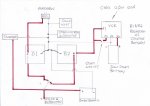
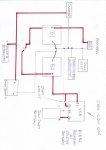
I attach a very simplified diagram of the current installation based on a hand drawn diagram supplied with the yacht by the previous owner who had installed the Solar and Sterling regulators.
I have added the VSR wired so that the connection will be made/broken based on the domestic battery state.
When a jump start is required the connection is made using the Start Assist switch/button.
I don't understand why there is a need to wire the new battery to the 1/2/both switch.
Having previously researched charging dissimilar batteries in parallel there seem to be a number of contradictory views.
I'm not doubting your statement but, as a layman in this area I don't know much about the theory of battery charging, so I find it difficult to understand how parallel charging batteries with different chemistry and Ah ratings can not cause a problem.
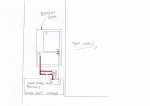
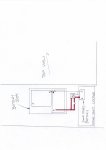
I also attach a top view of the layout of the batteries showing how I would probably install the 3rd battery.
I am happy adding cables but want to avoid moving or re-wiring existing - I have an extensive work program for April already.
One thing I now see from the datasheet is that the 3rd battery will be contributing to the supply until 3 minutes after the domestic batteries drop to <12.8V but I guess that won't take much out of it.
physical layout.jpgYacht Diagram.jpg
 

Attachments

  • physical layout.jpg
    physical layout.jpg
    228.5 KB · Views: 8
  • Yacht Diagram.jpg
    Yacht Diagram.jpg
    319.2 KB · Views: 13
Last edited:
I hope I'm not appearing argumentative - I just don't fully understand your suggestion.
I attach a very simplified diagram of the current installation based on a hand drawn diagram supplied with the yacht by the previous owner who had installed the Solar and Sterling regulators.
I have added the VSR wired so that the connection will be made/broken based on the domestic battery state.
When a jump start is required the connection is made using the Start Assist switch/button.
I don't understand why there is a need to wire the new battery to the 1/2/both switch.
Having previously researched charging dissimilar batteries in parallel there seem to be a number of contradictory views.
I'm not doubting your statement but, as a layman in this area I don't know much about the theory of battery charging, so I find it difficult to understand how parallel charging batteries with different chemistry and Ah ratings can not cause a problem.
I also attach a top view of the layout of the batteries showing how I would probably install the 3rd battery.
I am happy adding cables but want to avoid moving or re-wiring existing - I have an extensive work program for April already.
One thing I now see from the datasheet is that the 3rd battery will be contributing to the supply until 3 minutes after the domestic batteries drop to <12.8V but I guess that won't take much out of it.
View attachment 75409View attachment 75410

Let's look at the second picture. The cable from B2 to the switch needs moving from its current terminal to either, the positive post of B1 or the same terminal on the switch as B1, whichever is easiest. Those two batteries now form your domestic bank.

The negative battery negative cable has to be battery size cable and can go to the negative of either B1 or B2, or even the engine block connection, whichever is easiest.

The positive from the engine battery goes to the now vacant terminal on the isolator switch. You now have a dedicated setting on the switch to start the engine from the new battery. You can either start it from that battery always, switching to the domestics when the engine is running, or you can always use the domestic bank for engine starting and keep the new battery in reserve.

It would be better to start the engine from the engine battery. If the domestic batteries are low and you attempt to start the engine the voltage drop will cause various equipment to cycle and you can cause damage.

The VSR is connected correctly, you can also connect it across the two battery terminals at the switch, whichever is easier.

Forget the start assist. You cannot hope to start an engine by "jump starting" flat batteries with a 120a relay.

As for connecting the VSR to different size banks, that's exactly what it is designed for. Connecting it between lead acid and an AGM battery will not harm either battery, the charging voltages are close enough.

The solar controller is incorrectly connected, it should go directly to the domestic bank, suitably fused close to the batteries.
 
Tony - glad to see you have sought advice here. (For others, we were discussing this on the 12 volt forum.) I think you may need to make the shift from seeing the third battery as a sort of insurance policy, in case your standard Sadler 32 two battery system fails, to getting the benefits of having separate engine battery and domestic bank with any emergency being dealt with by your 'both' switch. This is top advice which I followed some time ago on the same boat as yours. I don't think there is a lot more wiring for you to do.

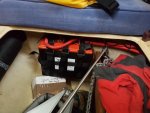
The place for the engine battery is a good one. Here's a photo of mine hanging high up in straps and taking up very little of that locker space.

Red Flash 1100.jpeg

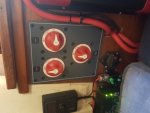
And this is my three switch panel which fits neatly on the left side of the companionway steps looking aft. (There are cheaper ones but this neatly covered a big hole.)

Battery switches.jpeg
Needs veering 90 degrees.

PaulRainbow has given you a handy way of wiring onto your 1+2+both switch but three switches has advantages which are probably best searched for rather than discussed ...
 
Last edited:
Thank you PaulRainbow.
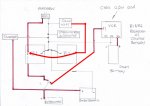
Modified diagram attached. Is it correct?
The 1/2/both switch will need to be in the 'both' position to charge the starter battery.
>>Forget the start assist. You cannot hope to start an engine by "jump starting" flat batteries with a 120a relay.
Agreed
yacht diagram mod1.jpg
 
Last edited:
Thank you.
Modified diagram attached.
The 1/2/both switch will need to be in the 'both' position to charge the starter battery.
>>Forget the start assist. You cannot hope to start an engine by "jump starting" flat batteries with a 120a relay.
Agreed
View attachment 75413

That's a start.

The engine battery needs a cable from it's positive terminal to the isolator switch, not via the VSR. It needs a negative cable too, going to one of the other batteries. Both of these cables must be sized for engine starting.

The relay is then connected to either, a positive terminal on each bank, or both battery terminals on the isolator, Its negative can come from anywhere convenient. These cables need to be rated no more than 120a, fused at the batteries.

Edit ; If you make the above changes, your diagram will look like the one i posted earlier.
 
Last edited:
I'm getting there. Thank for your patience :encouragement:
>>It needs a negative cable too, going to one of the other batteries.
The negative line is there but in pencil

Am I correct ref the 'both' or 'Start' switch setting to charge the start battery?
It looks like I can stop the start battery being charged using the switch.

Is this correct?
yacht diagram mod2.jpg
 
Top