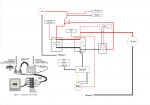
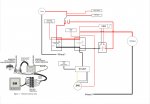
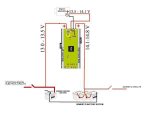
Victron Intelligent Battery Combiner Cyrix-ct 12/24V-120A VCR

Desk top PC, Windows 10 and Chrome

Perhaps the Adblock has blocked it .... can see other attachments OK though

Windows 10 and Firefox here, with the uBlock adblocker. Not sure what the issue is.

Let's try adding it to this post.

Here >>>
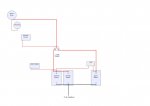
 

Attachments

  • Charging 2 Batteries One Engine  VSR and 1-2-B.jpg
    Charging 2 Batteries One Engine VSR and 1-2-B.jpg
    57 KB · Views: 15
@PaulRainbow - Dug out Visio 2003.

Attached is, I believe, the final circuit re-drawn.
You will see that I have added an image of a circuit from the NASA BM1 battery monitor manual.
The BM1 Load & Charge Current is 100 Amps Maximum.

I've also added in the BM1 circuit to my diagram and left the starter and windlass negative lines open.
Those negative lines need to go somewhere but, against the negative battery connection, the BM1 instructions say "No other connection should be made to this post"
Without them I believe the BM1 is wired in correctly.
I can't see they can go on the shunt - too much current drawn
Can you help/advise where I should attach them?

I suspect that switching from Domestic to Starter battery or Both will confuse the BM1 so other than seeing the voltage and amperage I'm not sure it will be a able to predict time to go???
Visio Circuit wiuth BM1.jpg
 

Attachments

  • Visio-Drawing1.pdf
    Visio-Drawing1.pdf
    108.3 KB · Views: 5
  • Visio Circuit wiuth BM1.jpg
    Visio Circuit wiuth BM1.jpg
    148.8 KB · Views: 11
Last edited:
@PaulRainbow - Dug out Visio 2003.

<snip>

I can't see they can go on the shunt - too much current drawn
Can you help/advise where I should attach them?

You're correct, they cannot go through the shunt. You need to connect them to the batteries.

I suspect that switching from Domestic to Starter battery or Both will confuse the BM1 so other than seeing the voltage and amperage I'm not sure it will be a able to predict time to go???

SOC and TTG will both be inaccurate, due to changing batteries and the fact that starter and windlass loads won't be "seen" by the BM1. With your current arrangement there's no way around that, but the BM1 isn't well known for it's SOC and TTG calculations.

The BM1 assumes that you will always use the same batteries (as would other monitors) and in the case of the 100a shunt would be assuming you are only monitoring the domestic bank. The only real way around these issues would be to change the 1-2-B switch for separate switches. one for each battery bank, and to run the windlass from the engine battery.

You could minimise things by using the engine battery for starting, then switching to the domestic bank. The monitor would not "see" the power used to start the engine because it won't be wired through the shunt, but then it wouldn't see the charge going back to the battery if you were switched back to the domestic bank. You could further minimise errors by only using the engine battery for the windlass. Personally, i wouldn't bother or worry about it, just monitor amps and volts and you'll quickly get a feel for how your batteries are doing.
 
So do I but how does that replace the VSR? Do you manually switch between domestic and starter battery?

My A2B gives a boosted charge to the house bank and an unboosted charge to the engine battery - no need to touch any switches. More costly than a VSR but very nice to have on a boat with an auxiliary engine that is run as little as possible until the sails take over.

Edit - better explanation below from pvb.

A2B wiring.jpg
 
Last edited:
So do I but how does that replace the VSR? Do you manually switch between domestic and starter battery?

In post 12 you said you have a Sterling regulator on your alternator; this is not the same as the Sterling Alternator to Battery Charger. The regulator simply increases the voltage of the alternator, to push more current in to the batteries. The A-to-B charger actually has 2 isolated outputs - one boosted for the domestic batteries, one unboosted for the start battery. As the start battery is isolated, there's no need for a VSR. The boosted output for the domestic batteries is also a true multi-stage charge regime, including the ability to drop to a float voltage when the batteries are fully charged.
 
Top