Daydream believer
Well-Known Member
Perhaps you should press the Control-Alt-Delete Keys thenHa! I have had a career in technology and the law of technology. You should stop digging.


Perhaps you should press the Control-Alt-Delete Keys thenHa! I have had a career in technology and the law of technology. You should stop digging.

So why are you scared of radios and maritime safety? Seems a bit odd.Ha! I have had a career in technology and the law of technology. You should stop digging.
For safety at sea, a mobile phone is vaguely useful. But you only talk to one person. The vhf is a net. Plus, of course, if phones were so good, the 600 odd thousand commercial vessels world wide would be using them. It has always seemed to me kinda selfish to ignore maritime comms for everything from emergency messages, collision avoidance, weather reports, yadda yadda. But not everyone understands seamanship. However much they are entitled to do so....Yeah. There are plenty of places where the HM is on a handheld at sea level or as close as makes no odds with land between him and the open sea. The Mobile Phone Mast will certainly be on high ground.
I think in the last 10 years the reliability of VHF and mobile phone have reversed and mobile is more reliable inshore than VHF.
I've actually lost track of what we're all squabbling about now, but I'm enjoying it.

Quite a few radios back then used Xtals, always came as a pair for transmit and receive. It was usually Simrad VHF we installed along with the Sailor MF radio telephones.The Sailor! I remember it came with ch16 and a couple of others and one had to buy separate quartzes for any additional channels
With the implementation of the VDES system for commercial shipping using VHF for satellite and ship to shore "highspeed" data transfer, real time updating of charts etc.For safety at sea, a mobile phone is vaguely useful. But you only talk to one person. The vhf is a net. Plus, of course, if phones were so good, the 600 odd thousand commercial vessels world wide would be using them. It has always seemed to me kinda selfish to ignore maritime comms for everything from emergency messages, collision avoidance, weather reports, yadda yadda. But not everyone understands seamanship. However much they are entitled to do so....
I don't think he's scared of radios - he's scared of admitting that if you are going to be permitted to broadcast radio waves that it might be a good idea to have controls on who, how and what is permitted, and consequently have to prove you are not completely and utterly clueless. I can't work out if he has an SRC and is objecting to the cost and quality of the training OR if he doesn't have one is declaring it unnecessary. The later seems a particularly bold move in foreign lands where marine paperwork seems to matter a lot more; the former seems to ignore the convenience that having an international agreement has brought.So why are you scared of radios and maritime safety? Seems a bit odd.
The back of a fag packet they use for training must be simply enoooormous.Ylop except in an emergency when you can just pick the thing up and say help we are sinking/bloke is dead etc.
The people on the other end are professional and will guide you through the process.
This is typical of all centres providing training.All day to learn how to say help.
Having attended a course you would be surprised how slow some people really are.All day to learn how to say help.

But done properly it is not just a case of blindly pressing a red button is it.How long is the course to learn how to press the red button?
I'm not sure what your point was - I haven't suggested anything to the contrary. However:Ylop except in an emergency when you can just pick the thing up and say help we are sinking/bloke is dead etc.
The people on the other end are professional and will guide you through the process.
All day to learn how to say help.
Both are covered on the same course. Ah are you one of the people who refuses to believe there is anything they could possibly learn on a course which takes much longer than they expect! Is it possible the course has a bit more content than "how to say help" and "how to press the red button"? Perhaps you should go on the course and see! I believe some who are "already experts" in marine comms say you can actually do the online course in 4 hrs... presumably they don't need the full hour to do the exam either.How long is the course to learn how to press the red button?
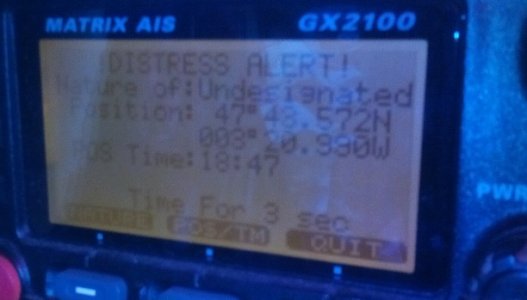
Especially not on something like the SH GX6000 - the most prominent red button will turn it off! I can't remember if the one under the flap is actually red or its just the cover! The one on the fist mike will make the radio switch to Ch16 (good) and display the word "Distress" which might make an inexperienced user think it has sent / is sending a distress message!But done properly it is not just a case of blindly pressing a red button is it.

Oooooh! I have a license! From 20 years ago.I don't think he's scared of radios - he's scared of admitting that if you are going to be permitted to broadcast radio waves that it might be a good idea to have controls on who, how and what is permitted, and consequently have to prove you are not completely and utterly clueless. I can't work out if he has an SRC and is objecting to the cost and quality of the training OR if he doesn't have one is declaring it unnecessary. The later seems a particularly bold move in foreign lands where marine paperwork seems to matter a lot more; the former seems to ignore the convenience that having an international agreement has brought.
In any case he seemed to be arguing for the sake of it, when having declared radios should be as easy to use as smartphones, he was pointed to one that was used from your smartphone and then he said he didn't need it!

For safety at sea, a mobile phone is vaguely useful. But you only talk to one person. The vhf is a net. Plus, of course, if phones were so good, the 600 odd thousand commercial vessels world wide would be using them. It has always seemed to me kinda selfish to ignore maritime comms for everything from emergency messages, collision avoidance, weather reports, yadda yadda. But not everyone understands seamanship. However much they are entitled to do so....

This is so beautifulYes as the radios use ATIS and are of low power without the features of the DSC enabled radios.
At sea you can use DSC, I had to get my radios reprogrammed for the VDES channels for 1st Jan 2024 as that became a legal requirement.
I'm a licenced ham radio operator and have been since 1980.
In the early 1970's I also installed serviced and repaired marine radios for ships/boats, but back then I did not have a radio licence and had to call on one of my colleagues who had a restricted ticket to come and test the radio installation after I had finished the install, on the training course at Decca Radar Ltd. we all brought up the fact that those of us in the class were the only ones trained on the radios but we could not actually transmit on them
It was a bit of nostalgia when I stepped on board our new to us boat and seen the radios same as I installed in the 1970s
View attachment 189068

So what?


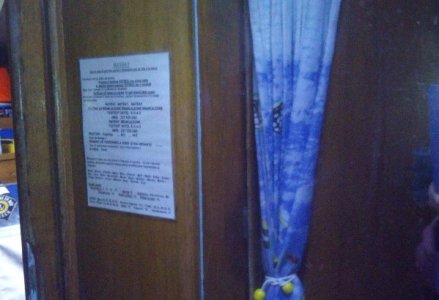
I attached a laminated sheet (with practical procedure, mmsi, phonetic alphabet, etc) in the toilets at eye's height, both my daughters learned it all when they were 5-6yo and 15 year later still know it by heart..
So how about a quick explanation of how to press the red button.
As in the type you give to your passengers.