Vhf call sign and MMSI

No, not at all. It is quite clear in the RYA VHF book (both short and long versions) that MMSI number should be read out in full after call sign.

D- for reading comprehension :)

Buck wasn't arguing with that. He was disagreeing with the idea that the MMSI is only included in the message as filler, to give receiving stations time to grab a pencil.

Pete
 
D- for reading comprehension :)

Buck wasn't arguing with that. He was disagreeing with the idea that the MMSI is only included in the message as filler, to give receiving stations time to grab a pencil.

Pete

Indeed, there were five of us on the course last year, all of whom were reasonably experienced radio operators but wanted the dsc endorsement so we all questioned 'why' the mmsi is included in the verbal transmission, after all, assuming procedure was followed it would have been sent within the initial dsc mayday which only coastguard or a suitably equipped large vessel is able to acknowledge so it only serves to link the verbal follow up with the digital mayday and which is therefore superflous detail for anyone other than the aforementioned. imho the instructor wasn't able to give a fully satisfactory answer, only pointing out that if we didn't do it we'd fail the course and in real life when you need to write down the message details it can take a while to locate a pen and paper, especially if its below deck and you're busy doing something else ( eg sailing ) therefore it was helpful to have a delay before the really vital bits of info (position) come in. There are imho a variety of reasons most of which have already been stated:

1. mmsi is the only unique link between digital and verbal message
2. for mayday relay to correctly identify origin
3. confirm whether one or more similar maydays are in the vicinity
4. give time for non-permanent radio operators to write the key details down.
5. reduce false alerts caused by testing/faults/accidental dsc maydays.
6. commercial shipping is more likely to react to a confirmed mayday
 
Last edited:
I suspect the unspoken reason is that coastguard and heavy shipping is so fed up of false digital alerts that their procedures include something about linking a verbal message to the digital one to qualify it before diverting resources to a rescue.

Whereas I suspect the real reason is that these things aren't decided by the Coastguard or the shipping companies, but by the radio wonks at the ITU with only a tenuous connection to reality :)

Pete
 
Whereas I suspect the real reason is that these things aren't decided by the Coastguard or the shipping companies, but by the radio wonks at the ITU with only a tenuous connection to reality :)

Pete

sorry Pete, I edited my post while you were replying as I rethought it, reflecting I doubt being fed up is a reason not to respond after all there are other reasons why the verbal follow up might be missing - dealing with a fire for example.
 
1. mmsi is the only unique link between digital and verbal message

True, but so what? the rescue services will react to either. for a station receiving the Mayday only a few stations, such as Coastguard, can decode the MMSI - so for anyone else responding its quite useless.

2. for mayday relay to correctly identify origin

Don't see this - If I'm relaying a Mayday I do not have access to MMSI so I can't correctly identify anything other than the vhf call. If the Coastguard receives the MMSI they will react to it whether or not anyone sends a Mayday relay. If I relay the Mayday they will react to my relay call. Either way the rescue services will detect the MMSI signal from a longish distance when they are approaching the casualty but will initially rely on the voice signal's given position.

3. confirm whether one or more similar maydays are in the vicinity

If there are two maydays in the vicinity the coast guard will hear 1 or 2 different mayday calls and 1, 2 or 0 MMSO calls.

If he can't hear one or other of the Maydays he will still recognise 2 different boats in distress from the MMSI - if he cannot receive either MMSI being told the number is of no help in finding the position even though he can identify the vessel - so there is little prospect of effecting a rescue without further information.

4. give time for non-permanent radio operators to write the key details down.

"Vessel calling Mayday please repeat the casualty's position"

5. reduce false alerts caused by testing/faults/accidental dsc maydays.

How - reciting the MMSI number doesn't stop you tinkering with VHF - the coastguard will NOT ignore a MMSI alert not accompanied by a mayday (wether or not the MMSI number is included in the VHF call. Neither will they ignore a call by VHF not accompanied by a matching MMSI included in the call.

6. commercial shipping is more likely to react to a confirmed mayday

How many commercial ships are capable of decoding a MMSI call? - I would suggest few. Whether or not they would react is another matter. I like to think all of them would.
 
1. mmsi is the only unique link between digital and verbal message

I suspect that if you were the coastguard dealing with distresses regularly, with limited information, and occasional misinformation, they may well find it helpful to categorically confirm that they are dealing with one source for the two messages. The DSC alert may well not give an indication of the nature of the emergency so the most appropriate response will then be gleaned from the voice conversation.
 
1. mmsi is the only unique link between digital and verbal message

True, but so what? the rescue services will react to either. for a station receiving the Mayday only a few stations, such as Coastguard, can decode the MMSI - so for anyone else responding its quite useless.

<snip>

6. commercial shipping is more likely to react to a confirmed mayday

How many commercial ships are capable of decoding a MMSI call? - I would suggest few. Whether or not they would react is another matter. I like to think all of them would.

Not really sure what you mean by "decoding" but not only every single commercial vessel (because they are required to be equipped with DSC VHF) but every non-commercial vessel with a DSC VHF set will have the MMSI number displayed as part of the data set transmitted when a DSC (and I just double checked this in the manuel for my SH 1600 and the MMSI number of the transmitting station is the FIRST item of information displayed when a DSC Distress Alert is received)

The MMSI number is the ONLY unique identifier of a DSC alert and it makes sense to state it at the beginning of a subsequent voice message (time permitting) so that the two can be absolutely and positively linked by all receiving stations capable of receiving the DSC alert in the first place

Of course, if the water is lapping around your knees or the flames are warming your tootsies already nobody is going to expect perfect VHF procedure but surely it makes sense to know and, circumstances, permitting, follow the correct procedure?
 
RYA and 5starmarine Get It Wrong

Here is a version you can print out and stick by your radio.

http://www.5starmarine.co.uk/images/5Star_Mayday.pdf
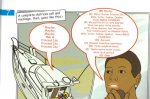
Looks like 5starmarine and the RYA have got this wrong.

I am referring to RYA VHF Handbook by Tim Bartlett (the 96 page version, not the shorter notes for the course).

On page 45 it says clealry that call sign and MMSI are read out just once, after boat name and just after the single "mayday" in the distress message.

5starmarine gets MMSI and call sign back to front, and repeats it twice - WRONG.

I attach a scan of page 46 of the RYA book which shows their example - they have call sign and MMSI repeated in the position part of the distress message - WRONG

So looks like even the experts struggle to get it right?

RYA Page 46.jpg
 
Looks like 5starmarine and the RYA have got this wrong.

I am referring to RYA VHF Handbook by Tim Bartlett (the 96 page version, not the shorter notes for the course).

On page 45 it says clealry that call sign and MMSI are read out just once, after boat name and just after the single "mayday" in the distress message.

5starmarine gets MMSI and call sign back to front, and repeats it twice - WRONG.

I attach a scan of page 46 of the RYA book which shows their example - they have call sign and MMSI repeated in the position part of the distress message - WRONG

So looks like even the experts struggle to get it right?

View attachment 32484

If you bother to keep up to date you will find that the procedure changed and my version, and the RYA's is the latest version.
 
If you bother to keep up to date you will find that the procedure changed and my version, and the RYA's is the latest version.

Well, the RYA version in the figure differs from the RYA version in the text, and your version differs from the RYA versions - both figure and text.

So which is the right version?
 
Well, the RYA version in the figure differs from the RYA version in the text, and your version differs from the RYA versions - both figure and text.

So which is the right version?

This was discussed when the issue arose 2 years ago.

http://www.ybw.com/forums/showthread.php?296139-Changes-to-Mayday-call/page7

The order of MMSI or call sign first is irrelevant or a matter of choice. The fact is that correct procedure now dictates that the MMSI and call sign are required to repeated in both the Mayday call and within the messages.
 
The link you sent seems very clear. It also shows a very clear order of content in the distress call and distress message.

This order and content is also confirmed in the text boxes at the bottom of page 44 (Distress Call) and on page 45 (Distress Message) of the RYA VHF Manual

The figure on page 46 then completely omits the call sign and MMSI number from the Distress Call, and puts in a repeat of the call sign and MMSI into the "POSITION" part of the message.

I don't understand your comment about keeping up to date. I only took my RYA VHF course 2 months ago, and in preparation I thought I was buying the most authoritative book I could - the RYA manual bought from the RYA web site.

It seems to me the instructors such as yourself should be portraying a consistent and simple message, not saying that it is up to us what order we do things in.

I was taught MIPDANIO not MIPIDANIO, as the RYA figure portrays.

Mistakes are understandable, but should not be covered up with bluster, but admitted and corrected.

Your own card seems more consistent with the correct procedure you show in the link, but you reverse call sign and MMSI number - I think only one way should be taught by all.
 
Last edited:
Just to add, I emailed RYA and they confirm the figure in the VHF manual is wrong. They re correcting it in next edition.
 
Top
