Varnish , Paint or Oil ?

Sorry to say I do get a mirror finish.
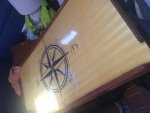
My saloon table stripped back to the wood, I inlaid it with a fleece backed wood pale beech veneer.
Onto that I fitted a compass rose dark blue stencil.
I initially did 4 coats but found that airborne dust was settling during the day, so lightly sanded back did 3 more coats at midnight, over 3 days, when all calm, using a green scrubber to matt back, now have a mirror finish.
The fiddles look equally good.
We do not protect it with place matts or similar, had wine and beer and food spills which a kitchen roll deals with.
Still looking great, so hard wearing.
Just a very satisfied customer of a product that has stood the test of time, if not the advertising artillery.
 
Fine to have a high gloss finish if you like internally - although personally I don't and use Renseal satin which gives a very durable finish for a fraction of the work and cost.

However this thread is about protecting external hardwood trim and for that purpose porous woodstains are far superior to gloss varnishes both in application and long life.
 
Yes it is about external which is why I personally recommend LeTonkinois to the OP.
This varnish has been around for a very long time before its modern counterparts or imitators were produced.
It’s pure resin with linseed oil and tung oil.
It doesn’t just sit on the surface but penetrates into the wood, it’s just as happy on metal.
Perfectly adapted to both mountain and coastal areas.
Has a high resistance to UV, to both temperature differences and weather, and to abrasion and shocks.
All the above (except for mountain areas) I have personal experience of.
I often wonder why those who either have little knowledge of this product or have never used it can so casually dismiss it.
We all have our own preferences of course, over some 40 years I haven't found anything superior to ‘Tonks’ for ease of application, simplicity of use, brush marks disappear etc.
 
Last edited:
Yes it is about external which is why I personally recommend LeTonkinois to the OP.
This varnish has been around for a very long time before its modern counterparts or imitators were produced.
It’s pure resin with linseed oil and tung oil.
It doesn’t just sit on the surface but penetrates into the wood, it’s just as happy on metal.
Perfectly adapted to both mountain and coastal areas.
Has a high resistance to UV, to both temperature differences and weather, and to abrasion and shocks.
All the above (except for mountain areas) I have personal experience of.
I often wonder why those who either have little knowledge of this product or have never used it can so casually dismiss it.
We all have our own preferences of course, over some 40 years I haven't found anything superior to ‘Tonks’ for ease of application, simplicity of use, brush marks disappear etc.
But, as you say it is personal recommendation. Just because it was formulated a long time ago does not make it any "better" - indeed it is the R&D that has gone into wood protection that has resulted in easier to use, longer lived products. I was only observing that it seemed somewhat odd using a product that you claim is superb for outside protection internally where those characteristics have little benefit.

I have no personal experience of using that product, just as you seem to have none of modern products. so one can only speak as one finds and explain why you come to a particular conclusion and let others make up their own minds.
 
I mentioned it has been around for a long time, a simple fact which was to indicate it must be doing something right, not to suggest that oldest is better? Reading between the lines or your interpretation is misleading you.
Similarly your assumption I do not use others is based on zero facts. When I cannot find a stockist, as for example in the Channel Islands, I resort to others. Rather than assume please ask the question.
Your analysis that something with all the required characteristics for external use and therefore somehow wasted internally is I am afraid at best a lack of information at worst an unreasoned critique.
Internal use of Tonks is perfect for hard wearing surfaces, I mentioned my saloon table earlier.
For sole plates I have not found anything to compare for hardness and durability, if there is one then fine, but please do some research b
Ha! Yes, it can be as divisive, although some people consider different opinions to be "argument" rather than discussion.

I used Deks Olje on the cockpit chart tables of my old Hallberg-Rassy 352. It looked OK for a while, then started to deteriorate, and in the end I stripped the whole off with Nitromors and simply treated it with Boracol to deter the algae and mould.
I stated my opinion re Le Tonkinios based on long usage, others who have never used it make assumptions, start an argument rather than ask why.
 
But, as you say it is personal recommendation. Just because it was formulated a long time ago does not make it any "better" - indeed it is the R&D that has gone into wood protection that has resulted in easier to use, longer lived products. I was only observing that it seemed somewhat odd using a product that you claim is superb for outside protection internally where those characteristics have little benefit.

I have no personal experience of using that product, just as you seem to have none of modern products. so one can only speak as one finds and explain why you come to a particular conclusion and let others make up their own minds.
For all you need to know:- Le Tonkinois (letonkinoisvarnish.co.uk)
 
To be perfectly honest with you whatever you use and satisfies you then GREAT.
I sent you the link purely for your information as you were making assumptions as to its qualities etc. Certainly not a sales pitch as I repeat I have no ties financial or otherwise with Le Tonkinois other than as a very satisfied customer.
Have you been vaccinated? I only ask as I am finding many who have are behaving quite out of character?
 
To be perfectly honest with you whatever you use and satisfies you then GREAT.
I sent you the link purely for your information as you were making assumptions as to its qualities etc. Certainly not a sales pitch as I repeat I have no ties financial or otherwise with Le Tonkinois other than as a very satisfied customer.
Have you been vaccinated? I only ask as I am finding many who have are behaving quite out of character?
Except that I was already aware of its properties so not making any assumptions at all, I owned a wooden boat with lots of brightwork and a beautiful 35' tall wooden mast - see post#10. The interior was also mostly bright finished against white panels. Over the years I investigated or used a variety of "traditional" finishes, but found them wanting either in the amount of work required or the durability of the finish, often both. Independent long term tests clearly demonstrate the superiority of modern porous woodstains for external use - if you are prepared to accept the less than shining finish. Even that has improved in recent years. All the major suppliers of yacht finishes are now offering similar products in their yacht range based on formulations derived from their products aimed at the building market. Similarly for interiors, domestic products are designed for much more demanding conditions than the interior of yachts. I laid a teak and holly ply floor in my bathroom around 30 years ago, finished in Ronseal polyurethane satin finish. Still fine and has never been recoated.

As you can see from this thread and many others on the subject I am not alone in preferring modern products which many owners of traditional boats have also adopted. The biggest builder of traditional boats in the UK switched many years ago.

There is still a market for traditional products, but it is tiny and shrinking as the big players have recognised. This is because the amount of external wooden trim on modern boats is minimal and modern interiors are dry so finishes last far longer. Their strategy is to maintain as much of that market as possible using newer products under their yachting brands where they are able to command premium prices, typically 10-15% at retail level over their domestic and industrial versions.
 
Another wild assumption ‘if your prepared to accept less than a shining finish’
From someone who refuses to
even read an alternative products specifications??? That’s rather rich.
As another contributor commented some are determined to turn an opinion into an argument.
I repeat to the OP take a look at Le Tokinois it’s brilliant.
 
Well I have just sanded then Olied some timbers above the Water Line , first time that I have ever used an Oil , as have used Varnish or Paint for such applications ; Might say that the two timbers are looking most well after two days , very easy to apply and a One Coat with out Undercoats or Primer necessary .

I am now a Oiled surface geek now , its great stuff to use and one Bottle goes on and on , the brushes have not Dried up on me , the Paint Pot with its cover on still has Oil foating in it = very nice stuff to work with , I have found out ; can wipe any Oil thats gone onto the GRP off easily , no need for Thinners (so far) ; happy near end of season Skipper these days
What oil did use?
 
To those of little faith who never having used Le Tonks yet mislead others as to its quality of finish here is my saloon table got gleaming, if you will excuse the old saying, like a tanner up a sweeps bum.
For younger members a tanner was a sixpence.
Do they know what a sweep was?
 

Attachments

  • 5F919CD4-18A0-4772-9EB0-4A92A2507862.jpeg
    5F919CD4-18A0-4772-9EB0-4A92A2507862.jpeg
    22.2 KB · Views: 17
Except that I was already aware of its properties so not making any assumptions at all, I owned a wooden boat with lots of brightwork and a beautiful 35' tall wooden mast - see post#10. The interior was also mostly bright finished against white panels. Over the years I investigated or used a variety of "traditional" finishes, but found them wanting either in the amount of work required or the durability of the finish, often both. Independent long term tests clearly demonstrate the superiority of modern porous woodstains for external use - if you are prepared to accept the less than shining finish. Even that has improved in recent years. All the major suppliers of yacht finishes are now offering similar products in their yacht range based on formulations derived from their products aimed at the building market. Similarly for interiors, domestic products are designed for much more demanding conditions than the interior of yachts. I laid a teak and holly ply floor in my bathroom around 30 years ago, finished in Ronseal polyurethane satin finish. Still fine and has never been recoated.

As you can see from this thread and many others on the subject I am not alone in preferring modern products which many owners of traditional boats have also adopted. The biggest builder of traditional boats in the UK switched many years ago.

There is still a market for traditional products, but it is tiny and shrinking as the big players have recognised. This is because the amount of external wooden trim on modern boats is minimal and modern interiors are dry so finishes last far longer. Their strategy is to maintain as much of that market as possible using newer products under their yachting brands where they are able to command premium prices, typically 10-15% at retail level over their domestic and industrial versions.
R & D? Le Tonks underwent development a couple hundred years ago, possibly longer by Chinese artisans (not to be confused with today’s CCP bunch of international criminals) who produced what we today wonder in awe as to how it was achieved.
Do not misinterpret that as previously.
I repeat, what suits you is fine, but I speculate now as you have, if for example you were looking for a varnish, and having read the manufacturers of Le Tonkinois long list of proven attributes, tested and tried over a very long period of time, I feel fairly sure you would be impressed, whether you decided or not to use it is irrelevant.
 
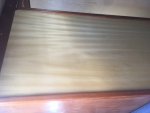
A freshly varnished veneered panel which will extend throughout the saloon bulkheads.
No diminishment of the beautiful grain, no darkening but is enhanced.
These areas will not by choice require a mirror finish, other than the dark surroundings.
 

Attachments

  • C718119A-3E4C-4360-AFB2-FA8696DE89D8.jpeg
    C718119A-3E4C-4360-AFB2-FA8696DE89D8.jpeg
    59.6 KB · Views: 8
I've always used Ronson's yacht varnish on my woodwork with good results although I don't pretend to be a perfectionist. It may not be the best finish but it's cheap and easy to apply.
We had a good chat with the Letter Tonkinois man at a yatch jumble (mostly about Eberspachers) but also about varnish. He showed me examples of varnished wood which were very impressive until he told me how many coats it took. Not for me I'm afraid.
 
Last edited:
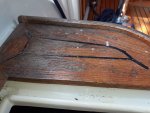
hopefully this isn't a hijack as the thread is very informative on a number of questions I have. My cabin wood (so interior under canvas cover) is looking fairly shabby from some water penetration. I think this was previously varnished before my time so my two questions are (1) to remove the grey i need to clean - wessex? - then sand , will I need to do this all round to get a standard colouring (there is a lot of wood !) (2) As its internal seems Cetol 7 or International Woodskin are the recommendations?
Any advice before my winter project will be welcome.
 

Attachments

  • 20210915_133406_resized_1.jpg
    20210915_133406_resized_1.jpg
    348.6 KB · Views: 3
Have to agree with Tranona. I applied Deks Olje to my toe rails one weekend and on the following weekend could barely tell they had been treated. These had previously been varnished. At the same time I treated some new teak and that lasted far longer, presumably as the wood soaked the oil to a greater depth.

Since then I use Woodskin, which gives me a full season of protection and decent appearance in Greece.
Could it be that the older dried out wood 'drank', the oil deep into its fibres and actually requires more, whereas the new wood, which has not yet lost its natural oils, have just superficially soaked in the oil and hence still looks as if it's only just been oiled?
 
Sorry to say I do get a mirror finish.
My saloon table stripped back to the wood, I inlaid it with a fleece backed wood pale beech veneer.
Onto that I fitted a compass rose dark blue stencil.
I initially did 4 coats but found that airborne dust was settling during the day, so lightly sanded back did 3 more coats at midnight, over 3 days, when all calm, using a green scrubber to matt back, now have a mirror finish.
The fiddles look equally good.
We do not protect it with place matts or similar, had wine and beer and food spills which a kitchen roll deals with.
Still looking great, so hard wearing.
Just a very satisfied customer of a product that has stood the test of time, if not the advertising artillery.
Post deleted
 

Other threads that may be of interest

Top