Variation and declination

I always thought that declination referred to dip. Apparently it is another name for variation. Admiralty charts use Variation. Where did Declination come from?

- The USA?

According to the OED it means both dip and variation. I guess a convention was established to avoid doubt and so in the UK variation and dip prevailed, but that is a guess. However, OED is clear that declination has two meanings; also Wiki.

It is probably not a right or wrong thing, just a matter of being precise when it is important in navigation and being aware of both meanings. I shall continue to use variation in my calculations.

From the OED: -

declination
NOUN


1Astronomy
The angular distance of a point north or south of the celestial equator.
‘the declination of Arcturus is 19 degrees north’
Compare with right ascension and celestial latitude
More example sentences
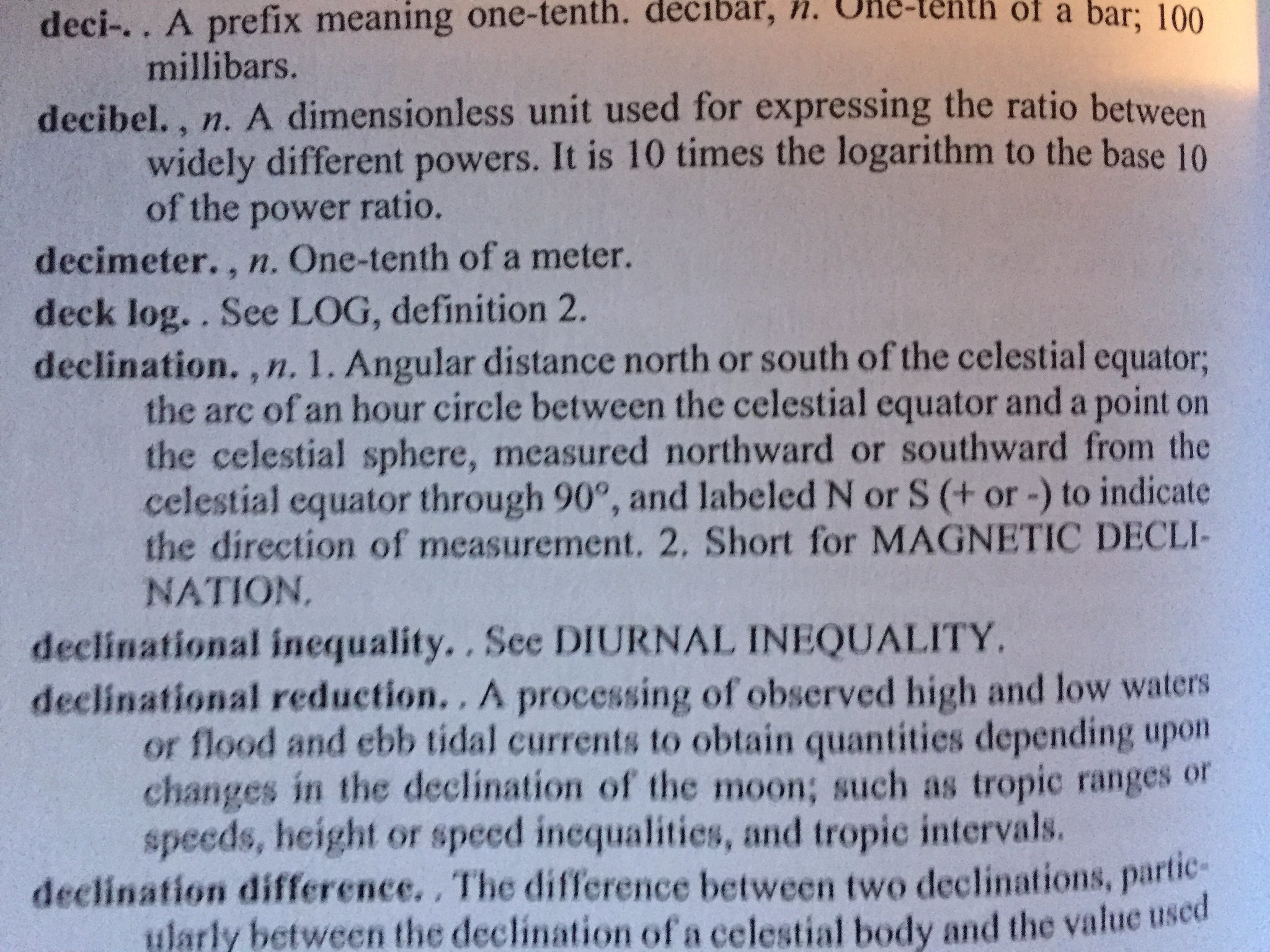
1.1 The angular deviation of a compass needle from true north (because the magnetic north pole and the geographic north pole do not coincide).
Example sentencesSynonyms
2Linguistics
another term for downdrift
3US Formal refusal.
as modifier ‘the mandatory vaccine declination form’
More example sentencesSynonyms
 
I was taught that declination was the angle of dip of a compass to the magnetic pole.
The OED has many things "wrong"!
For some reason they believe that if incorrect information is in common use long enough it becomes fact.
To drift slightly......eg I was taught at school that noon was 12am. For some reason we seem to have inherited (from the USA ?) that noon is now 12pm. How can 12 hours after midday (post maridien) be noon? I find it most confusing.
 
I was taught that declination was the angle of dip of a compass to the magnetic pole.
The OED has many things "wrong"!
For some reason they believe that if incorrect information is in common use long enough it becomes fact.
To drift slightly......eg I was taught at school that noon was 12am. For some reason we seem to have inherited (from the USA ?) that noon is now 12pm. How can 12 hours after midday (post maridien) be noon? I find it most confusing.

It seems Wiki is the same.
 
In the Admiralty Manual of Seamanship the difference between true north and magnetic north is described as 'variation' and in that section they also describe 'angle of dip' as oldsalt advises but specifically as the inclination of the lines of force (magnetic) to the horizontal. I could not find a reference to declination.

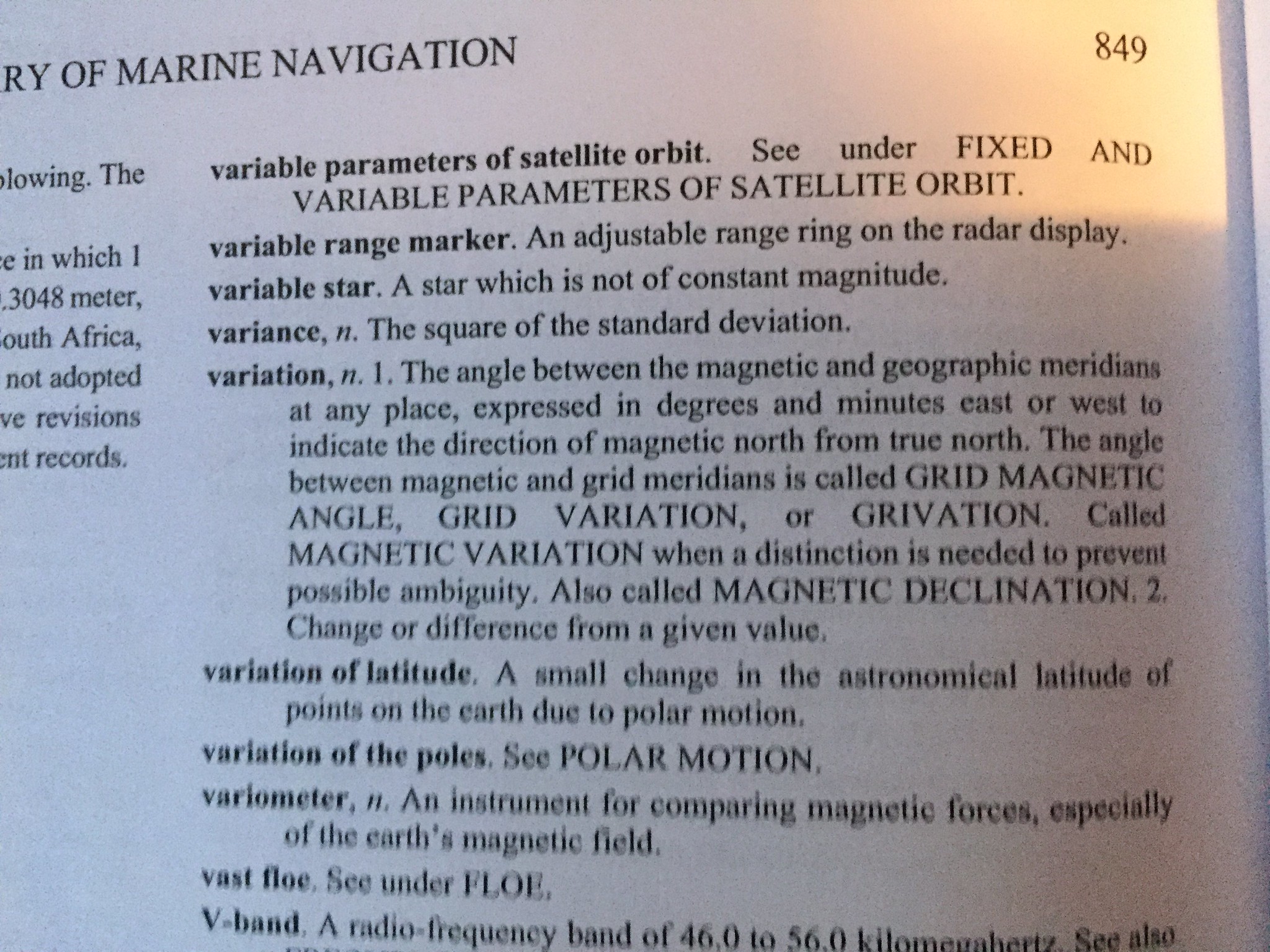
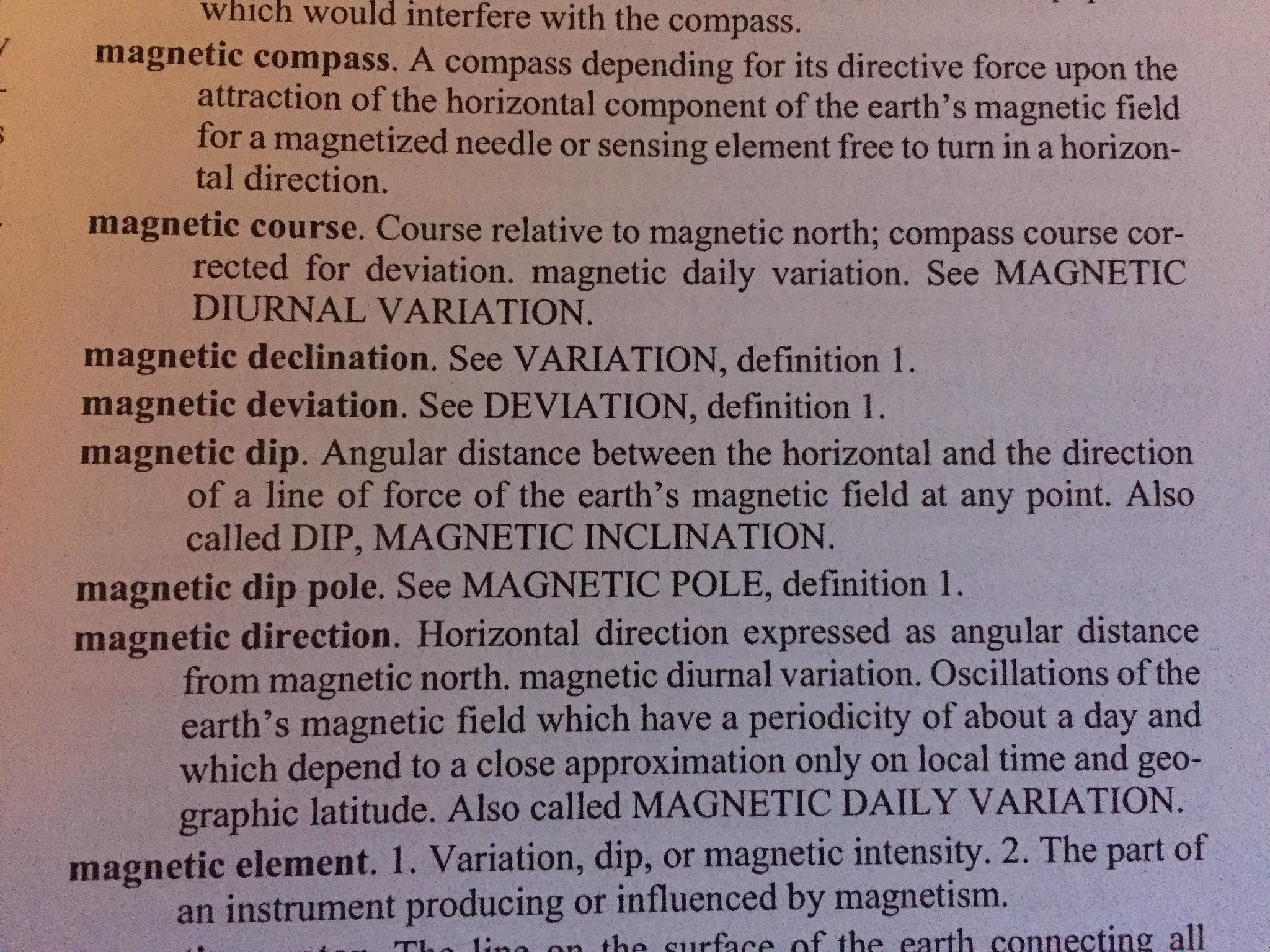
In Bowditch (the USA book) they also use the term variation as we understand. If I look up declination it is the suns angle north and south of the equator, which aligns with what I have been taught. Bowditch then expands its definition of declination as a short form of "Magnetic Declination". When Magnetic Declination is looked up in their list of definitions, it states 'see Variation'.
 
Wikipedia [ https://en.wikipedia.org/wiki/Magnetic_declination ] says that:

  • the true-magnetic angular difference is declination
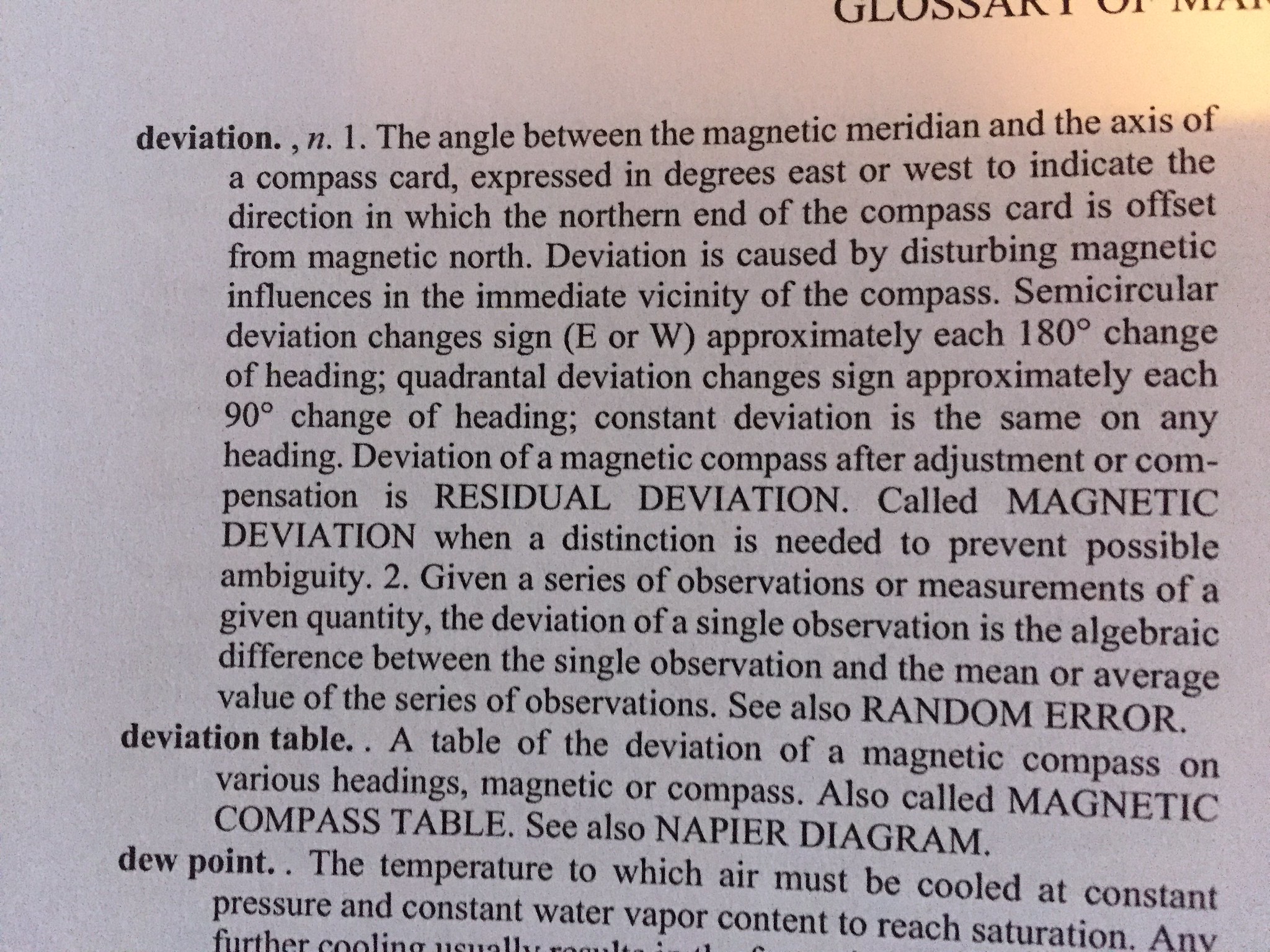
  • 'The term magnetic deviation is sometimes used loosely to mean the same as magnetic declination, but more correctly it refers to the error in a compass reading induced by nearby metallic objects, such as iron on board a ship or aircraft'. (And the wiki page for deviation agrees that it's just the error induced by local magnetic fields, so correcting the sensed direction correcting to magnetic North not to true North)
  • magnetic dip is not declination but inclination: 'Magnetic declination should not be confused with magnetic inclination, also known as magnetic dip, which is the angle that the Earth's magnetic field lines make with the downward side of the horizontal plane.'
Never knew that.

But the difference in terminology seems to be not US/ UK, but land/ sea. Maps seem to show 'declination' on a compass rose, while charts show 'variation' on it. If I search Bowditch ('The American Practical Navigator', all you ever need to know about maritime navigation and plenty more, available online) for 'declination', all references are to a celestial object's declination, ie its geographic latitude. If I search it for 'magnetic variation', they're all to the difference on the earth's surface between true and magnetic north.
 
I was taught that declination was the angle of dip of a compass to the magnetic pole.
The OED has many things "wrong"!
For some reason they believe that if incorrect information is in common use long enough it becomes fact.
To drift slightly......eg I was taught at school that noon was 12am. For some reason we seem to have inherited (from the USA ?) that noon is now 12pm. How can 12 hours after midday (post maridien) be noon? I find it most confusing.

This really annoys me! 12 o'clock can't be am or pm - it's midday/noon or midnight. To be pedantic 12am and 12pm are both midnight, as you suggest.

Back to the topic - I don't like declination, to me it means as a downward slope, the opposite of inclination. I think deviation is the correct alternative word for variation.

Another thing - I believe variation in the UK is now close to zero and may even be east of north in some places. This means a lot of the mnemonics for map to grid etc., are now wrong.
 
Another thing - I believe variation in the UK is now close to zero and may even be east of north in some places. This means a lot of the mnemonics for map to grid etc., are now wrong.

Amusing map/calculator here: http://www.threelittlemaids.co.uk/magdec/index1.html
If accurate, Mag and True are identical just S of Deal. Nowhere on land (yet) is Mag quite east of true, although it becomes so on crossings to the Continent east of Dieppe.
 
Last edited:
I was taught that declination was the angle of dip of a compass to the magnetic pole.
The OED has many things "wrong"!
For some reason they believe that if incorrect information is in common use long enough it becomes fact.
To drift slightly......eg I was taught at school that noon was 12am. For some reason we seem to have inherited (from the USA ?) that noon is now 12pm. How can 12 hours after midday (post maridien) be noon? I find it most confusing.

S'funny, I thought it was neither p.m nor a.m., but 12 Midday (and 12 Midnight)!
With regard to the substantive matter; when I did my Yachtmaster Theory course, Variation was explained as the angular difference between Magnetic North (somewhere in Northern Canada) and True North (the top end of the vertical lines on a nautical chart. Deviation was described as the "compass error" caused by large metallic objects in the proximity of the compass. Deviation of a vessel's compass can vary when on different headings, this is why we should "swing the compass", to produce a graph or tabulation of the compass's deviation in a rotation through 360 degrees and use the data thus obtained, along with the local Variation, to convert a True Course, i.e. plotted on the chart, into a Course to Steer.
Declination is something to do with celestial navigation.
 
Last edited:
S'funny, I thought it was neither p.m nor a.m., but 12 Midday (and 12 Midnight)!.

It's actually simpler than that...and perhaps also more vexing.

12PM means 12 hours post meridiam, or 12hours after midday. In other words, midnight.
12AM means 12 hours ante meridiam, or 12hours before midday. In other words...er, midnight.

Other logical arguments are available.
 
It's actually simpler than that...and perhaps also more vexing.

12PM means 12 hours post meridiam, or 12hours after midday. In other words, midnight.
12AM means 12 hours ante meridiam, or 12hours before midday. In other words...er, midnight.

Other logical arguments are available.

Um by that argument we would count down to midday so 10am would be 2 o’clock in the morning and 3am would be 9 o’clock in the morning! I don’t think am and pm mean literally the number of hours either before or after the meridian, but rather it is 2 o’clock, and the Sunday passed the meridian, as opposed. To 2 o’clock and the sun has not yet passed the meridian. 12pm (midday) is the oddity, but 12:01 pm is clearly in the afternoon. As such 12:00 pm exists for no time period and as such can be considered not to exists at all. :)

I hope. This clears things up entirely!
 
I like threads that have the reader reaching for their Bowditch or other forms of nautical reference.

I’ve just looked at The Oxford Companion to Ships and the Sea. It defines declination only in terms of celestial navigation. For variation it say “or magnetic declination”.

I’ve never heard the phrase magnetic declination before. I’ve learned something new today, thanks, OP!
 
Um by that argument we would count down to midday so 10am would be 2 o’clock in the morning and 3am would be 9 o’clock in the morning! I don’t think am and pm mean literally the number of hours either before or after the meridian, but rather it is 2 o’clock, and the Sunday passed the meridian, as opposed. To 2 o’clock and the sun has not yet passed the meridian. 12pm (midday) is the oddity, but 12:01 pm is clearly in the afternoon. As such 12:00 pm exists for no time period and as such can be considered not to exists at all. :)

I hope. This clears things up entirely!

Absolutely.

Except whether 12pm is midday or midnight? In my book, it is midday, for the reason that 12:34pm is 34 mins after noon, and 12:00:34 is 34 seconds after noon, so by stripping off the unnecessary accuracy, 12:00 can only helpfully refer to noon. Same story for 12am being midnight. Using the terms the other way around (12pm for midnight and 12am for midday) doesn't make sense when viewed as a continuum.
 
Um by that argument we would count down to midday so 10am would be 2 o’clock in the morning and 3am would be 9 o’clock in the morning! I don’t think am and pm mean literally the number of hours either before or after the meridian, but rather it is 2 o’clock, and the Sunday passed the meridian, as opposed. To 2 o’clock and the sun has not yet passed the meridian. 12pm (midday) is the oddity, but 12:01 pm is clearly in the afternoon. As such 12:00 pm exists for no time period and as such can be considered not to exists at all. :)

I hope. This clears things up entirely!

That's why some of us prefer the 24-hour clock, there's no such confusion.
 
what time is midnight on a 24 hour clock? 00:00 or 24:00

Either. 24:00 allows us to refer unambiguously to a period of time on the same day. For example, the driver will be available to take you home until 24:00 on Tuesday. This makes clear we're talking about the end of Tuesday, not the start of it.

The UK will leave the EU at 24:00 (Continental time) on 29 March 2019. If we wrote 00:00 on that day, you'd be justified in thinking we would be independent of the EU at lunchtime on that day.
 
Um by that argument we would count down to midday so 10am would be 2 o’clock in the morning and 3am would be 9 o’clock in the morning! I don’t think am and pm mean literally the number of hours either before or after the meridian, but rather it is 2 o’clock, and the Sunday passed the meridian, as opposed. To 2 o’clock and the sun has not yet passed the meridian. 12pm (midday) is the oddity, but 12:01 pm is clearly in the afternoon. As such 12:00 pm exists for no time period and as such can be considered not to exists at all. :)

I hope. This clears things up entirely!

Think of "am" as shorthand for "...of the ante meridian half of the day", or the forenoon if you're RN. So 10am is ten hours after midnight.

12:00 is obviously 24-hour clock so it doesn't need "pm".

12pm is just wrong.
 
Top