Krusty
Well-Known Member
Last year I posted details of my development of the V-twin riding sail concept, and there was quite a bit of interest. (Copy below)
By mistake, the links to illustrations have been removed and I have now been asked to provide access again.
There are two photos and a video clip within a composite sequence: sorry, you just have to ignore the irelevant bits!
http://i215.photobucket.com/albums/cc310/Piotaskipper/PIOTA%20Technical/VRidingsail1.jpg
http://i215.photobucket.com/albums/cc310/Piotaskipper/PIOTA%20Technical/VRidingsail3.jpg
http://s215.photobucket.com/albums/cc310/Piotaskipper/Video/?action=view¤t=RidingSail.flv
Copies of previous posts:
#1552249 - 20/08/2007
We have a purpose-made riding sail that can be rigged in three minutes and dropped in one, and it 'Does the Business' to the extent that we have NO ranging about at anchor and the only sheering is to meet wind-shifts: then the response is so rapid that the boat barely heels.
The boat just sits quiet, gently pitching if there is a sea running. Because she is always within about 5 dgrees of the windline, the windforces are minimised, loads on the anchor and deck gear markedly reduced.
I was lucky enough to meet John Armitage (co-author of the Norwegian Cruising Guide) days after we had both endured hurricane-force winds. I had set my 'bullet-proof' storm staysail as a riding sail on the backstay, in the manner suggested by others on this post: is was OK up through F8 & F9, but as the wind really got up it could not cope with the sheering and was been thrashed to shreds. It had to come down, leaving us ranging and plunging even on spread anchors 45 degrees.
John rode out the same weather in relative comfort with his (home-made) riding sail, and kindly demonstrated it on my boat, with suggestions for making our own.
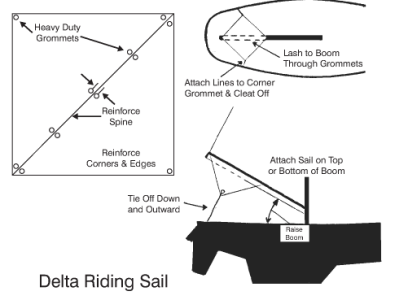
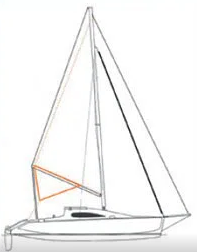
THE KEY is to use a V-twin configuration: like two small jibs joined at the luff, the clews spread apart by a spar (ours doubles as a boathook) The luff is vertical, just clear of the boom end, the head hoisted on the main haliard. The clews are just forward of the stern-rail, with the 'sheets' hitched round it. The tack has twin down-hauls with clips onto stanchion-bases. The sail is winched up bar taut: there is no flogging, no attrition, and it is silent.
It has become almost standard practice, after anchoring, to set the riding sail if there is any wind about, and we have used it a lot for six years. It has been a boon in several severe gales in the Hebrides, W.Ireland and Norway. As one visiting skipper remarked ''These should be standard equipment on cruising yachts!'
If there is enough interest, I will follow up with technical info on how and why it works, here or by PM's. (Not commercial)
I used an old small jib on the backstay a few times: it was never satisfactory! Two reasons: a jib is cut with fullness in the luff, which flutters (violently in strong winds) however hard you sheet it: and an old jib is liable to be split by such treatment. (I've done that too!)
The additional drag is small; not much more than some spray-hoods I've come across, but the large forces that build up when a yacht slews at 30 of 40 degrees to the wind are eliminated.
To illustrate: the load on a single anchor cable is at a minimum when truly head-to-wind, but that is at least doubled when sheering and ranging about through 30 degrees-plus.
With my riding sail set, the load seems to be about 120 per cent of the load without it. (The test-method?... taking the load by hand & body!)
CAUTION: The sail needs to be of adequate size; the design determines how sensitive it is and how quickly and effectively it does the job: its construction determines how robust it will prove to be.
BUT: scaling up my boat's dimensions according to hull size may not be enough!
WHY? A yacht ranges about on her anchor because her ''Centre of Windage'' (CW) is forward of her underwater ''Centre of Lateral Resistance'' (CLR): it is an 'unstable configuration' in that direction, and like all unstable systems, it is easily set oscillating.
A Riding Sail works because it shifts the CW behind the CLR, to become a stable configuration.
Piota has hanked-on sails. A modern yacht with roller-furled headsails has far more windage forward, and if it has a shallow fore-foot and deeper hull sections aft, the CW and CLR are even further unbalanced, in the wrong direction!
THAT is the primary reason why so many modern yachts are wild creatures at anchor: nothing to do with all-chain cables or snubbers, or whatever!
Such a yacht will need a larger riding sail than mine: possibly so much larger that it cannot be fitted in the space between boom and backstay. A riding sail will help, but may not achieve total stability on its own:
The best way to begin soothing the antics of such a yacht at anchor in a wind is to remove that furled genoa!
-----------------------------------------------------------
Riding sail for PIOTA [Posted ybw Nov.08]
Dimensions: (Hollows in brackets): Luff 8ft (1.5in.) Leech 9ft.8in. (1.75in.) Foot 5ft 6in (1.0in.)
Cloth: dacron/polyester 5oz.
Fittings: D-rings -- Must be of a size to accept the splice of a 6/8mm sheet and the tapered end of the spar.
Construction: Lay one sail on the other,(corners correspomding): turn over top one like a page of a book to leave the luffs edge-to-edge. Join luffs with 2" flat webbing to stiffen and 'round' the leading edge of the 'V' when set; -- no turbulent eddies, attrition or noise!
Spar: 30mm alloy tube with wooden plug and plastic boathook fitting each end.
THE TRICK at the design stage is to make a mock-up of all the edges in string joined with slip-knots; then adjust the dimensions of the sail and spar to meet these criteria:
1. The luff is clear the boom. (1/2 in. is enough!)
2. The spar is clear of the backstay: ahead is preferable to abaft for ease of setting-up.
3. The tack-lines, forward and outboard, should be close to bisecting the angle at the tack.
4. Each sheet, from the stern-rail, should bisect its clew, (viewed from abeam)
Contrary to what might be expected, it is neither necessary nor desirable to attach anything to the backstay. When all the dimensions are compatible and the sail is set flying it is self-stabilising: and silent!
By mistake, the links to illustrations have been removed and I have now been asked to provide access again.
There are two photos and a video clip within a composite sequence: sorry, you just have to ignore the irelevant bits!
http://i215.photobucket.com/albums/cc310/Piotaskipper/PIOTA%20Technical/VRidingsail1.jpg
http://i215.photobucket.com/albums/cc310/Piotaskipper/PIOTA%20Technical/VRidingsail3.jpg
http://s215.photobucket.com/albums/cc310/Piotaskipper/Video/?action=view¤t=RidingSail.flv
Copies of previous posts:
#1552249 - 20/08/2007
We have a purpose-made riding sail that can be rigged in three minutes and dropped in one, and it 'Does the Business' to the extent that we have NO ranging about at anchor and the only sheering is to meet wind-shifts: then the response is so rapid that the boat barely heels.
The boat just sits quiet, gently pitching if there is a sea running. Because she is always within about 5 dgrees of the windline, the windforces are minimised, loads on the anchor and deck gear markedly reduced.
I was lucky enough to meet John Armitage (co-author of the Norwegian Cruising Guide) days after we had both endured hurricane-force winds. I had set my 'bullet-proof' storm staysail as a riding sail on the backstay, in the manner suggested by others on this post: is was OK up through F8 & F9, but as the wind really got up it could not cope with the sheering and was been thrashed to shreds. It had to come down, leaving us ranging and plunging even on spread anchors 45 degrees.
John rode out the same weather in relative comfort with his (home-made) riding sail, and kindly demonstrated it on my boat, with suggestions for making our own.
THE KEY is to use a V-twin configuration: like two small jibs joined at the luff, the clews spread apart by a spar (ours doubles as a boathook) The luff is vertical, just clear of the boom end, the head hoisted on the main haliard. The clews are just forward of the stern-rail, with the 'sheets' hitched round it. The tack has twin down-hauls with clips onto stanchion-bases. The sail is winched up bar taut: there is no flogging, no attrition, and it is silent.
It has become almost standard practice, after anchoring, to set the riding sail if there is any wind about, and we have used it a lot for six years. It has been a boon in several severe gales in the Hebrides, W.Ireland and Norway. As one visiting skipper remarked ''These should be standard equipment on cruising yachts!'
If there is enough interest, I will follow up with technical info on how and why it works, here or by PM's. (Not commercial)
I used an old small jib on the backstay a few times: it was never satisfactory! Two reasons: a jib is cut with fullness in the luff, which flutters (violently in strong winds) however hard you sheet it: and an old jib is liable to be split by such treatment. (I've done that too!)
The additional drag is small; not much more than some spray-hoods I've come across, but the large forces that build up when a yacht slews at 30 of 40 degrees to the wind are eliminated.
To illustrate: the load on a single anchor cable is at a minimum when truly head-to-wind, but that is at least doubled when sheering and ranging about through 30 degrees-plus.
With my riding sail set, the load seems to be about 120 per cent of the load without it. (The test-method?... taking the load by hand & body!)
CAUTION: The sail needs to be of adequate size; the design determines how sensitive it is and how quickly and effectively it does the job: its construction determines how robust it will prove to be.
BUT: scaling up my boat's dimensions according to hull size may not be enough!
WHY? A yacht ranges about on her anchor because her ''Centre of Windage'' (CW) is forward of her underwater ''Centre of Lateral Resistance'' (CLR): it is an 'unstable configuration' in that direction, and like all unstable systems, it is easily set oscillating.
A Riding Sail works because it shifts the CW behind the CLR, to become a stable configuration.
Piota has hanked-on sails. A modern yacht with roller-furled headsails has far more windage forward, and if it has a shallow fore-foot and deeper hull sections aft, the CW and CLR are even further unbalanced, in the wrong direction!
THAT is the primary reason why so many modern yachts are wild creatures at anchor: nothing to do with all-chain cables or snubbers, or whatever!
Such a yacht will need a larger riding sail than mine: possibly so much larger that it cannot be fitted in the space between boom and backstay. A riding sail will help, but may not achieve total stability on its own:
The best way to begin soothing the antics of such a yacht at anchor in a wind is to remove that furled genoa!
-----------------------------------------------------------
Riding sail for PIOTA [Posted ybw Nov.08]
Dimensions: (Hollows in brackets): Luff 8ft (1.5in.) Leech 9ft.8in. (1.75in.) Foot 5ft 6in (1.0in.)
Cloth: dacron/polyester 5oz.
Fittings: D-rings -- Must be of a size to accept the splice of a 6/8mm sheet and the tapered end of the spar.
Construction: Lay one sail on the other,(corners correspomding): turn over top one like a page of a book to leave the luffs edge-to-edge. Join luffs with 2" flat webbing to stiffen and 'round' the leading edge of the 'V' when set; -- no turbulent eddies, attrition or noise!
Spar: 30mm alloy tube with wooden plug and plastic boathook fitting each end.
THE TRICK at the design stage is to make a mock-up of all the edges in string joined with slip-knots; then adjust the dimensions of the sail and spar to meet these criteria:
1. The luff is clear the boom. (1/2 in. is enough!)
2. The spar is clear of the backstay: ahead is preferable to abaft for ease of setting-up.
3. The tack-lines, forward and outboard, should be close to bisecting the angle at the tack.
4. Each sheet, from the stern-rail, should bisect its clew, (viewed from abeam)
Contrary to what might be expected, it is neither necessary nor desirable to attach anything to the backstay. When all the dimensions are compatible and the sail is set flying it is self-stabilising: and silent!