Snowgoose-1
Well-Known Member
Just for info, do you sew by hand, and how many rows of stitches.home sewn they cost about 20-30euro (home sewn), half a night in a marina?
Ta

Just for info, do you sew by hand, and how many rows of stitches.home sewn they cost about 20-30euro (home sewn), half a night in a marina?
Dyneema has no elasticity, the shock loads could be enormous damaging the jack stays, specifically the stitching, the individual and the points of securement of the jackstays. You could use nylon tethers - but they are so short as to have minimal stretch.As he says do not use webbing. Use dyneema instead. Easy to splice and make up your own and much more resistant to UV and it doesn't roll under your feet and a safety clip slides along it more easily. I swopped from webbing years ago.

This sort of thing?.......home sewn they cost about 20-30euro (home sewn), half a night in a marina?

Well found.At 12 years old, if their UV resistance has been put to any kind of test at all, I bet they're useful as chocolate teapots.
Go to 7 minutes 50 seconds in the clip below, for one season's UV effect. Although the whole channel is worth watching/subscribing to.


I use webbing with 1.5x 2x the (usually suggested) 2t breaking load, whatever I find, and sew them with the Sailrite. Loose a bit of maximum load here and there, there will still be a comfortable safety margin. A bit like soft shackles, if in doubt go oversize, after all it's for personal use and not to be sold, no Breaking Load guarantee or whatever.Just for info, do you sew by hand, and how many rows of stitches.
Ta


Ah but you wouldn't use stitching - that is why I specified using a splice. The strength of the right size of dyeema is 4,800kg for 5mm - I would use 6mm instead as against strength of 2,100 kg for webbing . So there is a much greater safety margin and less likely hood of shock force damage .There again webbing is not very elastic and there are different varieties of webbing some of which are not suitable for jackstays -really only high tenacity polyester is suitable.Dyneema has no elasticity, the shock loads could be enormous damaging the jack stays, specifically the stitching


I am admiring your boom strap because I know I ought to replace mine… I do have a Sailrite and I ought to be able to do that…I use webbing with 1.5x 2x the (usually suggested) 2t breaking load, whatever I find, and sew them with the Sailrite. Loose a bit of maximum load here and there, there will still be a comfortable safety margin. A bit like soft shackles, if in doubt go oversize, after all it's for personal use and not to be sold, no Breaking Load guarantee or whatever.
Type of stitches, I use both the 7 rows and the "W" patterns indicated/tested here (note the "boxed-X" does not seem particularly good)
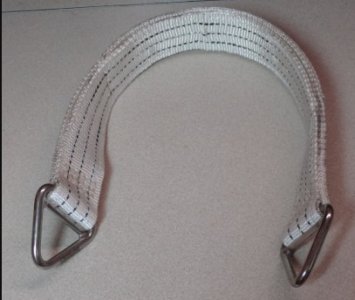
Webbing can easily be sewn even with a domestic machine, just go slowly, as an example I made this boom strap with a domestic machine, it's about 1cm thick I might possibly lift the boat with it.
View attachment 185298
ThanksI am admiring your boom strap because I know I ought to replace mine… I do have a Sailrite and I ought to be able to do that…
Just remember if you sew several layers keeping it flat then it won't take the U-shape, sew it while keeping it curved, adding maybe a few staples here and there to keep all layers together in the final shape.
Something he did not explain, because I think he may not have noticed, is that the best pattern depends on both the construction of the webbing and how much it stretches. The patterns for nylon, for example, are different from polyester. This is what happened at 5:50, and he didn't know why. The reason is that the webbing was stretching, loading some rows more than others. The lower the stretch, the less the pattern matters.I am admiring your boom strap because I know I ought to replace mine… I do have a Sailrite and I ought to be able to do that…
Rope tends to roll under foot. Dyneema can be used, but it needs to be thinner, like 5 or 6 mm. I tested this for PS.This thread has made me re think. Why not 8mm dyneema, with splices not sewn loops?

The s/s fitting is an Ankarolina buckle which I've always had on my boat at the cockpit end, with a stitched loop for a shackle at the bow end. Advantage is that webbing is fully adjustable (one wants it fairly taught of course), disadvantage is that the stitched loop for the shackle forward is the theoretical weak point (through abrasion and/or UV deterioration). So I was thinking of getting a second pair of buckles to eliminate stitching altogether, but the webbing needs some slack to open the buckles slightly to get them onto (and later off) the U-bolts, so one at each end would result in a slack line which isn't good.I have seen jackstays with stainless fitting at either end. So they fold back and go through a buckle. Rather like straps on a back pack or LJ
So not relaint on stiching, and fully adjustable.to.boat length.
2000kg is a 20g pull for the average wet guy on a lanyard. That’s going to sting a bit, as they say. Unless you’re exceptionally fat, I think 2000 kg is probably enough.The s/s fitting is an Ankarolina buckle which I've always had on my boat at the cockpit end, with a stitched loop for a shackle at the bow end. Advantage is that webbing is fully adjustable (one wants it fairly taught of course), disadvantage is that the stitched loop for the shackle forward is the theoretical weak point (through abrasion and/or UV deterioration). So I was thinking of getting a second pair of buckles to eliminate stitching altogether, but the webbing needs some slack to open the buckles slightly to get them onto (and later off) the U-bolts, so one at each end would result in a slack line which isn't good.
My pair of very heavy-duty white webbing jackstays (with a massive excess of machine stitching at the loop ends) are now pretty old, circa 15yrs! Even though I've always removed them and stowed them in the dark below when not in use, it seems prudent to replace them.
Jimmy Green do made-to-measure webbing jackstays (I don't think as thick as my existing old webbing). Their coloured webbing is rated to 2000kg as the colouring process heats and therefore weakens the material, whereas white is rated to 3000kg.
