Upgrade to hot water system

AntarcticPilot

Well-Known Member
Joined
4 May 2007
Messages
11,211
Location
Cambridge, UK
www.cooperandyau.co.uk
I'm thinking of installing a small mains operated water heater; the kind with a small tank (around 5-10 litres, like this https://www.screwfix.com/p/flomasta-undersink-electric-water-heater-2kw-10ltr/997ym?ref=SFAppShare), operating on about 2kW. I have a spare MCB on my mains consumer unit, and would use that to power it.

There is an existing calorifier, which works fine but which only provides hot water after the engine has run long enough to get up to temperature - which is a long time; the Volvo Penta 2003 warms up very slowly! The calorifier is difficult of access, being at the after end of the cockpit locker, and does not have any facility for fitting an immersion heater. Replacing it would be a difficult and arduous job.

What I have in mind is to install a water heater on the return line from the calorifier. This would provide hot water in both the heads and the kitchen sinks. If the water is hot from the calorifier, the thermostat of the water heater will keep the power off. I'd put the water heater in the heads compartment, where I think access to the pipework is feasible.

This may be a totally bonkers idea! But having hot water reliably available while in a marina would make a big difference to my comfort.

Any thoughts or suggestions would be welcome!

I should say that cost is a factor, so using a diesel water heater is not going to happen. And changing the existing calorifier for one with an immersion heater would be a difficult job.
 
If your engine is slow to warm, it might be worth checking the thermostat isn't stuck open. You can cause a lot of wear to an engine running it cool all the time.

Would it be worth then considering a new regular type of calorifier with immersion and locating it conveniently and running new flow/return pipes to the engine once the new thermostat reveals how much wasted heat these old chug a lugs throw out?

Not sure of your idea for putting something in the "return line of the calorifier". The flow/return pipes contain engine coolant, not potable water. The calorifier usually only has a single hot water out pipe (via a mixer valve). Is that what you meant?
 
Last edited:
I'm probably missing something, but if it's in series with the calorifier then surely you'd get 10 litres of cold water before you got any hot water from the calorifier?
 
If your engine is slow to warm, it might be worth checking the thermostat isn't stuck open. You can cause a lot of wear to an engine running it cool all the time.

Would it be worth then considering a new regular type of calorifier with immersion and locating it conveniently and running new flow/return pipes to the engine once the new thermostat reveals how much wasted heat these old chug a lugs throw out?

Not sure of your idea for putting something in the "return line of the calorifier". The flow/return pipes contain engine coolant, not potable water. The calorifier usually only has a single hot water out pipe (via a mixer valve). Is that what you meant?
I did indeed mean the hot water output from the calorifier. It is, of course, a circuit with cold water in and hot water out.

Replacing the calorifier would cost at least as much as my proposed solution and would be more difficult to execute; the calorifier is VERY difficult to access, especially for my aging body!

The Volvo 2003 is designed for raw water cooling, and because there is no heat retained in the cooling water, takes longer to reach it's operating temperature than a freshwater cooled engine.

It would be in the hot water feed from the calorifier, and when operating would maintain a small volume of hot water. If the calorifier was providing hot water, the water heater's thermostat would allow that straight through; if not (the usual situation when on shore power) the water heater would operate. However, I take your point that if the calorifier was hot but shore power was not available, there would be a reservoir of cold water. To avoid that, it would be useful to have a bypass valve for the water heater.
 
The only downside I can see is the 2Kw. This may well be amply provided in UK but in Europe you might struggle to find that much power in ports and marinas. My calorifier, and I suspect many others, came with an 850 watt immersion heater.

My original calorifier had provision to fit an immersion heater but it was so badly corroded that I could not unscrew the flange. I replaced it with a new calorifier including immersion, which proved to be an excellent modification
 
The Volvo 2003 is designed for raw water cooling, and because there is no heat retained in the cooling water, takes longer to reach it's operating temperature than a freshwater cooled engine.

I'm surprised there isn't a thermostat even in a raw water cooling system as running an internal combustion engine too cool is very bad for it viz wear on all the parts.

A quick look sees a parts site that sells two different types of stat -

Direct cooled engines 60°C / 62°C Volvo Part number 877355

Fresh cooled engines 74°C Volvo Part number 875795

https://parts4engines.com/products/volvo-penta-2003-thermostat
 
Last edited:
I'm surprised there isn't a thermostat even in a raw water cooling system as running an internal combustion engine too cool is very bad for it viz wear on all the parts.

A quick look sees a parts site that sells two different types of stat -

Direct cooled engines 60°C / 62°C Volvo Part number 877355

Fresh cooled engines 74°C Volvo Part number 875795

https://parts4engines.com/products/volvo-penta-2003-thermostat
There is a thermostat, but because all the cooling water enters at sea temperature, it takes longer to warm up than an engine with a closed loop freshwater cooling system. The engine is designed for it, so I have no concerns.

In a freshwater system, the same coolant circulates round the engine, so it can reach a steady state temperature, as some heat is retained in the coolant. In a raw water system, no heat is retained in the coolant, so it takes longer for the engine block etc. to reach a steady state.
 
Last edited:
The only downside I can see is the 2Kw. This may well be amply provided in UK but in Europe you might struggle to find that much power in ports and marinas. My calorifier, and I suspect many others, came with an 850 watt immersion heater.

My original calorifier had provision to fit an immersion heater but it was so badly corroded that I could not unscrew the flange. I replaced it with a new calorifier including immersion, which proved to be an excellent modification
Thanks for the warning. I currently don't plan to go abroad, so I'm not too worried.

I just checked prices for calorifiers and my proposed solution is FAR cheaper than replacing the calorifier - I hadn't realised they were so expensive!
 
You only live once. I think that the traditional system with a calorifier is likely to give the best service in the long run with the least complication. I would cancel a subscription or two, stock up with Voltarol and go for it.
 
In a raw water system, no heat is retained in the coolant, so it takes longer for the engine block etc. to reach a steady state.
If the stat is working properly, little or no new water enters the block until it's heated up and opened the stat.

Since the stat is rated at 60C for sea water systems, if your calorifier isn't heating, my money is still on the stat being knacked.
 
If the stat is working properly, little or no new water enters the block until it's heated up and opened the stat.

Since the stat is rated at 60C for sea water systems, if your calorifier isn't heating, my money is still on the stat being knacked.
The thermostat is fine. It does heat - but not until the engine has run for a while. Indeed, it can get too hot to be comfortable on your hand. But it takes time, and only works when the engine has been run for long enough - and that isn't every day.
 
The is a cheaper option that's even easier to install :
.
.
.
.
.
.
.
.
.
.
.
.
.
.
.
.
.
.
.
.
shopping
 
The thermostat is fine. It does heat - but not until the engine has run for a while. Indeed, it can get too hot to be comfortable on your hand. But it takes time, and only works when the engine has been run for long enough - and that isn't every day.
I think we're talking at cross purposes here. I'm sure you know the stat is normally closed and should open when the engine gets warm. Imagine how quickly the engine would destroy itself if the seawater intake stopped. That's how the stat should work, start engine, within 5 mins or less, block reaches 60C, stat opens to then regulate the temperature at 60C, it's not a switch but will partially open and close to maintain 60C.

I genuinely don't understand what you mean when you say the engine has to run a long time before the stat works. It's operation is to let cool/cold water in to cool the engine. Until then, little or no seawater should be going through the block, I guess it bypasses into the exhaust in the warming up stage?
 
I genuinely don't understand what you mean when you say the engine has to run a long time before the stat works. It's operation is to let cool/cold water in to cool the engine. Until then, little or no seawater should be going through the block, I guess it bypasses into the exhaust in the warming up stage?
I don't think that is what he said. As I understood it he said it takes a long time for the calorifier to become hot. The 2003 without a fresh water conversion does not heat the calorifier very well, unlike systems that utilise an additional pump.
 
This is just a suggestion - but would your idea not be better with an "instant tankless" hot water tap. These are available for ~£50 (ones that do boiling water too are more expensive). I've never used one inline with a hot water supply but it seems like it should work. I assume the water still flows when the power is off.
 
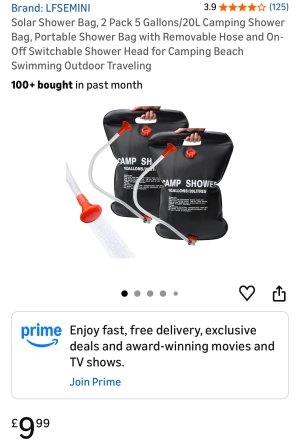
If you had a hatch or opening porthole directly over the shower area, this might work ( they can get VERY hot, if you’re lucky )
Not the answer you be looking for but cheeep as a cheep thing can be.


A57DC0B9-F428-49F8-8463-3370C82B8333.jpeg
 
I have a small hot water tank with immersion heater under a bunk, all insulated. It is connected to the calorifier. The immersion heater is low wattage but heats the small volume quickly enough, and then the larger calorifier tank. I have found that it always provides lots of hot water on demand when plugged in and heats up very quickly. That would be my recommendation, based on my experience, just plumb in a new, small, hot water tank.

Edit: Holy Molly - just checked the price of the small hot water tanks, very expensive. Your idea is certainly lower cost.
 
Top