
Unexpected find on lowering the furling genoa

Perhaps not all furling gear is working on the same principles...
Mine is Harken from the beginning of the 90's and I just found this old photo of the upper parts.
As can be seen space is rather tight and I doubt a spliced eye on the halyard plus a soft shackle would bring any benefit.
Also, the holes in the 'ears' of the swivel are just over 6mm and have sharp edges – clearly intended stainless steel hardware.

EDIT: In addition, no room for the type of shackle mentioned in post #15. I have one on my main halyard, though.
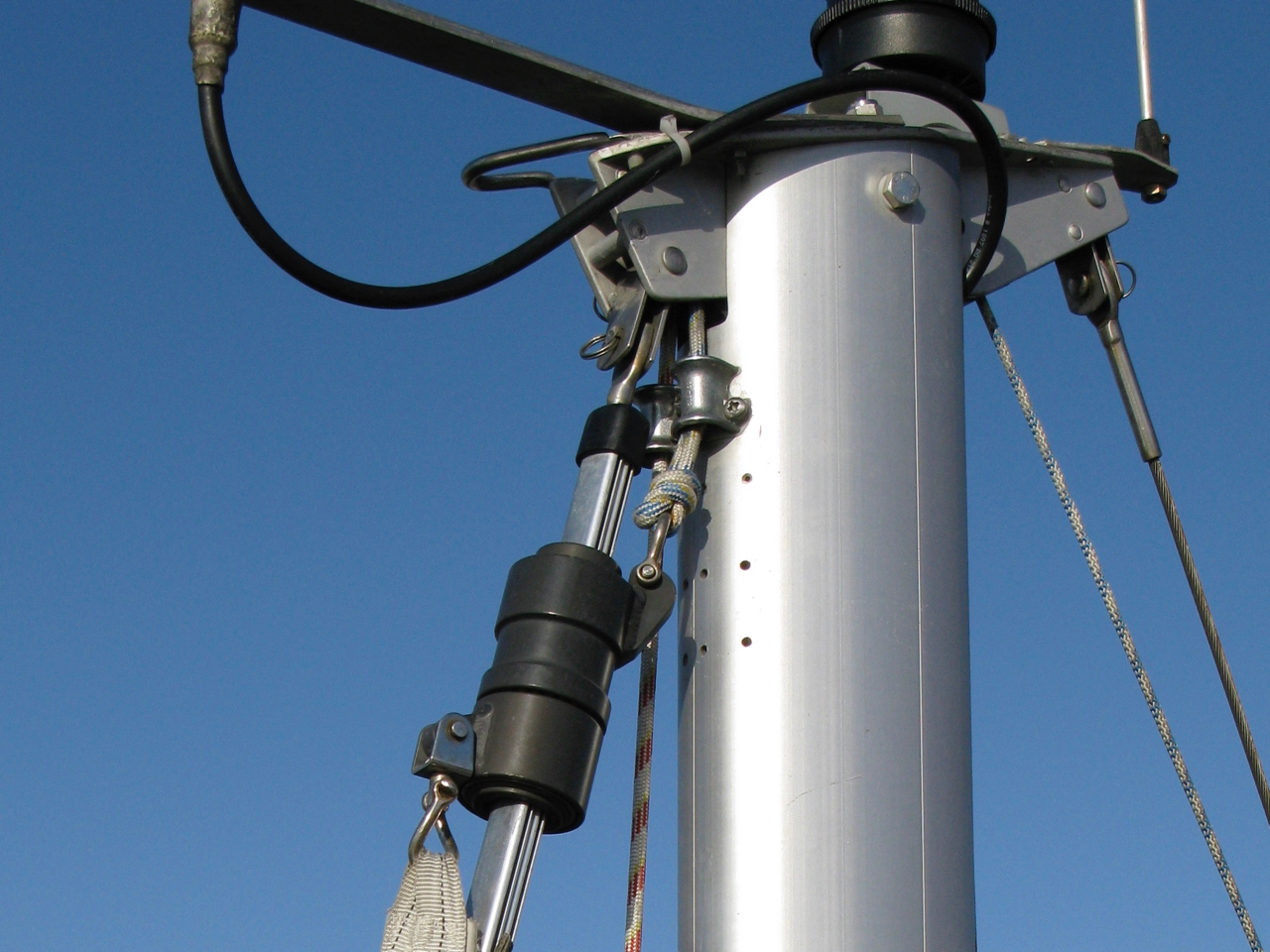
Halyard%20swivel.jpg
 
Last edited:
So no reply to my crazy post #20 then ??

BabaYaga ...... thst is too close at top to the rope guide for my liking ... just saying. I'm sure its been good for years.

I have to say - I'm a person who prefers reduce the number of connectors used in a system
 
So no reply to my crazy post #20 then ??

BabaYaga ...... thst is too close at top to the rope guide for my liking ... just saying. I'm sure its been good for years.

I have to say - I'm a person who prefers reduce the number of connectors used in a system
So regarding your post #20, I have never come across a sail that is “hoisted by the furling line”, so don’t understand that aspect.

But one reason why our genoa halyard is kept reasonably big is that we only have 3 ropes going up our mast - main, jib and spinnaker halyards. And I want all of them to be strong enough to safely support a person going up the mast - primary plus secondary rope - if have a problem with one of the halyards.
 
So no reply to my crazy post #20 then ??

Doesn't the halyard have a third and fourth job?

Your sail is cut to suit a known luff sag.

Wind gets up luff sag increases.

Mast head rig tighten backstay induces more tension in Forestay to bring sag back to normal.

Fractional rig this just bends the mast with little or no influence on forestay tension or sag.
A compromise solution is to increase main sheet tension but usually the only alternative to change the draft iis by significantly increasing the haliard tension.

Probably only critical to a racer!

On a dinghy one of the most useful controls in varying conditions was a mulipurchase ram or Highfield lever on jib halyard. The forestay was often just left flapping around attached with a piece of string to hold the mast up if the halyard broke!

So does the halyard have a fourth job?

To prevent the mast falling down if the forestay pings?

I don't think I am replacing my halyard with a piece of string?
 
Doesn't the halyard have a third and fourth job?

Your sail is cut to suit a known luff sag.

Wind gets up luff sag increases.

Mast head rig tighten backstay induces more tension in Forestay to bring sag back to normal.

True with hanked on sail ... less so with furled - yes you can - but the foil itself counters the winds trying to change luff. W#ith a furling genny - major changer you will introduce is mainsail not foresail.

Fractional rig this just bends the mast with little or no influence on forestay tension or sag.
A compromise solution is to increase main sheet tension but usually the only alternative to change the draft iis by significantly increasing the haliard tension.

Whats main got to do with this ?? But in fact there will still be a tension effect on a fractional forestay etc.

Probably only critical to a racer!

So ?

On a dinghy one of the most useful controls in varying conditions was a mulipurchase ram or Highfield lever on jib halyard. The forestay was often just left flapping around attached with a piece of string to hold the mast up if the halyard broke!

Interesting ... I raced many different dinghys and TBH - never saw such on a jib halyard .... all dinghys I raced / sailed - the stay was the main mast support with sail hanked on ... then of course halyard has a 'tension luff job as there is no foil.

So does the halyard have a fourth job?

To prevent the mast falling down if the forestay pings?

I don't think I am replacing my halyard with a piece of string?

I actually had my forestay fail on my Snap 23 and the spinnaker halyard was used to save the mast .... it was a Profurl 2000 so genny halyard was redundant.

Second - I did not even try to suggest you replace with 'string' ........... that really is you grabbing at straws and stretching the point

A reduction of one or two steps in halyard size will not have you all running for the lifeboats ................. I accept as boat size increases - the margin of rope diameter vs rope strength provided narrows. A halyard on a mid 20ft sized boat is way oversize - to basically have comfortable handling. But a 40's sized boat - the rope will not have such great margin ...
 
but has no-one considered that the average genny halyard used on a furling gear is grossly oversized ?
My halyards are 10mm, I would not like to go any thinner for something with which I will be manually handling a load (so topping lift is thinner).
But I agree that a halyard for a furling genoa should not need to be tightened up very hard – at least that's what my sailmaker told me.
 
Crikey you must be old if you only sailed dinghies with hank on jibs. I can just about remember them on a Heron & Firefly and I think that maybe it is only the Mirror class that still has velcro hanks and no luff wire.

Late sixties most classes went over to wire reinforced jib Luffs. Certainly the mainstream Gp14, Lark, Fireball 470s 420s and 505s were using them by then.

Modern Dinghy trend is now to have a stuff luff.

This does exactly what you suggest a foil does but can't. A foil is never under tension it just adopts the sag of the forestay and does little to help a jib hold any shape.

With a stiff luff you control jib sag by tensioning the bottom of the luff wire and draft is controlled by jib cunningham.

Not easy to make it furl!

How a Stuff Luff Jib Works - 505 Class - American Section.
 
My halyards are 10mm, I would not like to go any thinner for something with which I will be manually handling a load (so topping lift is thinner).
But I agree that a halyard for a furling genoa should not need to be tightened up very hard – at least that's what my sailmaker told me.


If you do not sufficiently harden up a Plastimo or similar system - you will get halyard wrap .... the halyard exit angle and tension from the top swivel is supposed to prevent wrap. Often it doesn't - so doughnuts and other means have been devised - the 'ultimate' of course is the second line back to a point lower on the mast to prevent the wrap ...

EBgHerWl.jpg
 
Crikey you must be old if you only sailed dinghies with hank on jibs. I can just about remember them on a Heron & Firefly and I think that maybe it is only the Mirror class that still has velcro hanks and no luff wire.

Late sixties most classes went over to wire reinforced jib Luffs. Certainly the mainstream Gp14, Lark, Fireball 470s 420s and 505s were using them by then.

Modern Dinghy trend is now to have a stuff luff.

This does exactly what you suggest a foil does but can't. A foil is never under tension it just adopts the sag of the forestay and does little to help a jib hold any shape.

With a stiff luff you control jib sag by tensioning the bottom of the luff wire and draft is controlled by jib cunningham.

Not easy to make it furl!

How a Stuff Luff Jib Works - 505 Class - American Section.


Funny actually ... Plymouth Marine College ... I raced GP14 "Pollux" against local clubs ..... 1973 .. 75 ... 76

Prior to that various common dinghys such as Cadets .... RNSA ..... Enterprise .... even the classic Wayfarer .....

Nearest to anything you describe was a wire luff but the above dinghys I mention - were all hanked on ....

Dare I mention it ... Wyckham Martin swivels ..... UGH !! awful things ... we removed them on a couple of boats ...

Edit : Just to add to the pot ........... the GP14's we raced were built by us in the Seamanship Centre to exact class specs
 
Self-locking bow shackle - Dia 6 mm | Wichard Marine
I find that they have a line of shackles that are said to be self-locking (I am not sure if these were available 30 years ago).
Does anyone know whether this self-locking mechanism is reliable?
I have had them on my jackstays for 15 years without any problems.
(Before anyone jumps in to tell me I shouldn't keep webbing jackstays that long, when not sailing they are removed and kept below.)
 
If you do not sufficiently harden up a Plastimo or similar system - you will get halyard wrap .... the halyard exit angle and tension from the top swivel is supposed to prevent wrap. Often it doesn't - so doughnuts and other means have been devised - the 'ultimate' of course is the second line back to a point lower on the mast to prevent the wrap ...

EBgHerWl.jpg
That furler and jib look far far too short for the length of the forestay so I can see exactly why you would get halyard wrap.
 
That furler and jib look far far too short for the length of the forestay so I can see exactly why you would get halyard wrap.

Its short because of striking an overhead cable a few years back across the river .... but anyway - I appreciate your opinion - but mine is not only that has similar arrangement regardless of foil / sail height .....

In fact it was only a few months back a forumite on here had wrap even though he had max height gear .... he fitted as per my suggestion and bingo - solved.
 
BabaYaga

I think you mentioned you would use cable ties - they don't last for ever but degrade in UV. I use them for short term securement, only. I'm like Vyv - rely on a blue Loctite and a big spanner.

Our furling headsail is also secured with a stainless bow shackle, the pin of which passes through a pin sized hole in a 'cube' of aluminium. I would not trust a soft shackle in such a location as the cube is sharp edged - and even dyneema will abrade - constantly moving against a 'sharp' edge.

Jonathan
 
cable ties - they don't last for ever but degrade in UV. I use them for short term securement, only. I'm like Vyv - rely on a blue Loctite and a big spanner.

Thanks for the warning. I'm not unaware of this, but I step and unstep the mast every year, so can easily renew them. However, the hole in shackle pin's head is tiny, so perhaps a piece of monel wire will be better.

I would not trust a soft shackle in such a location as the cube is sharp edged - and even dyneema will abrade - constantly moving against a 'sharp' edge.

Fully agree.
 
Thanks for the warning. I'm not unaware of this, but I step and unstep the mast every year, so can easily renew them. However, the hole in shackle pin's head is tiny, so perhaps a piece of monel wire will be better.


Fully agree.

Black cable ties are meant, or said to be, more UV resistant - but they still fail. We use them, they must be about 8mm (size does not matter) for our HF aerial cable - to keep it neat and tidy. We have a constant need to replace some of them. For a shackle wire (and I prefer Loctite) and a big spanner are much better options. My suggestion is try Loctite (and wire) and see how you like the Loctite (using wire as your back up). In some applications you simply cannot use wire - so its useful to have an alternative.

Jonathan
 
So regarding your post #20, I have never come across a sail that is “hoisted by the furling line”, so don’t understand that aspect.

But one reason why our genoa halyard is kept reasonably big is that we only have 3 ropes going up our mast - main, jib and spinnaker halyards. And I want all of them to be strong enough to safely support a person going up the mast - primary plus secondary rope - if have a problem with one of the halyards.
Also as a jury rig if a shroud or forestay gives way and you are lucky enough to be able to be able to get a halyard onto a cleat to hold the mast.
 
So regarding your post #20, I have never come across a sail that is “hoisted by the furling line”, so don’t understand that aspect.

But one reason why our genoa halyard is kept reasonably big is that we only have 3 ropes going up our mast - main, jib and spinnaker halyards. And I want all of them to be strong enough to safely support a person going up the mast - primary plus secondary rope - if have a problem with one of the halyards.

The original Profurl 2000 furling line - I described already .... the foil has TWO grooves ... one for sail, other for furling line which passes over a sheave in the top of the foil and then back down to sail head. You hoist the sail using the furling line ... once sail is set - the furling line is then locked off at bottom and then wound onto drum. The halyard is redundant.

Looks like the 2000 system as I fitted to my previous boat and also assisted others to fit - no longer listed and the installation manual ??? Appears Profurl have altered to have a halyard top swivel now.

As regards hoisting aloft .... I'm not a lover of using rigging that has been out there in all weathers etc. I'm off the school that prefers to run a new or line that has been stored protected from elements. Therefore a line suitable for on-board use can then be chosen and it used to pull through a rope for hoisting anyone aloft.
 
Perhaps not all furling gear is working on the same principles...
Mine is Harken from the beginning of the 90's and I just found this old photo of the upper parts.
As can be seen space is rather tight and I doubt a spliced eye on the halyard plus a soft shackle would bring any benefit.
Also, the holes in the 'ears' of the swivel are just over 6mm and have sharp edges – clearly intended stainless steel hardware.

EDIT: In addition, no room for the type of shackle mentioned in post #15. I have one on my main halyard, though.
Halyard%20swivel.jpg

I note the half-dozen ( perhaps more ) rivet holes.

What were they used for?
 
I note the half-dozen ( perhaps more ) rivet holes.

What were they used for?

I originally had this type of halyard restrainer
Halyard Restrainers | West Marine
which was also repositioned at some point when the second (spare) halyard was installed.
In this photo my previous genoa is raised on the foil by a short piece of webbing at the tack. My present sail is not, so margins at the top are not quite as tight.
 
Top