Two Quick Questions

Spirit (of Glenans)

Well-Known Member
Joined
28 Mar 2017
Messages
3,341
Location
Me; Nth County Dublin, Boat;Malahide
Visit site
1. Can anyone tell me what is the most suitable thinner for Jotun Vinygard?
2. I plan to scale the rust patches/craters off my keel this morning and fill the deeper indentations with epoxy filler. I also intend to use a rust killer and prime the repairs with Vinygard or Primocon (I have both), Obviously the rust killer will be used first, but I would like to know if I should apply the primer before the filler or vice versa?
Edit: I will be using an electric needle scaler to remove the rust.
 
Last edited:
Jotun thinner No.7, similar to Int. no. 3 but as usual twice the quantity for the price.
Of course, Jotun products are sold at sensible prices but I wanted to do the job today and my nearest chandlery, Marine Parts Direct doesn't stock Jotun. I would have had to go to Howth, which would have cost me another hour. A trade off between saving money and getting the job done ?
 
ref the order of primer and filler, I would chip off the rust, apply the rust killer, prime well making sure to get into any pits, apply filler, sand smooth then apply primer again.
This sequence means that there is primer between bare metal and filler, and any areas sanded bare of primer during the smoothing of the filler are covered again.
 
ref the order of primer and filler, I would chip off the rust, apply the rust killer, prime well making sure to get into any pits, apply filler, sand smooth then apply primer again.
This sequence means that there is primer between bare metal and filler, and any areas sanded bare of primer during the smoothing of the filler are covered again.

I cannot see the point of primer before filler .. sorry. The days of primers having corrosion prevention in are long gone .. such as Red Lead etc. - so the primer before filler ? IMHO is doing nothing but may in fact hinder the fillers 'bond' to the item.

Just my opinion.
 
I cannot see the point of primer before filler .. sorry. The days of primers having corrosion prevention in are long gone .. such as Red Lead etc. - so the primer before filler ? IMHO is doing nothing but may in fact hinder the fillers 'bond' to the item.

Just my opinion.
The logic is that the primer is sealing the metal from oxygen and water and this protection runs under the filler which in some cases is a bit hygroscopic, depending on what the actual filling agent is.
Vynaguard is an aluminium based paint which is really good at sticking to the substrate and keeping water out, so a good coat of that prevents rust and helps the filler to adhere. Then if the filler is going to absorb any water it does not touch the metal. It is a principle I learned when repairing classic cars but admittedly car body filler is different to an epoxy based marine filler.
 
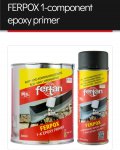
I would suggest Fertan rust treatment followed a few days later by Fertox single pack epoxy primer, then fill and fair before applying the primocon And AF.
 
The logic is that the primer is sealing the metal from oxygen and water and this protection runs under the filler which in some cases is a bit hygroscopic, depending on what the actual filling agent is.
Vynaguard is an aluminium based paint which is really good at sticking to the substrate and keeping water out, so a good coat of that prevents rust and helps the filler to adhere. Then if the filler is going to absorb any water it does not touch the metal. It is a principle I learned when repairing classic cars but admittedly car body filler is different to an epoxy based marine filler.

But surely - your sealing against water etc. is done by the primer on top of filler.

As regards Epoxy Filler being Hygroscopic ?? I'm a bit skeptical of that ..

Second - consider all those boats that have underwater gelcoat removed - then epoxy based Osmosis treatment ... you think the epoxy is that much different ?
 
Not to pick on refueler… but:
The days of primers having corrosion prevention in are long gone .. such as Red Lead etc. - so the primer before filler ?
Our keel is primed with a zinc phosphate additive epoxy. Definitely goes on to bare metal. Definitely had the additive, as it weighed a lot more than any other paint I’ve ever mixed (by weight)

And…
As regards Epoxy Filler being Hygroscopic ?? I'm a bit skeptical of that ..
It depends what sort of filler… cab-o-sil or milled glass -based = unlikely - but most of the ‘low density’ fillers will absorb enough water to a) require re-coating with epoxy on their TDS and b) reportedly cause blisters, poor adhesion or other weirdness below the waterline if you don’t.
 
I cannot see the point of primer before filler .. sorry. The days of primers having corrosion prevention in are long gone .. such as Red Lead etc. - so the primer before filler ? IMHO is doing nothing but may in fact hinder the fillers 'bond' to the item.

Just my opinion.

For filling casting holes in keel, I wire brushed, then Fertan, then car body filler followed by Vinyguard. Still there years later.
 
The process is very simple based on many years in corrosion protection.
1. Clean as thoroughly as you can. Needle gun is pretty good at removing all corrosion products if area is open and accessible.
2. Rust preventer if absolutely necessary but stay away from it if you can. Rust preventers reduce adhesion of primer to substrate so should be avoided whenever possible. If used make sure any loose or dusty deposits are removed before priming.
3. Prime with chosen product. Most underwater metal primers are now aluminium based, not as good as zinc, but still have good anticorrosive properties. You want good adhesion of primer direct to metal to exclude oxygen and water for as long as possible. Definitely do not put filler directly on metal. Even good epoxy fillers are far more permeable than primers.
4. Fill and fair
5. Prime again to get the required film thickness of primer as specified. This will definitely be more than 2 coats if brushing or rolling it on. Brush is much better than roller unless surface is completely smooth.
 
Top