Twin screw control

KREW2

Well-Known Member
Joined
20 Jan 2005
Messages
4,994
Location
Dorset
Visit site
I have just come over from sailing to power, age dictated.
My new to me boat, a Seaward 25 twin screw on shafts is obviously very different from a single prop. I have no problem driving and berthing our 38ft club mooring boat. It's an old steel harbour launch with a single prop, and a rudder the size of a postage stamp, but I now see twin engines is different.
I have done a couple of hours marina berthing practice with two different yacht master instructors.
One was definitely engines only for any close quarter manoeuvres, the other used the wheel and engines for forward docking, engine only for reversing into a berth.
Whilst all very alien to me, I managed to accomplish both methods with some degree of success.
I have looked at a few videos and read articles nearly all seem to say engines only. I know practice is needed but I would be interested to hear from those experienced with twin engines on shafts as to their preference.
 
It depends on the hull form to a certain extent in my experience. On our Broom 41 it was usually engines only as it was a planing hull with only a skeg keel and the torque of each prop combined with the paddle wheel effect were usually enough to get the boat to do precisely what I wanted it to.

Our current Hardy is semi-displacement with a noticeable keel, which restricts sideways movement a little so whilst it is mainly engines I sometimes need to use a little wheel to get where I need to be. To be fair, as I have got used to it I probably use less wheel than I did in our fist season with her and I tend not to use the wheel at all going stern first into a berth.
 
Last edited:
I have a 35' planing hull with twin engines - I use just the engines - forward or reverse UNLESS a sudden move is required, then I use the wheel to amplify the effect with a short burst of power then immediately back to straight ahead
 
planning hull with a 20cm keel thing at the bottom.
Only use engines when reversing to a berth (med stern to).
If (often) sidewind takes me a bit off target, I use the bowthruster to quickly realign the boat. Short 3-4sec thrust is usually enough.
If I've messed it a lot (does happen!) best cancel routine, go off, realign and come back in.
TBH never found rudders to be of any serious use on reverse.
Watching yachts stern-to, I think mobos can do everything much slower than what you have to do with a single prop and massive rudder on a yacht. So guess you have to unlearn fast moving reverse routines :)
 
Last edited:
Indeed there is certainly some unlearning to do. Seaward are semi displacement with a bit of a keel which is the depth of the props.
It was odd I thought to have two very experienced boat handlers with different tuition methods. Guess I'm going to have to practice and see what suits me best
 
Indeed there is certainly some unlearning to do. Seaward are semi displacement with a bit of a keel which is the depth of the props.
It was odd I thought to have two very experienced boat handlers with different tuition methods. Guess I'm going to have to practice and see what suits me best

I think it illustrates that there are different ways of doing things and the suitability of each may vary with individual boats, which is my experience. You will no doubt find what works best for you and your boat. ?
 
Last edited:
Very helpful to find out if you have counter rotating props and to think about what way the props will “walk” you in and out a berth. If you’re clever enough, this can be very effective at moving you away from and into a berth. Go into open water and have a practise. You’ll soon know which engine will be bias to which direction, forward and reverse. Reverse in particular and understanding what the prop will do, I terms of the movement of the boat, can be very useful. One of them will help you, the other will hinder you. If you get me
 
I don't know if this helps but I always think of it like this.
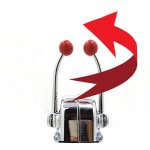
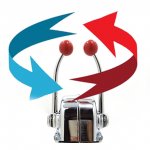
Throttle levers are usually curved.
I like to think the the direction of the lever corresponds to the way that the boat will behave.
This image is how I like to think about it.
Assume that we are looking forward.
In this image the starboard lever is pushed forward so the bow will be moving to port and the stern to starboard.
throttles.resized.jpg
And, pulling the lever back does the opposite (well - nearly)


In this image the port lever is pulled back as well as the starboard lever pushed forward.
The result will be the boat turning (almost) in its own length to port.
throttle.jpg

So, to recap, I like to think of the curves of the levers that show the way the boat will turn.

When going backwards, I turn around and look backwards.
Then the same lever concept works when the boat is going backwards.

All this is very different to a single engine RIBs that I have had many many years experience as safety boat coxswain etc .

My tip for what is is worth is to stand up when manoeuvring a boat.
You can see much more and this "lever concept" works better.
Even walk about.
Also, generally, I only give the throttle a short "blip" and only with the lever in (what I call) "first position" - the first click from neutral.
Let the momentum do the job.
Lots of people use too much throttle - - my motto is "if you are going to have a crash - make it a slow crash"

Most of us aren't professional but thats my three penny worth anyway and I've been handling twin shafts successfully for a good few years now.
 
let's be frank, only solution is a handheld remote with anchor and bow/stern thruster controls as well as engines ? - working on it...
 
Thanks for the replies.
Yes, counter rotating props so I am aware of the prop walk.
The instructors had most things in common. Slow is the order of the day, and both talked about looking all round, facing the way you are going, and as Hurricane pointed out the direction of the control levers knob, which is a great tip. Sunset has the same controls as pictured. The rudder and control lever man also said walk over to starboard to get a better idea of your positioning.
The only thing they differed in was one said until you have more experience with twin shafts leave the rudders centered and just use the engines, the other had me berthing with both. So I posted here to get the general opinion of others as to what they do.
I am going to the Isle of Wight tomorrow to bring Sunset back to Weymouth. If all goes well I will post here, if not I will keep quiet about it
 
Yea - but how many people do you see manoeuvring boats whilst sitting down?
They cannot be getting the best view - especially on my boat - even with my docking cameras, I stand up and walk around.

I agree - standing up gives a far better view and on our boat the helm is on a freestanding binnacle so when going astern I can stand in front of it looking aft. I also use the curve of the throttles as a ready reminder.
 
Last edited:
We switched from a long keel single screw sailing boat to a twin motor boat some years ago and found it was interestingly different. Lots of good advice here already. One thing we did was to get a half days professional tuition in our own boat, concentrating on berthing and departing from marina berths and alongside berths in a tideway, as these were the skills that were quite different. He was more inclined to the" no rudder, engines only" at low speed school, but did advise use of rudder in some manoeuvres. All boats are different and the main thing is lots of practice.
One tip we learnt from another boater when on the Thames.
If alongside a quay or a pontoon and wanting to depart, put the wheel well over towards the dock and then engage ahead on the inboard engine only. This will tend to turn the bow away from the quay but the opposite rudder kicks the stern away also so that you don't drag the aft corner along the quay. Once moving ahead and clear engage the other engine and straighten the wheel. Seems to work pretty well.
Another one from our instructor was departing in a confined space between boats and/or with wind onto the berth.
Slip all lines just leaving a slipped bowline and go astern on the inside engine, you will need some fenders well forward, slowly increase power and the stern will move steadily away from the quay. Once you are well clear of the boat astern slip the bowline and motor away astern.

If you have a bow thruster, we did not!, then some manoeuvres are much easier.

Good luck
 
  • Like
Reactions: vas
We have a Hardy 42, semi displacement. My experience is that at manoeuvring speeds there’s not enough water over the rudders for the to do much, so I centre them and use engines, assisted by bow and stern thrusters.

Thrusters aren’t essential but certainly make life easier and give you more options. For the most part they just help to reinforce the direction of movement and fine tune, although exiting the middle of a row of rafted boats sideways (Weymouth Quay) is cool :)

Find your own method that’s safe and stress free, but I’d say more engine than rudder on a twin screw boat.
 
We have a Hardy 42, semi displacement. My experience is that at manoeuvring speeds there’s not enough water over the rudders for the to do much, so I centre them and use engines, assisted by bow and stern thrusters.
Yes, I do the same but when you have time and want to turn the boat in its own length (say 180 degrees using split throttles), try turning the rudders in the same direction. I think you will find it makes the turn much quicker.
Other than that, the rudders don't do much when the boat isn't moving.
 
We lived on a twin engined and high windage SD trawler in the USA and though we had little trouble despite no thrusters found the rudders ineffective at low speeds as was the autopilot. Now we have a twin engine SD Birchwood TS37 with both bow and stern thrusters the truly chicken option. After 50 plus years of sail, I still find it more intuitive to berth a single engine fin keel saily boat with a girt great rudder and significant and predictable prop kick. Having both stern and bow thrusters was a SWMBO non negotiable , this time round, she being the primary docking hand (stroke made me less agile by far) as well as the holder of the nookie cabin keys. :whistle: I did find the mechanical separated gear/throttles on the US boat easier than the fly by wire single levers we now have.

BTW those armchair saily boat 'experts' that think it is a doddle with 2 engines need to think again, because the skills are very different and transition harder than you think.:ROFLMAO:
 
I bought Sunset from east Cowes to Weymouth today.
It was a great run on a near perfect day, and the fact that I'm posting tells you all it went very well.
The only hitch was the raymarine C80 plotter would not get a fix, so seatalk would not work and the auto helm where the rudder indicator is just displayed SEATLK FAIL. I was more concerned about having the rudder indicator working so I switched off the plotter and just ran on visual.
As for getting into my berth I found it helpful to initiate the turn with 10 degrees of rudder, centre them and bring it alongside with the engines.
As for the plotter, much googling has suggested that the internal rechargeable battery may need replacing, anybody else had this problem.
 
Top