
twin fuel filters

Joined
7 Jan 2007
Messages
5,025
Visit site
Hi my boat has a glass bowl type filter after the tank,I have been advised to change this to twin filters. I have had a look on eBay and they come in two types, one type with a switch over lever, the other type just twin filters.
My engine is a Perkins perama m30 diesel.

I can't see the advantage of the twin filters without the lever, wouldn't they both block up? Or am I missing something.
 
sounds odd - there is no performance advantage to having two parallel filters - unless as you say there is a switch over valve incase one bungs up. Whats the reason for wanting to "upgrade"?
 
That's what I was thinking, I had the diesel bug and putting the fuel system back after I cleaned it out one off the engineers in the yard noticed my glass bowl filter and recommended removing it and installing twin switchover valves. ASAP sell racor for £390- vat but they have a lever to switch if one gets blocked, the other type on eBay are just twin inline filters which I can't see the advantage off.
 
The only reason to specify twin filters in parallel is to be able to isolate one filter in order to change the element whilst keeping the other filter inline and the engine running. The only other reason to have twin filters, but in series, is to have a 2 step filtration process ie with the second filter having a finer micron rating than the first but I can't really see the point of doing that if there's already a fine filter on the engine. A 3 step filtration process is a bit over the top for the quality of diesel we get in the UK
 
So twin filters without the facilities to isolate a blocked one is a waste of money?

Have you got a link or a pic to show what these twin filters look like that you are considering? Your statement is correct for filters in parallel but not necessarily for filters in series as they may be designed as 2 step filters but as I said that sounds over the top. Does your Perkins engine have an on-engine fuel filter?
 
Yep, twin parallel filters that cannot be switched = a waste of money. you might as well have one filter, the right size.

Switchable are good. That's what your engineer is recommending according to #3

Not necessary though if the bug was a one off and you don't expect it again. But very useful if you have a significant risk of bug again.

Also, if you get the restriction gauge on the racors you're in even better shape because the gauge will tell you if the filter is becoming blocked
 
Yep, twin parallel filters that cannot be switched = a waste of money. you might as well have one filter, the right size.

Switchable are good. That's what your engineer is recommending according to #3

Not necessary though if the bug was a one off and you don't expect it again. But very useful if you have a significant risk of bug again.

Also, if you get the restriction gauge on the racors you're in even better shape because the gauge will tell you if the filter is becoming blocked

Thanks, that's what I thought....cleaned the tank out as best I could, took about 50 ltrs of diesel and filtered it three times, but my boat is a commercial boat and I can't have the engine cut out. The racors are the thing, but £££££££s.

Deleted User, I can't post links for some reason, but Google 'twin fuel filters' and lots come up.yes my engine has a secondary filter.
 
Deleted User, I can't post links for some reason, but Google 'twin fuel filters' and lots come up.yes my engine has a secondary filter.

The only thing remotely boaty that comes up are the twin Racor filters which are the switchable type and are definitely a good idea
 
twin inline automotive type filters usually split the duty of water separation and dirt filtration using two different elements types in the two stages so for example stage 1 might be water sep. whilst stage two is dirt removal.

Its a totaly different application of duty and standy filters separated by a valve.
 
cheapest option to give you a duty and standy situation is buy another of the type you have and install with T pieces and valves. Racor may cost you plenty but will they deliver more?
 
cheapest option to give you a duty and standy situation is buy another of the type you have and install with T pieces and valves. Racor may cost you plenty but will they deliver more?

Yes. I can change my Racor 500's without having to bleed the system, handy or what? Try that with a CAV!
 
cheapest option to give you a duty and standy situation is buy another of the type you have and install with T pieces and valves. Racor may cost you plenty but will they deliver more?

That's what my engineer suggested, have you a picture I could follow? He said two T pieces and four valves and two filters.
 
That's what my engineer suggested, have you a picture I could follow? He said two T pieces and four valves and two filters.

That's one option, alternatively just use two three-port valves.

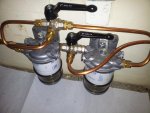
EDIT: Here's the setup I made for our previous boat:

49584830d3fd5897f971f9844b119a47_zpsllqxxcd4.jpg


The pipework looks a bit more complicated than it really needs to - the idea is that the valve handles cover the in-use filter and reveal the disconnected one, to ensure that the wrong filter isn't unscrewed by mistake. Probably over-thought that one a bit :). Nowadays I'd probably just do it with simpler runs of flexible fuel hose.

Pete
 
Last edited:
Here one of mine that I made with parts from ASAP.

20120513_162726.jpg

I know lots of folks don't like CAV filters but after using them since 1980 never had an issue myself. They are ok for low fuel use engines like my Perkins M135's.

Twin makes it easy to change the not in use one & bleeding is a doddle. I do have a system that monitors the pressure across the filters with gauges by the helm.
 
Here one of mine that I made with parts from ASAP.

View attachment 51136

I know lots of folks don't like CAV filters but after using them since 1980 never had an issue myself. They are ok for low fuel use engines like my Perkins M135's.

Twin makes it easy to change the not in use one & bleeding is a doddle. I do have a system that monitors the pressure across the filters with gauges by the helm.

Thanks for the PIC...does the fuel supply come in from the right of the PIC? I want to make my own set up.
 
That's one option, alternatively just use two three-port valves.

EDIT: Here's the setup I made for our previous boat:

49584830d3fd5897f971f9844b119a47_zpsllqxxcd4.jpg


The pipework looks a bit more complicated than it really needs to - the idea is that the valve handles cover the in-use filter and reveal the disconnected one, to ensure that the wrong filter isn't unscrewed by mistake. Probably over-thought that one a bit :). Nowadays I'd probably just do it with simpler runs of flexible fuel hose.
Pete
Shiny!
 
Top