
Trojan Batteries?

Richard10002

Well-Known Member
Joined
17 Mar 2006
Messages
18,979
Location
Manchester
Visit site
I fitted 3 new cheap open lead acid batteries in March last year, 110Ah each, £70 each. I've done my best to not fall below 50%SOC, and mostly charge up to what feels like 100% SOC, but probably never is.

I have no shore power so use engine or Honda genny via an 80A Sterling inverter charger.

Anyway... They're knackered! Probably only have a capacity of about 60Ah total, so I'm forever charging at the wrong end of the SOC scale.

I am sure I don't use 100Ah per day... Probably more like 50Ah

If I buy 3 105Ah Trojan batteries for about £400, my hope is that, if I keep them between 85%SOC and 50% SOC, I'll have 100 Ah to play with, and will always be fast charging, between 50% and 85%. Should be able to go a couple of days without charging.

Should also be able to do a monthly long equalise, (I've been trying a weekly equalise on the present batteries, but it hasn't had any effect- so I've got the facility and discipline to do it).

Any flaws in the above? Is my Maths and procedure OK?
 
Hi Richard I recommend you buy the largest and best make of batteries you can afford as this will be money well spent... For the money Varta are also a good make and are fitted as standard on a lot of big boats..

Fridges use a lot of juice as well as low voltage lighting - televisions - power invertors {this will really drain your batteries quickly} etc - Have you worked out how much amperage all your appliances use as this will help clarify how much battery power you currently use
 
If they're knacked after only one year, have you tried a claim under guarantee? £70 isn't cheap, most motor factors have them cheaper than that and something seems wrong if they don't last longer, have you checked charging voltage? Are they gassing a lot?
 
I presume that you are talking about Trojan 27TMX. I considered these but checked with Trojan's Tech. support before buying and decided to fit T105s instead.

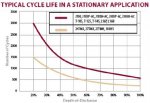
The graph for discharge cycles vs. depth of discharge showed that 27TMX was only expected to last for half the time a T105 should manage. On top of that, T105s were much cheaper per Ah.

27TMX ~£1.32 / Ah
T105 ~£1.05 / Ah
I think I managed to get a discount that took it to £1.03 / Ah

Down side is that T105s were taller and I had to lower the base of the battery box. Another problem is that you buy in pairs to get 12V so capacity would be 225Ah(£236) or 450Ah(£473). Vs. 315Ah(£415) with 27TMX

Up side is a lot more Ah for given cost and twice the lifespan (based on Trojan's own predictions). Sorry the graph is fuzzy but it shows 600 & 1200 cycles at 50%DOD. Even if you don't believe T105s will give 1200 cycles it still shows that Trojan expect them to last 2 x life of 27TMX.

Might not suit your situation but might help you decide if it is worth buying 27TMXs.
 

Attachments

  • TrojanDoD.jpg
    TrojanDoD.jpg
    23.3 KB · Views: 0
Last edited:
Your charger is a bit big, want to sell it? :)

Funny, I was thinking the same thing. Trojan suggest limiting charge to 10-13% of capacity for T105s and I think it's the same for 12V models.

3 x 10⁵ Ah would get away with 40A (barely). Of course any other loads during charging would be a problem.
However, 80A would be fine for my 450Ah T105s. So 60A plus 10A for misc. other loads still leaves some to spare with an 80A charger.

My present charger is just about OK on shorepower but is a weak point at anchor. Takes ages using the Honda genny if I let batteries get to 50%. Fortunately, that takes a while with wind, solar and a bit of motoring. But an 80A charger would be great and on my (ever growing) list.
 
Last edited:
Funny, I was thinking the same thing. Trojan suggest limiting charge to 10-13% of capacity for T105s and I think it's the same for 12V models.

3 x 10⁵ Ah would get away with 40A (barely). Of course any other loads during charging would be a problem.
However, 80A would be fine for my 450Ah T105s. So 60A plus 10A for misc. other loads still leaves some to spare with an 80A charger.

My present charger is just about OK on shorepower but is a weak point at anchor. Takes ages using the Honda genny if I let batteries get to 50%. Fortunately, that takes a while with wind, solar and a bit of motoring. But an 80A charger would be great and on my (ever growing) list.

your honda will out put about 12Amps no matter how big the onboard charger is. 12 Amps is 12Amps. then the loss`s through the charger will also drop that 12Amps
 
I have been told that good batteries to buy are 6 v golf cart batteries
They are constantly being run flat & fast charged & are designed for this type of use
Cost wise i am told they are economical- £ per amp
A lot depends on space you have available
 
I fitted 3 new cheap open lead acid batteries in March last year, 110Ah each, £70 each. I've done my best to not fall below 50%SOC, and mostly charge up to what feels like 100% SOC, but probably never is.

I have no shore power so use engine or Honda genny via an 80A Sterling inverter charger.

Anyway... They're knackered! Probably only have a capacity of about 60Ah total, so I'm forever charging at the wrong end of the SOC scale.

I am sure I don't use 100Ah per day... Probably more like 50Ah

If I buy 3 105Ah Trojan batteries for about £400, my hope is that, if I keep them between 85%SOC and 50% SOC, I'll have 100 Ah to play with, and will always be fast charging, between 50% and 85%. Should be able to go a couple of days without charging.

Should also be able to do a monthly long equalise, (I've been trying a weekly equalise on the present batteries, but it hasn't had any effect- so I've got the facility and discipline to do it).

Any flaws in the above? Is my Maths and procedure OK?


First, I'd check your usage more carefully - I quite easily reach 100ah/day if I include the computer.

With your charging methods it's unlikely your batteries have ever been fully charged (it takes 4 hours motoring with a a smart controller and a 110amp alternator to get mine to 95%).

Whilst I'm sure your current batteries are at the end of their life I fear even Trojans will not survive your regime for very long.

Before laying out all that cash for batteries try one of the multi-mode mains chargers on desulphation cycle - but give your betteries more time to charge.

When you do replace - look for industrial traction batteries, if you can fit them into your battery boxes. They are made by a range of manufacturers but to a far higher specification (and price) than automotive batteries.
 
Last edited:
I have been told that good batteries to buy are 6 v golf cart batteries
They are constantly being run flat & fast charged & are designed for this type of use
Cost wise i am told they are economical- £ per amp

The 6V Trojans referred to above are of this very type. One poster referred to them as "deep cycle" an expression bandied about and stretched beyond accurate meaning. "Traction battery" is the more accurate term. They're also used on leccy fork-lift trucks.

My take, for what it's worth, is that the OP's battery regime may be excessively demanding of his batteries. It needs a careful assessment before he lashes out on more expense.
 
your honda will out put about 12Amps no matter how big the onboard charger is. 12 Amps is 12Amps. then the loss`s through the charger will also drop that 12Amps

Not certain where you are getting 12A from as I didn't mention the model of Honda generator.

It's a 20Eui rated at ~1.6kVa (230V model).
AC(230) 7A
DC(12V unregulated) 8A

Perhaps you thought it was a 120V model where output is 13.3A

Doesn't really matter, an 80A 12V charger would run using my 1.6kVa genny.

80A @ 12.7V ~1.02kVa allowing for effic. rating on charger that's only ~1.25kVa, so no problem running the charger.
Anyway, the actual output wouldn't be 80A with my batteries even with parasitic items (ignoring initial startup).
 
Last edited:
Not certain where you are getting 12A from as I didn't mention the model of Honda generator.

It's a 20Eui rated at ~1.6kVa (230V model).
AC(230) 7A
DC(12V unregulated) 8A

Perhaps you thought it was a 120V model where output is 13.3A

Doesn't really matter, an 80A 12V charger would run using my 1.6kVa genny.

80A @ 12.7V ~1.02kVa allowing for effic. rating on charger that's only ~1.25kVa, so no problem running the charger.
Anyway, the actual output wouldn't be 80A with my batteries even with parasitic items (ignoring initial startup).

yes but if the genny output is 7A @240v then its only putting 7A into the charger & you will never ever see 80A from that charger. you might be getting say 10>12 Ah @ 12v
 
Last edited:
Possibly not massively helpful to you, but I have 3 pairs of 6v 225ah Trojans, and they're mustard!

Shorepower charger is a Sterling ProDigital 40amp, and on the engine I have a 60A alternator with a Sterling AtoB charger.

I find that when cruising, I run instruments, fridge & autopilot 24/7, and lights at night. 2-3 hours of engine charging each day gets them back to float charge.

The 6v Trojans are worth the money.
 
yes but if the genny output is 7A @240v then its only putting 7A into the charger & you will never ever see 80A from that charger. you might be getting say 10>12 Ah @ 12v

Its a 1.6KW genny so as his charger is MAINS operated, this is more than enough to run a 80a 12v battery charger.
 
>Trojan suggest limiting charge to 10-13% of capacity for T105s and I think it's the same for 12V models.


The way to go is a smart charger, which we have, it charges an increasingly lower voltage the more the battery is charged.
 
I fitted 3 new cheap open lead acid batteries in March last year, 110Ah each, £70 each. I've done my best to not fall below 50%SOC, and mostly charge up to what feels like 100% SOC, but probably never is.

I have no shore power so use engine or Honda genny via an 80A Sterling inverter charger.

Anyway... They're knackered! Probably only have a capacity of about 60Ah total, so I'm forever charging at the wrong end of the SOC scale.

I am sure I don't use 100Ah per day... Probably more like 50Ah

If I buy 3 105Ah Trojan batteries for about £400, my hope is that, if I keep them between 85%SOC and 50% SOC, I'll have 100 Ah to play with, and will always be fast charging, between 50% and 85%. Should be able to go a couple of days without charging.

Should also be able to do a monthly long equalise, (I've been trying a weekly equalise on the present batteries, but it hasn't had any effect- so I've got the facility and discipline to do it).

Any flaws in the above? Is my Maths and procedure OK?
What's wrong with using smaller batteries and running the genny more often? It must be vastly cheaper, not to mention the weight saving.

I use Optima 74ah Blue Tops and although expensive, there is no limit on charging current so can be charged quickly, albeit more frequently.
 
Top