Tricolour on masthead for sailing - overkill?

I find pulpit lights reflect too much off the pulpit even after wrapping the stainless steel tube in black tape.

I have a NASA Supernova tri/anchor light. It's so bright I can see that it's lit even in direct sunlight. The downside is that the bracket has snapped 8 years after it was professionally fitted to a new mast on a lightly used boat. It's currently dangling from the top of the mast and I'm going to have to unstep the mast and refit it. It seems to be a well made light let down by a weak bracket.
[/QUOT
My only issue with that is that you will be showing two stern lights then - one at deck level and one much higher but that’s not a huge objection
To be legal, you can tape a cover over the lower one when using the upper one.
 
I was crewing on a boat which was going up the channel into Paimpol at night, when we almost collided with a boat coming downstream using masthead nav lights. We were obviously only keeping a lookout at water level in such a narrow channel.
I once got sworn at by a fishing boat, because my pulpit lights on a small boat were hidden behind moored boats until the last moment. You can't win?

People need to be aware that other boats may have higher or lower navlights and keep a proper lookout.
If you go into Pompey only looking for navlights within 15ft of water level, you may get squished by a ship.

In some ways, I think the all round masthead white plus bicolour covers the bases quite well, provide you keep a good lookout astern, although small boats overtaking will probably see your instrument lights.

But being seen is only half the battle, the other half is both parties understanding what the other is doing.
 
I've nearly hit a boat in an anchorage as I didn't see it or others. From a distance the masthead lights got lost in the street lights and as we got close, getting ready to anchor, you are looking around but not up. It was only the 'shadow' of the boat that alerted us to it being there. It wasn't a stormy night but just dark and no moon.
I tend to anchor in pitch black coves with no street lights for maybe 10 miles, so I want to be able to see my anchor light from miles inland as sit outside pub or tramp back. I have a hanging thing - well I have duplicates of all lights, radios etc - but it is more readily obscured by rigging furled sails or other stuff and harder to get set up plug in etc
 
I think the quality of the NASA supernova lights are very good, I fitted one to our old boat in 2012, and it was still working last year, when I spoke to the new owner. I've recently put one on our new boat.

The only tricky bit is wireing them up, as they only come with 8" of cable. Solder and glue lined heat shrink works well though. Oh, and if you go for a combined light, rather than just a tricolour, you need a double pole double throw switch to operate it.
I concur with this so make sure you are happy to have separate switch fitted - the toggle switch reverses the polarity of the feed which changes it between anchor and tricolour and this will not fit in a standard switch panel
 
Just thinking about wiring options for this.

If I went with Nasa, switching between tri and anchor is a case of switching polarity (so needs a double pole double throw switch as previous posters have mentioned). It would allow either anchor or masthead tri to be on. Deck-level nav would then be on independent circuit and could theoretically be on at same time as masthead nav.

If I went with Aquasignal, I could actually use a DPDT switch to select between the two sets of nav lights (i.e. pulpit and stern OR masthead) which would help avoid a situation where both sets are on at the same time. Anchor light could then just be on separate switchable circuit.

Have I got that right?

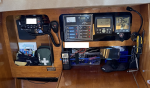
Current switch panel....
IMG_1732.png

Incidentally - a deep forum / google search of Nasa vs Aquasignal S34 seems to reveal equal supporters / complainants for both! It seems that AS 34s are reported to have a wider vertical viewing angle than the Nasa - can anyone confirm that?

The other advantage of the Nasa is a slightly more practical one, in that it would be easier to mount as the current masthead bracket is not wide enough for the AS 34 due to the current bracket at masthead having sides. Might have to have masthead VHF bracket re-made flat to fit the AS34.
 

Attachments

  • IMG_3111.JPG
    IMG_3111.JPG
    730.9 KB · Views: 13
Last edited:
I concur with this so make sure you are happy to have separate switch fitted - the toggle switch reverses the polarity of the feed which changes it between anchor and tricolour and this will not fit in a standard switch panel
I swapped my changeover switch on sold boat for a pair of double pole switches which fitted in switch pasnel. Both up - off, one down - anchor light on - other down -tri on, (and obviously both down -nothing on. I also fitted relay driven from top light to disconnect stern light if using masthead anchor light as steaming light, but another switch might do the same job
 
Incidentally - a deep forum / google search of Nasa vs Aquasignal S34 seems to reveal equal supporters / complainants for both! It seems that AS 34s are reported to have a wider vertical viewing angle than the Nasa - can anyone confirm that?

I had a good look at all the offerings a few years ago at a boat show and this was indeed the conclusion I came to. It is possible that things have changed since Since we want to be see when heeled at say 30 degrees+, I found it surprising that the output looked somewhat diminished at this angle, and that nobody seemed too bothered by it.

Seem to remember Yachting Monthly doing some tests on this in the past. Not sure if this is the relevant data: https://keyassets.timeincuk.net/ins...oads/sites/20/filebank/led_table_part_two.pdf
 
Whatever you decide, I'd also be tempted to spend a bit more and get an AquaSignal Series 34 light, rather than a Nasa product.
Disagree profoundly. Nasa is a British company and should be supported especially at the moment but apart from that, it is superior. Angles are better and the method it uses to achieve brightness is clever. I looked at an AquaSignal pulpit light a while ago (may have changed now). I'm surprised they got any with the absolutely awful sector separation
 
Maybe red and green all round lights up the mast is not so silly?
I would like to do that but 1 metre vertical separation is hard to achieve. I've considered changing the all-round Nasa white for red led (pretty straightforward) and a garland of greens round the mast a metre down but it is hardly elegant.
Solutions?
 
Disagree profoundly. Nasa is a British company and should be supported especially at the moment but apart from that, it is superior. Angles are better and the method it uses to achieve brightness is clever. I looked at an AquaSignal pulpit light a while ago (may have changed now). I'm surprised they got any with the absolutely awful sector separation

Could you share any more about the method they use to achieve brightness @Graham_Wright? It's been quite hard finding any detailed critique of either of them to be honest.
 
I was told by a skipper mate of mine that on his big ship he likes to see masthead lights when you are far away as you are easier to see but deck level when in close contact as its easier to judge distance. So, for the Solent, use deck lights for the channel (and further afield) a masthead. I have and use both.
 
Disagree profoundly. Nasa is a British company and should be supported especially at the moment but apart from that, it is superior. Angles are better and the method it uses to achieve brightness is clever. I looked at an AquaSignal pulpit light a while ago (may have changed now). I'm surprised they got any with the absolutely awful sector separation

Glad to hear the Supernova is OK now. I'm sure you know only too well that there were reports of failures after it was introduced, and indeed people are still saying that the bracket for it is rubbish.
 
I was told by a skipper mate of mine that on his big ship he likes to see masthead lights when you are far away as you are easier to see but deck level when in close contact as its easier to judge distance. So, for the Solent, use deck lights for the channel (and further afield) a masthead. I have and use both.
with deck level port and starboard and all round masthead you cover all bases if motoring
 
Could you share any more about the method they use to achieve brightness @Graham_Wright? It's been quite hard finding any detailed critique of either of them to be honest.
The less are pulsed. If you have a combined tri and anchor light, the selection is achieved by sensing the polarity of the source. (I.e., if one wire is positive, one set of leds lights up via a diode and vice versa for the other).
 
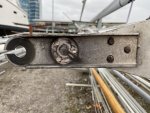
Yes, the bracket is poor. I made a stainless "stick" welded to my aerial cross rails that accepted the stem.

This is slightly off-putting - do we know which bit of the bracket is considered sub-standard? Is it the whole thing, or just the 'stick'? I'd rather not have to fabricate custom brackets on top of everything else!

The less are pulsed. If you have a combined tri and anchor light, the selection is achieved by sensing the polarity of the source. (I.e., if one wire is positive, one set of leds lights up via a diode and vice versa for the other).

Ah interesting - thanks.
 
Top