Trad boat rally

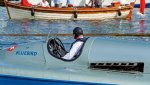
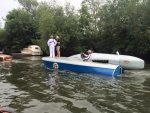
I've been going since the late 80's, believe today is the biggest attended I've ever seen. Lots of different things to previous Trad Rallies, but the 1916 MTB is fascinating, having recently read the book about how we used them to attack the red Russians in 1919. The torpedo was dropped off the back, facing the way the boat was going, which had to veer off very quickly or risk being hit by it's own torpedo. The boat here today looks ready to fire it again, but it's tiny compared to MTB 102 moored just upstream.
 
Thanks for posting those pics. All very nice, but my god I'd love to take ownership of that MTB!

Agreed but ...... have a look at the specs (www.mtb102.com)

TECHNICAL INFORMATION
Length 68', beam 14'9", draft 3'9". Built of double diagonal Honduras Mahogany on Canadian Rock Elm, and powered by three Isotta Fraschini 57 litre petrol engines each of 1100hp. giving a speed of 48 knots light and 43 knots loaded and armed, this made her the fastest wartime British naval vessel in service.
Originally a single torpedo was fired through the stem, through a hatch in the bow. A second torpedo was loaded from rails on the after deck, the location of the torpedo tube is evident from the long bulge on the fore deck. It was discovered during trials that better accuracy and reliability could be achieved with two side tubes, and the original torpedo arrangement was changed to two 21" tubes. These were angled out at 10° from the centreline, with the side decks being scalloped. She was also involved in the trials for depth-charges, machine guns and the Swiss made Oerlikon 20mm cannon.
The original engines were replaced with two perkins P6 diesels while in private ownership. The Italian engines became difficult to maintain because of the lack of spares resulting from Italys' alliance with Germany during the war and most MTBs were powered by Packard engines made in America.
Maintenance and upkeep is largely carried out on a voluntary basis, but in 1983 it became necessary for major work to be carried out on the hull and decks, and £20,000 was spent to ensure that 102 remained a sound and seaworthy boat. It then became apparent that the old engines were going to be the next problem, but in 1985 Perkins Engines Ltd. came to the rescue with the generous provision of two turbo-charged V8 engines.
However, maintenance upkeep and preservation of this unique vessel remains expensive, and in 1990 after rough weather during the return to Dunkirk, further extensive work was carried out to reinforce the hull and decks, at a cost of £50,000. In 1995, enroute to the V.J. Day celebrations, the port engine seized and the journey had to be abondoned. The filming for Chanel 4s' 'Classic Ships' was conducted on just one engine, and then in 1996 Cummins Marine supplied new 'Diamond Series' diesel engines to, appropriately enough, take 102 into her Diamond Anniversary year. In 2002 two specially tuned high output Cummins L10 600h.p. engines have been fitted.
She is one of only a few WWII Royal Navy vessels still afloat, and is thought to be the only Royal Navy vessel that took part in the Dunkirk evacuation which has survived.
The MTB 102 Trust has now been set up to obtain major sponsorship and finance to keep this unique vessel operating for as long as possible, and your support is vital for this to succeed.
 
Thanks for that. I wonder why it had three engines but now has two?

I thinks there's another MTB moored at Port Hampton, on the Middlesex side of the Island, that looks like it was used as a houseboat.
 
Thanks for that. I wonder why it had three engines but now has two?
Dad was a MTB coxswain during the latter stages of WW2. The centre engine was rigged for silent running so you could poodle around quite happy in the knowledge you were very unlikely to be heard. If you needed to be somewhere in a hurry, or just needed to get the hell out of somewhere, you opened up the taps on all three. The acceleration was brutal and crew were often injured if they weren't hanging on to something securely at the time.

Dad was involved in dropping boffins on the French beaches to assess the suitability for the D-Day landings. The approach was always silent, drop the guys in the rubber dinghies, stand off and wait for their return. Once back on board, silent run until a sufficient distance from the shore then full speed for home.

I guess when it became necessary to re-engine just on the basis of cost alone it made sense to have two not three.
 

Other threads that may be of interest

Top