
lustyd
Well-Known Member
Spinnaker halyard will happily hoist it on/off the foredeck, I do this solo on mine quite often.hump it up to the foredeck

Spinnaker halyard will happily hoist it on/off the foredeck, I do this solo on mine quite often.hump it up to the foredeck

Spinnaker halyard will happily hoist it on/off the foredeck, I do this solo on mine quite often.

I used to tow mine backwards with only the vee of the bow in the water. Never ran any risk of flipping even In bad chop or strong winds. Minimal additional drag. Our boat had a sugar scoop stern without any obstructions. This allowed the inflatable tube extensions to be pulled under the lower rung of the aft rail. Holes in the top of the transom were strong points allowing dinghy to be lashed onto the stern with the transom resting on a rubber pad on the centreline.I need the tow my tender occassionally when in the Solent not in F6!. I have done it few times and know the pitfalls etc. The tender is a 2.3 mtr air deck with transom stern and side tubes aft of the transom, typical of inflateables today. This one has a centre towing eye at the bow and an eye on either side of the bow a little aft and nearly the full width of the dinghy apart. what is the best way to rig the tow line
1. one centre tow line
2. a bridle from each side eye to one central tow line.
3. separate lines from each side eye led to the port and starbord of the stern.
Which method will give greastest control on the yawing of the dinghy, i will put a little weight in the stern to keep it bows up a liitle.
hope to get some advise from those who have done it.
David MH

That would be a 2-man job on my boat, with the halyard led to the cockpit. In any case, I would still have to manoeuvre the dinghy out of the cockpit, along the deck and past the rigging, when all I have to do is get it out of the locker and start pumping, and in any case the rails forward are slightly higher. My laziness knows no bounds when it comes to saving myself effort.Spinnaker halyard will happily hoist it on/off the foredeck, I do this solo on mine quite often.

We have one, I don’t really understand why anyone these days carries their flubber inflated.Get a decent inflation pump. Hey presto! Problem solved.
We have aluminium floor, its a lot of work to inflate/deflate and we use the tender a lot. The tender also sits nicely on the foredeck inflated but is less easy to secure when deflated, and we’d then have to store the floor somewhere.We have one, I don’t really understand why anyone these days carries their flubber inflated.
You’ve got the room to keep it inflated obviously. Technically we do too, but it would get in the way of the downwind sails and the handling of them. Our electric pump takes about 5 minutes to inflate ours, and air floor model. Most important, Mrs C can use the pump, I can finish tidying and packing the main, tidy the cockpit and make sure whatever mooring we are using is sound. We’ll be in the bar at least as soon as someone towing theirs. Assuming we arrive at the same time that is, what with them losing a knot or so by towing, without even bringing halfmarans into the conversationWe have aluminium floor, its a lot of work to inflate/deflate and we use the tender a lot. The tender also sits nicely on the foredeck inflated but is less easy to secure when deflated, and we’d then have to store the floor somewhere.
Plenty of reasons, every boat and crew have different requirements. i also saw a lady using an electric pump this week and she took so long to inflate that i walked to the shower and back and the tender still wasn't inflated so lower effort isnt necessarily better


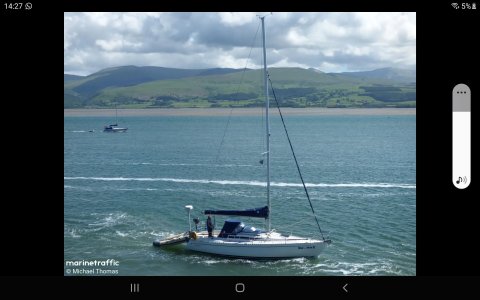
Hey, nice looking boat. What type is that?I used to tow mine backwards with only the vee of the bow in the water. Never ran any risk of flipping even In bad chop or strong winds. Minimal additional drag. Our boat had a sugar scoop stern without any obstructions. This allowed the inflatable tube extensions to be pulled under the lower rung of the aft rail. Holes in the top of the transom were strong points allowing dinghy to be lashed onto the stern with the transom resting on a rubber pad on the centreline.
I hated having it either inflated or deflated in front of the cockpit because of restricted vision. It made an easy access route for swimmers without any need for a boarding ladder. Never used it for mob recovery but it was a safer option than a hard transom recovery.View attachment 196814


I found it easiest to tow with the dinghy pulled in as tight as possible, with its bow clear of the water, which with my set-up greatly reduced drag.
The centre one is not for towing, its just for a painter. The two side ones are for towing and should be used with a bridle. Usually the manual covers this, as well as lifting points (usually inside). If you use the middle one it’ll eventually rip off.

The carabiniers are only used as a temporary measure, e.g when returning to the boat or attaching to a ring ashore.I wouldn’t use a carabiner for this as any strange side loads and the dinghy is gone, we’ve had reports of that on the forum before. Knots are very easy so there’s no reason to.
Mine is a length of (about 2m ish) floating line from one d-ring to the other. I tied a knot in the middle to give a loop which i can attach another floating line to when towing. As per Vyv, mine never comes off and i use it to lift the dinghy onto the boat as well as towing. I also have a painter on the centre ring to tie up the dinghy.
I found it easiest to tow with the dinghy pulled in as tight as possible, with its bow clear of the water, which with my set-up greatly reduced drag.
I found it easiest to tow with the dinghy pulled in as tight as possible, with its bow clear of the water, which with my set-up greatly reduced drag.