Toe-rail + rubbing strake Design ideas.

Yep, all agreed.
Pics obviously are not enough to evaluate all that, but it shouldn't be too difficult for Vas to judge, looking at the real thing.
Btw, interesting to hear of "puddle". I just checked it on the dictionary, can't believe to have never heard that before....
....well, either that, or my neurons are decreasing faster than I thought! :D
Ha that's funny. With your uber-command of EN it is a strange you never came across that word. It's a very common word, at least in UK where it does rain a lot. "Stepping in a puddle" is as common an expression here as "basking in sunshine" is for you :D
 
MM,

good point but as JFM says I feel I don't have a problem
It did rain (not an awful lot though) two days ago when the pieces were bolted down and glued to one another (in order to get the right curvature of the deck), but no water was to be seen staying anywhere.
Further, around the top point of the deck (which is close to the foot of the lower helm windscreen (or top of the sundeck if you wish) there's minimal slope towards the side and the deck is not exceptionally wide there. There is a substantial slope on the longitudinal axis which is a good thing.
So all in all, it seems to me that no puddle would form and the water would leave from these two holes. However, as port side is going to be glued tomorrow, I'll check again with level and establish if there's a need for a third hole amidship (a five minute job BEFORE they are glued down)

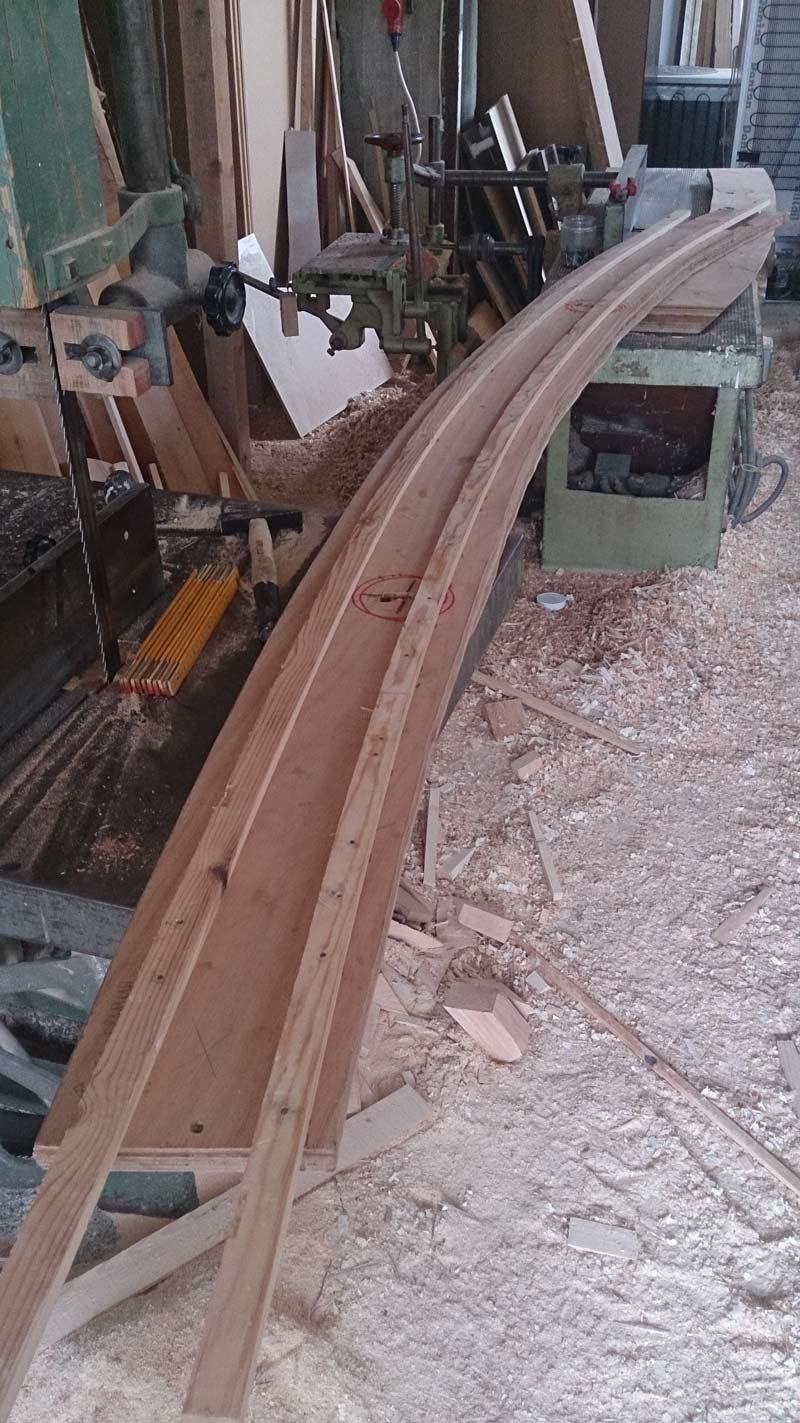
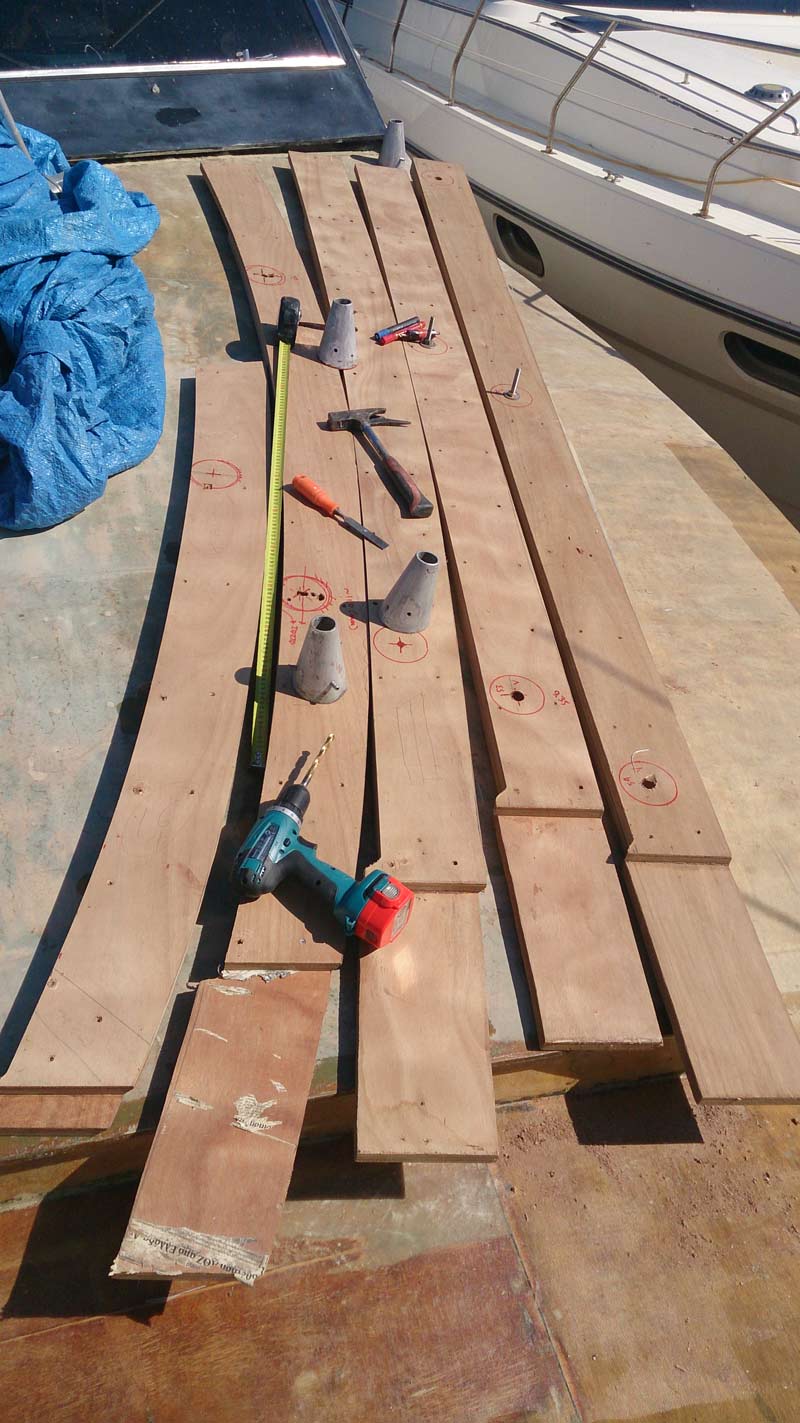
Today I helped George route a constant width on all 5 pieces, took us the 2.5h (and I thought it would be half an hour job...) but they came out perfect.
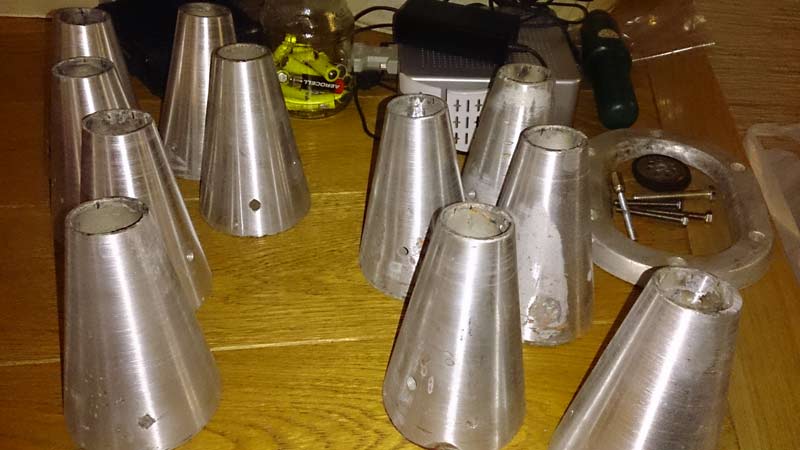
Sending 15 stanchion supports for minor welding (filling extra holes that PO did to keep the thing together...) tomorrow, preparing the stbrd side and hopefully have both sides done by the w/e.
Need to find a way to straighten a few stanchions AND paint the stanchion support alloy cones (powder coating and anodizing are out of the question).

cheers

V.
 
There is a substantial slope on the longitudinal axis which is a good thing.
Yeah, that's exactly what I meant by "static AoA".
I suspected that in your boat, as with most planing hulls, that could have been enough to avoid the "puddle" risk, but it's obviously impossible to tell based on the pics alone.
And once checked that such problem doesn't exist, I really can't think of any other cons of your solution, which looks indeed very elegant, from both an aesthetic and an engineering viewpoint.
Looking forward to the pics of the final result, I bet she'll be stunning! :)
 
Hi Vas,

Great and interesting progress.

Re your stanchion bases, wouldit not be cheaper to havea new set turned rather than filling and anodising the old ones? Or could you add a stainless shroud to the cover the old ones?
 
wakeup,

I decided to rebuilt and keep the original stanchions and railing. They are alloy and 31mm in dia :eek: (the ss ones on the P45 next to me are around 20mm)
The bases are not a cone with a hole in the bottom. They feature three threads near the bottom at 120deg apart and with an allen threaded M6 (iirc) bolt you are meant to tune and regulate the angle that the stanchion is coming out of the base. It's not too complicated, but a clever idea nevertheless and actually is the strongest reason for me wanting to keep this setup!

Up till now it's cost me 220euro to fill the wrong/failing threads and the extra holes that PO opened here and there in a desperate attempt to keep the stanchions up...
It's also cost me another 20euro in screws and various bits and bobs.
End result I can post a pic tomorrow is not that bad, it's actually rather good. Only catch is that following the tig (?) welding, sanding, latheing (what's the right spelling for that ???) I have a few that need a bit of filling/sanding the others just need a quick pass with a 120grit paper (on hand due to the conical shape) and then painting.
Everyone says that anodizing WONT work (due to the micropores/bubbling from the welding) so I think for this year I'll spend another 20euro on 3 good quality alloy wheel spraycans and give them a pass.

More head scratching regarding 4-5 slightly bent stanchions and 2 that are badly corroded at the bottom where they meet the cone.

We shall see, after all I don't expect everything to work out OK on the first go, I should have some (smaller) projects to keep me busy for the following years, shouldn't I? :p

cheers

V.
 
I should have known you'd have all the angles covered.

planning, thinking and sketching is a great part of the enjoyment ;)


another update on this.
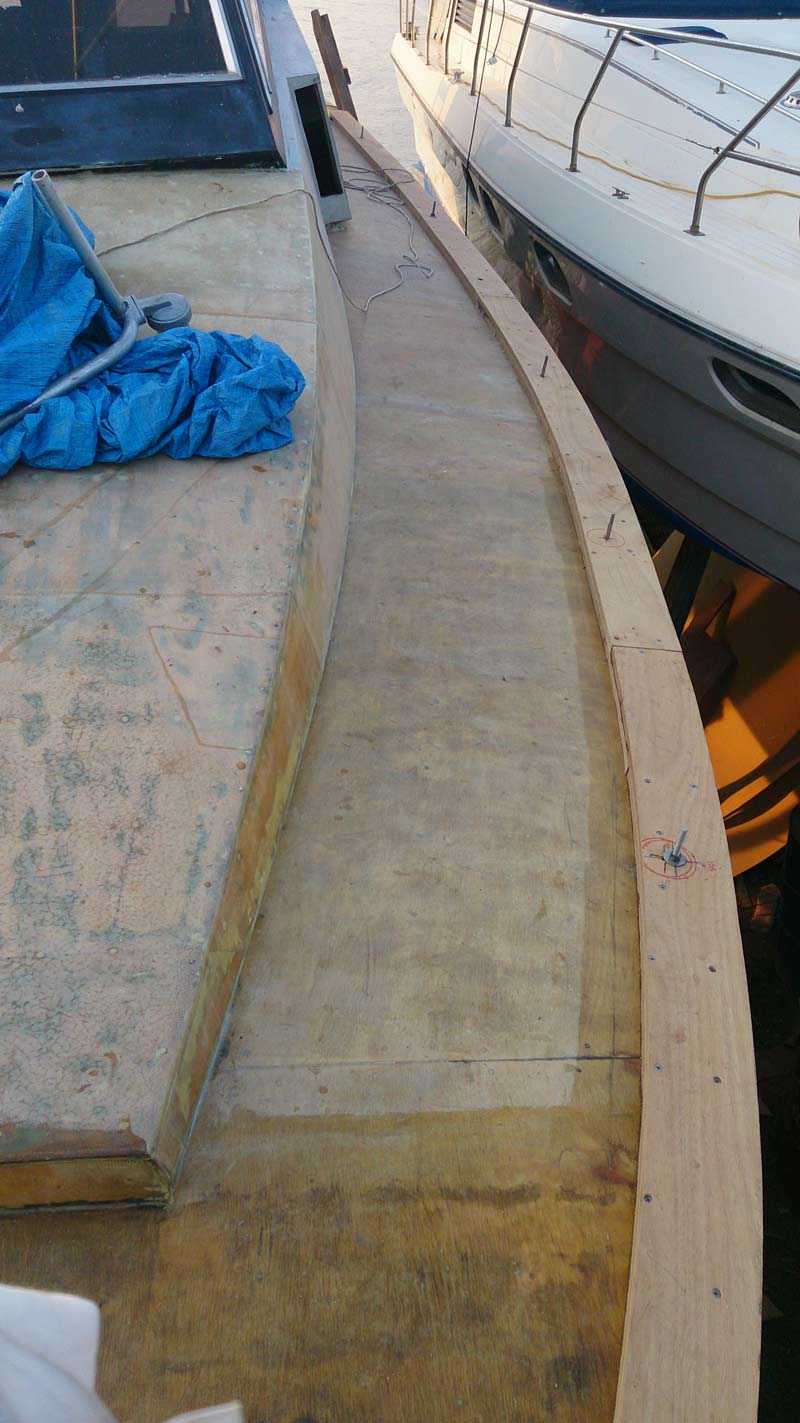
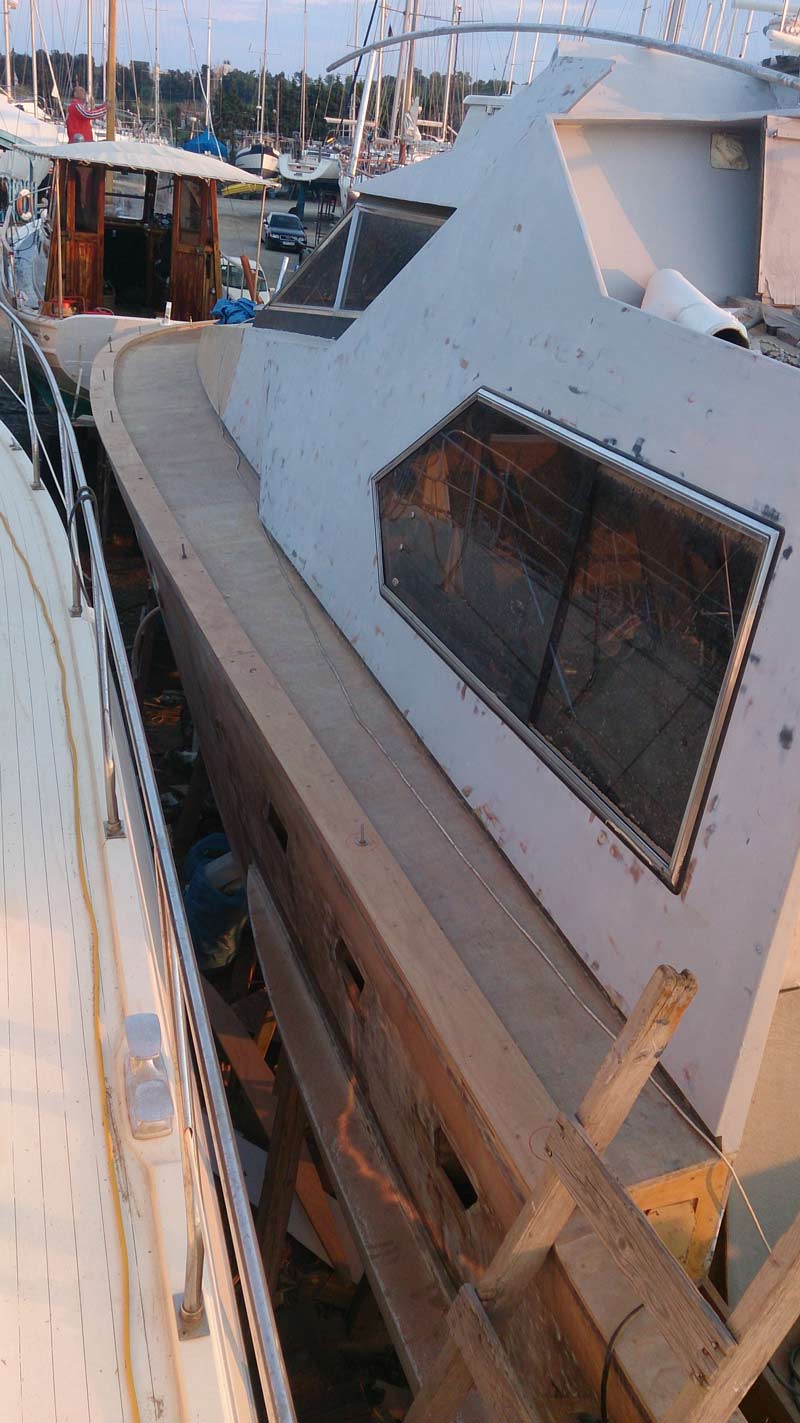
Port side ply is trimmed, sized properly, glued in place, and sanding on the hull side flush to the rest.
Was a bit of a complicated job getting it right:

For starters, we glued the two pieces together and bolted them down to the deck.
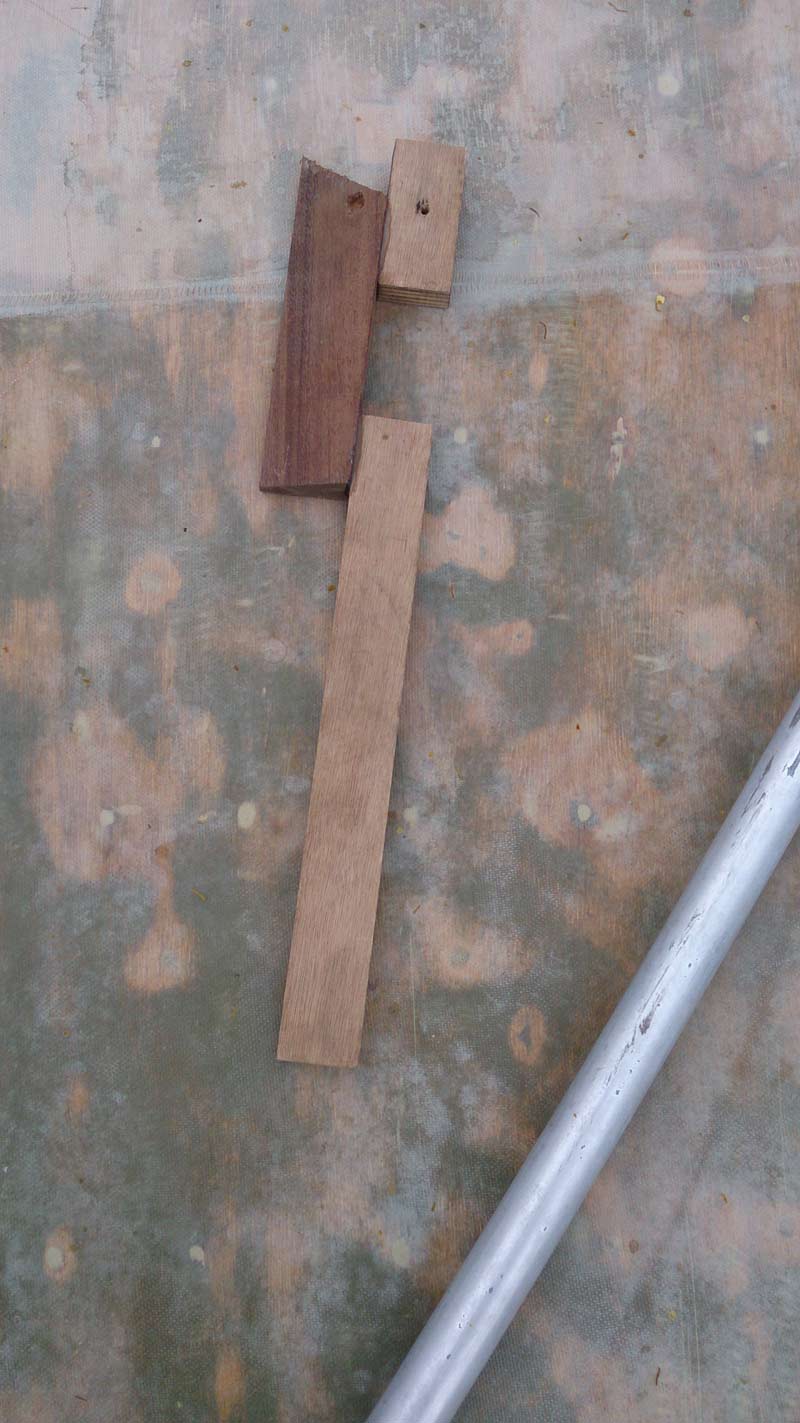
Then we marked the hull line underneath and I built a special hi-tech tool in order to mark on top the hull line considering that the two 20mm layers of ply were protruding over the hull edge:

markingtool.jpg


Following, George with the el.plane (is that how you call this tool I wonder) brought the outer edge close to the hull shape (but not perfectly so)

Next step was at George's workshop, routing the right overall (top) width of the plinth to 145mm. Was also slightly convoluted, as we had to nail a thin strip on top of the ply exactly on the marked curve and use it as a lead for the router. Worked out fine.

toerail+rubbingstrake_12.jpg


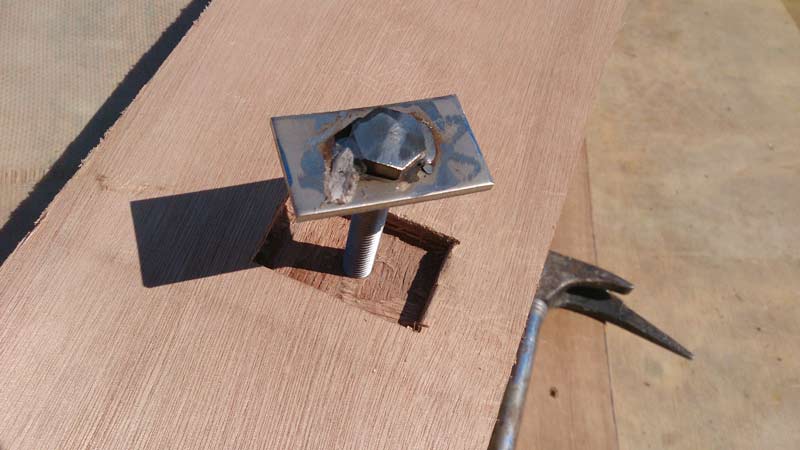
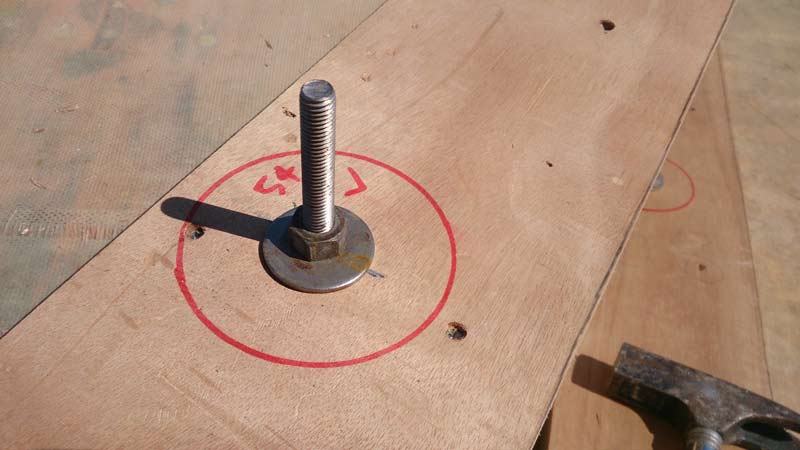
Next step was back in the boat epoxying them in place after I chiseled and fitted the non-through bolts for the stanchion bases:


toerail+rubbingstrake_13.jpg


toerail+rubbingstrake_14.jpg


toerail+rubbingstrake_15.jpg


Marking the spacing of the bases and more importantly the offset from the hull (or inner end of the plinth) took some planning as I wanted everything to be smooth and symmetrical. All pieces ready to be epoxied and bolted in place:


toerail+rubbingstrake_16.jpg


End result looks very good, with right spacing throughout.

toerail+rubbingstrake_17.jpg


toerail+rubbingstrake_18.jpg


George sanded and smoothed the outside, true to the hull and finally decided not to bother with the 4 (or 6)mm ply on the side, but get a strip of iroko maybe 8mm thick and 70-80mm wide to cover the endgrain of the two 20mm plys and sort out the mess immediately lower to them from the old iroko rubbing strake. Although I'd spend a few days sanding, replacing, smoothing, epoxying etc there, it's not perfectly smooth and this seems to be a neat and quick(ish) solution.
Effectively the capping will look 165mm wide on top and around 90mm high. All iroko left raw (well sanded), possibly oiled (not sure, but definitely not painted)

Next step for tomorrow is to seal the inner endgrain with a layer of mat and epoxy. Then i'll probably put another layer of mat all the way along the plinth and over the side.

Stbrd side is ready for routing the right width on Monday. Leaving on Thu morning for a week (CERN visit with 12yo daughter, Munich and Milano visit as well...) and want to have done all that capping so that George can cut and fit the iroko on the lot while I'm away.

Got the twenty stanchion bases from the machine shop, don't look half as bad, but need some more work.

the good:

stanchionbase_1.jpg


the bad:
stanchionbase_2.jpg


and the ugly:
stanchionbase_3.jpg


Some filling, sanding and most likely a alloy wheel spray can for this year.

cheers

V.
 
The toe rail is looking really good Vas, great progress. You've earned your week off. Have a good one.

thanks P :D

I'm just trying to work myself out these last few days and take more advantage of the sleeping in the trip ;)

haven't replied to your PM, sorry, I'm looking at it and will let you know when I figure out what.

cheers

V.
 

Other threads that may be of interest

Top