Tips on furling a main

sailaboutvic

Well-Known Member
Joined
26 Jan 2004
Messages
9,972
Location
Northern Europe
Visit site
After 40 year of owning boat with slab reefing we now have one with in mast seldom furling system, the sail is 34 sq metre .
After 18 months I really started to hate the thing , no matter what we try in any blow it's a night mare to get in .
No doubt replies are going to come rolling in from people who going to say
" I had mine for X years and never a problem "
We have tried keeping the luff very tight and a bit loose .
We tried boom 90 degrees, a bit higher a bit lower , in the wind off the wind , foot tight foot loosening , keeping a the wind off the port and letting the foot off a small amount at a time , so far the best way in any blow as been getting the boom in the middle wind directly from behind and go to the mast and wined it in , keeping the foot tight .
Yes it been Grease just a few months ago . The man sail is old but in good nick .
Up to 15 kts yes it will come in without too much of a problem but still hard , over that you fighting with it the last few weeks we been sailing in winds up to 35 kts trying to put a reef in at 20 kts has been a battle .
Over to you guys , what's going wrong . What are we missing?
 
I have never owned one but recently was made aware that you need to furl it on the tack that allows the cloth to run straight onto the spar, rather than the one that requires it to turn back on itself around the slot before winding on to the spar. That's all I know.
 
I have never owned one but recently was made aware that you need to furl it on the tack that allows the cloth to run straight onto the spar, rather than the one that requires it to turn back on itself around the slot before winding on to the spar. That's all I know.

You better off not owner one :) .
Quite correct in our case it wind over the port , in light wind it works but still hard work , come wind over 15 kts your fighting with the wind in the sail , if you let the Main sheet out too far, or let the foot go then you get a very flapping sail and it's not going in right and there a chance which have happen that it folds up on it self , another problem .
Each pull on the furling line only take in a very small amount .
 
No personal experience, but chap in sailing club had exactly the same problem. Wouldn't wind in, difficult to wind out. On advice of sailmaker he had the sail recut to a more flat profile. Complete waste of money and time.
 
Mine must be very similar to your system although my sail is fully battened. I fought with it last year, my first with in mast furling, then found that being just slightly on starboard tack is the trick. Not enough to be really sailing but for the sail to be nearly full and just luffing slightly. It transformed the system and I can now pull the sail in by hand from the cockpit until I get to the last batten which gets a bit tight. Max wind, though, has been less than you at a steady 25kn.
Hope you can sort it. I went from strong dislike to reasonably happy over a few days. Now I'm still suspicious of it but feeling moderately confident it will do what I want, when I want!
 
I have an 18.5m mast with inmast furling by Proctor, now Selden. We had problems for ages! Here are the things in order of effectiveness that got us to the point today where it is realively easy to furl. Note that in a real blow it will be hard regardless so reef early.

1. Stripped winding gear in mast and re greased. Only grease created tonnes of resistance.
2. Replaced the sheaves and Deleon balls on all deck organisers to reduce resistance.
3. Ensure boom in on portnside so main furled in to mast anti-clockwise without chaffing on mast. Or vice versa.
5. Ensure slight tension on outhaul so it furls in nicely.
6. Keep boom slightly up so clew ends up furling higher.
7. Don't have halyard too tight. Or fuel a little then release it before furlong more.
8. Having two people pull the furling line at the same time after 3,2,1 PULL!
9. Have a winchrite for difficult times to singlehand fuel.

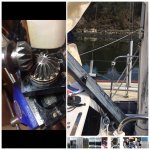
All above helped but no.1 and no.2 were really effective! Photo below shows the simplicity of furling gear.

A28F0E82-9A2B-4CA8-B2CB-7B62514E05C5.jpeg
 
Last edited:
Mine must be very similar to your system although my sail is fully battened. I fought with it last year, my first with in mast furling, then found that being just slightly on starboard tack is the trick. Not enough to be really sailing but for the sail to be nearly full and just luffing slightly. It transformed the system and I can now pull the sail in by hand from the cockpit until I get to the last batten which gets a bit tight. Max wind, though, has been less than you at a steady 25kn.
Hope you can sort it. I went from strong dislike to reasonably happy over a few days. Now I'm still suspicious of it but feeling moderately confident it will do what I want, when I want!

Battens may help , although unless I try them I wouldn't know .
It seen it depend on which way your furling is if you have it on the port or starboard tack .
In heavy winds you really need to get it in quickly unless you want a shreddered sail , well that's my view anyway , and not only it's hard to reef in but the amount that being taken in each time is so small there a possibility it could easily happen , that why o taken to go to the mast now and hand reel it on , not much fun when it blowing 30 plus and the boat is bouncing about . We just taken it out this morning to take a good look and re adjust the luff , good job we did as the top part didn't want to come out when it was totally out . At anchor no wind , I sorted it in no time but if I was out and it was blow , that would had been a problem .
 
I can't really give any advice, but yes, I'm one of those annoying people who find the system excellent. When we first bought the (new to us) boat, I had absolutely no experience of in-mast furling, and struggled with it. I took the (nearly new) sail to a sailmaker, who did some alterations, saying that she had never seen a sail so poorly suited to furling. Whatever she did completely solved the problem.

I find furling is best either head to wind, or if underway, on starboard tack with the sheet eased well off. It will furl on port tack, but the way the sail rolls up, means that there is a sudden change of direction, and therefore more friction that way.

I have found it to be a great system, allowing the sail to be brought out, furled, or reefed to any extent without leaving the wheel. Find out what the problems with your set up are, and fix them, and you will love it.
 
I have an 18.5m mast with inmast furling by Proctor, now Selden. We had problems for ages! Here are the things in order of effectiveness that got us to the point today where it is realively easy to furl. Note that in a real blow it will be hard regardless so reef early.

1. Stripped winding gear in mast and re greased. Only grease created tonnes of resistance.
2. Replaced the sheaves and Deleon balls on all deck organisers to reduce resistance.
3. Ensure boom in on portnside so main furled in to mast anti-clockwise without chaffing on mast. Or vice versa.
5. Ensure slight tension on outhaul so it furls in nicely.
6. Keep boom slightly up so clew ends up furling higher.
7. Don't have halyard too tight. Or fuel a little then release it before furlong more.
8. Having two people pull the furling line at the same time after 3,2,1 PULL!
9. Have a winchrite for difficult times to singlehand fuel.

All above helped but no.1 and no.2 were really effective!

Amit I not done 1
2 the deck organisers seen to be free and work ok , no frictions any where , lines all in line .
The rest we don't at some point or another other then the winchrite , which we don't have k and really surly you shouldn't need that much power .
Any way thank for the tips , hoping someone will nail it before I get really fed up and end up putting a track on the mast and a new sail .
 
Wind slightly on starboard bow, so the sail has a clear run through the slot on to the starboard side of the furling spar. Not too much halyard tension. Keep a little tension on the outhaul whilst furling, so it rolls up tightly. Take the furling gearbox out of the mast every couple of years and service it thoroughly.

Of course, if the sail is baggy or badly cut it won't furl easily.
 
Wind slightly on starboard bow, so the sail has a clear run through the slot on to the starboard side of the furling spar. Not too much halyard tension. Keep a little tension on the outhaul whilst furling, so it rolls up tightly. Take the furling gearbox out of the mast every couple of years and service it thoroughly.

Of course, if the sail is baggy or badly cut it won't furl easily.

Thanks
Other then taken out the gearbox which I plain to do this year , every thing else we tried .

Baggy sail , ? I wouldn't say it baggy , but then I not a sail maker .
I guess if I had to replace the sail , I spend a bit more and put a track on the mast and go for slab reefing .
 
Thanks
Other then taken out the gearbox which I plain to do this year , every thing else we tried .

Baggy sail , ? I wouldn't say it baggy , but then I not a sail maker .
I guess if I had to replace the sail , I spend a bit more and put a track on the mast and go for slab reefing .

Yeah get the box out. When I took mine out i needed an adjustable spanner to turn the drive. Afterwards I could do it with forefinger and thumb! The whole job was in fact a lot more straightforward than I thought which is why it took me so long to get round to it.
 
Yeah get the box out. When I took mine out i needed an adjustable spanner to turn the drive. Afterwards I could do it with forefinger and thumb! The whole job was in fact a lot more straightforward than I thought which is why it took me so long to get round to it.
Have to take a close look how to remove it , if you have any more photos that be great .
 
Thanks
Other then taken out the gearbox which I plain to do this year , every thing else we tried .

Baggy sail , ? I wouldn't say it baggy , but then I not a sail maker .
I guess if I had to replace the sail , I spend a bit more and put a track on the mast and go for slab reefing .

You will need a new mast as there is not a track that will fit - the mast for a battened sail is a different section. Plus you will probably need a new boom and all the hardware.

As the others have said, particularly northcave on a well used system you need to go though all the mechanical bits to make sure they move smoothly. I would add the outhaul car as well which needs to run smoothly (Teflon spray regularly). You can check the furling line by comparing the ease of furling at the mast with using the line. You have two changes of direction where friction can be a problem. Also check the tension on the furling mandrel - instructions in Selden manual.

Having said all that it is more likely to be the sail that is adding to any mechanical issues. Difficult to get right, even for new sails. The one that came with my new boat is about to be modified to take excess belly out of it, not necessarily because it is difficult to furl but it is too full aft and that already creates a couple of small creases when furling that will only get worse as it ages. With my last boat I noticed furling getting harder as the sail got more used and was instantly better with a new sail.

Have not reefed the new boat in over 25 knots so far, but was fine at that speed for taking in 3 or 4 rolls by hand and in normal furling have never used the winch. The sail is a bit smaller than yours at about 27 sqm and is plain, (cheap!) and no battens.

Instructive to talk to a sailmaker as although like many things you will get conflicting views, it will help you understand the problems. I had a morning out with the sailmaker I use, mainly to try out my furling cruising chute, but learned a lot about the ins and outs of different approaches to making mains for furling systems. Hence the first change to take a bit out of the luff to take some belly out of the sail and move it forward. Bit too soon to justify a new sail, but it is likely not to have battens, partly for wear reasons, and partly because there is little room inside the backstay to get any roach to increase area.

Hope you get yours sorted as on balance I still think for shorthanded sailing in mast has a lot to offer.
 
To day we had quite light winds , and it came out just by pulling in the foot , never had to use the furling lines , again going in it wasn't too bad but I had to give it quite a pull to get it in .
The way I understand it , is when furling slight tension on the foot , wind over the port boom 90d or just off and in it comes , there another flying pig :) , well that's been tried many a times over last season and this year , and in very light winds it seen to work with a bit of elbow Grease , but in any type of blow , you can forget it , we also tried many other combination, as in my first posting .

The gear was grease through the holes in the mast end of last year and again this year , so was the top swivel , I really should had taken it out and inspected it and cleaned it but on a pontoon it seen to work ok . Plus I need to take a good look how it comes out as I never had anything to do with inmast furling before.

The Main sail looks very good , cloth wise , it's a Hood sail and the owners before us very rarely used it , most of the time they used the head sail and it shows , we got getting caught out on one of the Peloponnese legs a few weeks ago the sail ripped from the luff to the leach , luckily we keep sail cloth and after a days work fighting with the metres and metres of sail to get it through the sailrite , my on board wonder women managed to fix it , but the cloth is so badly worn in other places ,
We are having Quantum Athens make us a new sail .

If they have time they said they will deliver the sail and fit it , in which case I will ask him to take a look and the main sail and get his option .
This coming week will be interesting , there a Mastral forecaster for some days if not a week , I not looking forward to reefing or getting the Main in .
Thanks everyone for your input .
I am open to any suggestions if there any more .
 
Last edited:
Mine must be very similar to your system although my sail is fully battened. I fought with it last year, my first with in mast furling, then found that being just slightly on starboard tack is the trick. Not enough to be really sailing but for the sail to be nearly full and just luffing slightly. It transformed the system and I can now pull the sail in by hand from the cockpit until I get to the last batten which gets a bit tight. Max wind, though, has been less than you at a steady 25kn.
Hope you can sort it. I went from strong dislike to reasonably happy over a few days. Now I'm still suspicious of it but feeling moderately confident it will do what I want, when I want!
What happens to the battens if the sail is fully battened? Do they roll round the in-mast pole when you start to reef?
 
Top