Tinned copper bars for DIY blocks

slawosz

Well-Known Member
Joined
26 Sep 2018
Messages
625
Location
London
Visit site
Hi,
I am looking for marine-friendly bars to use with 3D-printed blocks. Is there something like this that I could buy?
 
There are other simpler ways of making bus bar type connections, particularly once you get down to low amperage circuits. I only used metal bus bars up to the switch panel.
 
Thanks.
Regarding copper flat bars, I am afraid that would quickly deteriorate in the marine environment.
Would this be suitable? 210-133 | Wago 2002 Busbar for Terminal Block | RS Components
That is not intended for bus bars with stud terminals but for their terminal blocks which would normally fit in a DIN rail. What do you want the bus bars for? alternatives for low amperage are here 12voltplanet.co.uk/terminal-blocks.html My distribution panel negative bus is made up of 2 lengths of flexible blocks linked with jumper wires. I have used the Blue Sea for smaller buses with the jumper links and made small distribution boards using 5 way Wagos to connect 4 circuits to one switch for example.
 
What do you want the bus bars for? alternatives for low amperage are here 12voltplanet.co.uk/terminal-blocks.html My distribution panel negative bus is made up of 2 lengths of flexible blocks linked with jumper wires.
The one you linked are perfectly fine. I just want to do them myself. Although probably will end up buying such blocks and jumpers. Just wanted to save extra 40 GBP and show how great is 3D printing ;) I dont want Wagos, I want to have each cable terminated with eye and attached to the terminal block.
 
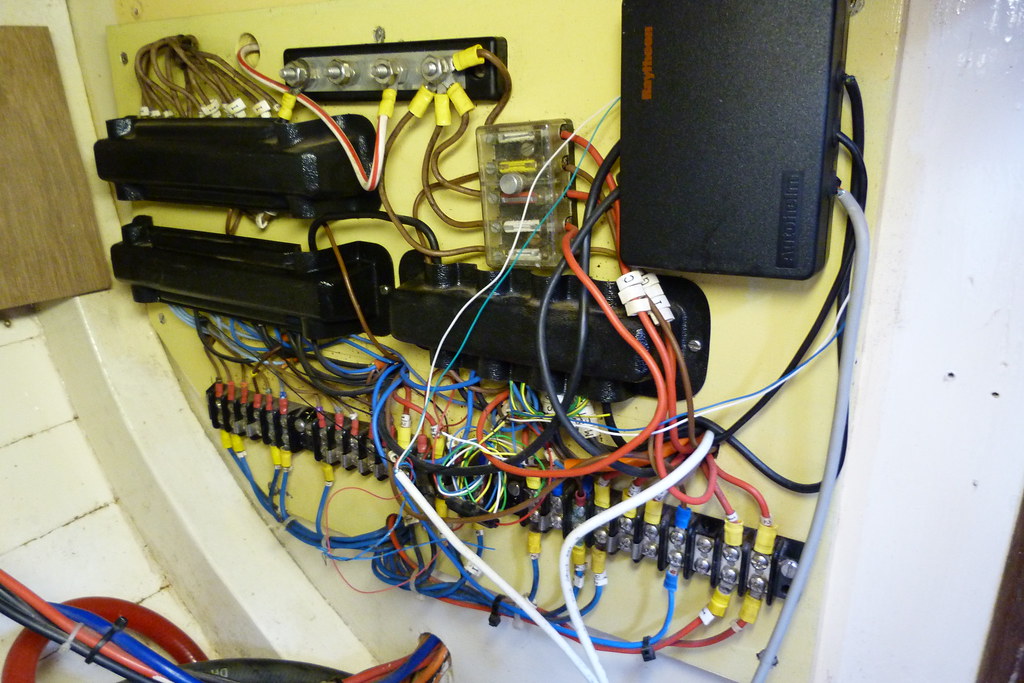
If it helps, this is the back of my new distribution panel. Initially I was going to use Blue Sea blocks as I had a supply of jumpers but still high cost for the 16 ways I have. You can see hiw I have used Wagis in the mini distribution board for the nav gear just below the chart plotter. Have a similar board where I linked all the existing interior lighting circuits into one feed from the panel.
IMG_20220426_144226.jpg
 
If it helps, this is the back of my new distribution panel. Initially I was going to use Blue Sea blocks as I had a supply of jumpers but still high cost for the 16 ways I have. You can see hiw I have used Wagis in the mini distribution board for the nav gear just below the chart plotter. Have a similar board where I linked all the existing interior lighting circuits into one feed from the panel.
View attachment 136942
I note that you seem to have taken the -VE in to one end of the chock blocks.-----Stop reading at this point if I have got that wrong & ignore me please. :rolleyes:
I took it into both ends of the blocks as any break in a single link messes up the whole remaining block. - I make the comment, because if one link goes the current can still work to all the other items by running along from the other end. When the power goes down it only affects the one bit where the connection failed & you can find it quicker. Of course it may never fail . It is just a precaution
 
Does something like this help?
Well, I am trying to do this part myself, rather them buying
What are you printing with? I understand that PLA absorbs water.
I need to leave some PLA part in the water and see how much. But this, I would print from PET.

If it helps, this is the back of my new distribution panel.

Thanks. I would love to avoid any locking connections and do something like @tillergirl had:
74 by Roger Gaspar, on Flickr

I am just trying to do them myself, but I am afraid I will end up buying jumpers. Its just awful lot of money for piece of metal!

M Machines
Page 30 for copper strip if that is what you want.
Excellent company. Use them regularly
No connection
Thanks, will take a look!


That looks a useful site.
Tinning them is easy enough with liquid flux and solder, plus small blow torch.
How you could do it?
 
Slawosz

That black box is the interface. That converts the Raymarine language to NMEA which fed to the Navico Tiller Pilot. Yes the jumpers are expensive but very convenient!
 
Top