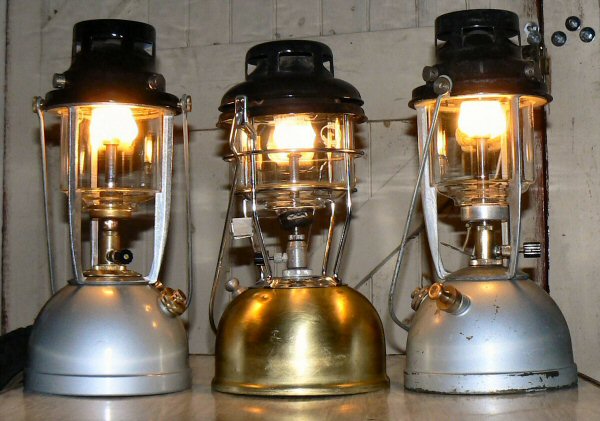
Tilly Lamp - magnificent success - more Tilly Lamp tips needed

I know that this may seem a little odd to you "Tilley types" but I once heard that if you connected a bulb ( not the tulip type but an edison one) to a battery ,that gave out some form of light
Might be worth a try some time

you have no understanding of us Tilley Lamp enthusiasts

I was after the tilly for heat as well as light

but I think I may be better going back to the candles and flower pot

I will experiment this autumn and winter and make some fascinating films about it

Dylan
 
Last edited:
This may be turning into a 'rich vein of trad boating lore' from yesteryear. Dim flickering memory reminds me that some long-lost loved boats had candle brackets. Would I be right in thinking such were called 'sconces'...?

Again, it is not strictly necessary to utilise one or more of SWMBO's precious 'Monty Don' clay pots. In fact it may well be socially and maritally prudent to eschew 'borrowing' such recently-valuable horticultural artifacts, and substitute the just-as-effective but far-more-readily-available clay roofing tile....... easier to stow, too.

And do bear in mind that such a tile, warmed through and wrapped in a piece of flannel or a favourite sailing wooly-pully, makes an excellent foot-warmer placed at the bottom of one's sleeping bag when the evening's festivities are at an end.... and a long cold winter's night beckons.
 
you have no understanding of us Tilley Lamp enthusiasts

I was after the tilly for heat as well as light

but I think I may be better going back to the candles and flower pot

I will experiment this autumn and winter and make some fascinating films about it

Dylan

One of the best gadgets I had in my early sailing life, was a Tilley radiant heater. It worked on the same Tilley/ Primus principle but had a stainless steel orb mantle which glowed red and a dished reflector to direct the heat.
Very efficient and it still retained the entertaining theatrical tension when lighting.
 
This may be turning into a 'rich vein of trad boating lore' from yesteryear. Dim flickering memory reminds me that some long-lost loved boats had candle brackets. Would I be right in thinking such were called 'sconces'...?

Again, it is not strictly necessary to utilise one or more of SWMBO's precious 'Monty Don' clay pots. In fact it may well be socially and maritally prudent to eschew 'borrowing' such recently-valuable horticultural artifacts, and substitute the just-as-effective but far-more-readily-available clay roofing tile....... easier to stow, too.

And do bear in mind that such a tile, warmed through and wrapped in a piece of flannel or a favourite sailing wooly-pully, makes an excellent foot-warmer placed at the bottom of one's sleeping bag when the evening's festivities are at an end.... and a long cold winter's night beckons.

the Tilley lamp experiemnt will continue thjrough this winter and I shall try both the tilley lamp for light and heat

and then try candles/flower pot for heat and LEds for light

I shall make a fascinating film about it
 
Back in neolithic days i used a camping Gaz light & found it gave excellent light & warmth
Must be worth a try

When we were young my dad had a caravan lit by gas through bulkhead mounted lamps. I am a big chap and was never a small child and when I stomped about and "shut" the door the mantles would disintegrate and would be found in crumbled dust on the seats.....

My child hood holidays are remembered fondly in a haze of poor reading light and a repeatedly clipped ear every time i shut the door!
 
Meant to ask can you use the same odourless fuel in a Tilly!?

Coleman liquid fuel has a flash point of -18C, I seem to remember it is SBP 2, quite a volatile solvent not far removed from petrol. Paraffin has a flash point of above 37C.

I have used a petrol stove of similar design to a primus, it didn't have a pump, just one turn of a copper pipe as a burner. Not very controllable and maybe somewhat hazardous.
 
I hate Tilly Lamps. I lost count of the times I was out fishing on a beach in a howling gale and the Tilly (or Anchor, equally heinous device) blew out, never to be re-lit. Now I have a Coleman NorthStar 2000. A few pumps, press the electronic ignition button and "Let there be light". Wonderful piece of gear. I've only ever put unleaded in mine, seems perfectly happy after ten years', admittedly fairly infrequent, use without ever cleaning it!
 
One of the best gadgets I had in my early sailing life, was a Tilley radiant heater. It worked on the same Tilley/ Primus principle but had a stainless steel orb mantle which glowed red and a dished reflector to direct the heat.
Very efficient and it still retained the entertaining theatrical tension when lighting.

I remember seeing those, too. I don't recall us ever having one - but my memory may be at fault, as it would have been 40-50 years ago!
 
Coleman liquid fuel has a flash point of -18C, I seem to remember it is SBP 2, quite a volatile solvent not far removed from petrol. Paraffin has a flash point of above 37C.

I have used a petrol stove of similar design to a primus, it didn't have a pump, just one turn of a copper pipe as a burner. Not very controllable and maybe somewhat hazardous.

Yes. You can use unleaded petrol in the Coleman as well. Suppose its like having a gas stove on board except it gives off warm light and heat. The trouble with paraffin is that it'll stink out even a moderately sized room let alone a small boat. You could try R.O.L.F. oil but ... still very smelly in my opinion despite the name!!
 
Tilly Lamps

One of the causes of smell when using paraffin lamps & stoves is the spilling of paraffin when filling. We used to have cans for oil heaters that prevented overflow when the fuel reached the air intake pipe in the spout. (I still have one somewhere). They are unfortunately too large for the tilly lamp. A smaller can would be excellent, but I have not seen one. It would be useful to know if they are still available.
 
Well I thought Id dig out the old Tilley lantern

Mine is a rather superior gold colour.... none of your common reds

DSCF1251.jpg


I remembered that the old meths torch fell to bit a while back

DSCF1260.jpg


The replacement was rather different

DSCF1248.jpg


DSCF1250.jpg


At first i thought it would be an improvement on the old clip on one but once the lamp is assembled its clear that its difficult to fill. However with the aid of a small syringe a a piece of plastic tube I made a filler
So I thought I'd give it a try

DSCF1252.jpg


after about 3 minutes the meths had nearly all gone and time to give it the fist few pumps.

DSCF1253.jpg


Another couple of minutes later pumped up and burning brightly

DSCF1254.jpg
 
the Tilley lamp experiemnt will continue thjrough this winter and I shall try both the tilley lamp for light and heat

The biggest problem with Tilley lamps on small boats - and I write with a little experience - is the huge amount of condensation they give. A pint of paraffin can give the best part of a gallon of water, so you need a lot of ventilation to avoid getting soaked ... and in winter that can rather negate the heating effect.

I'm a great fan of Tilley lamps, and the heat is lovely, but on the boat I tended to use it for an hour at most. Perhaps some enterprising person could make a chimney with a cowl to fit over the top of the lamp and divert the combustion products outside. Along with quite a lot of the heat, of course ...
 
I'd have thought an over reaction too but I'm not qualified to disagree with a Health Physics Monitor.
I dont know what assumptions you refer to. Other than in countries where its banned gas mantles contain thorium, which is radioactive.
ITYWF that luminous clocks and watches these days generally use phosphorescent rather than radioluminescent paint so probably only your diving watch that should be kept in its lead lined casket.
Could we just put this scare to bed? Mantles used to contain radioactive material, usually thorium. Thorium is an alpha particle emitter, with a small amount of accompanying gamma radiation. The alpha particles won't go through a sheet of paper. The amount of gamma radiation in terms of human health is trivial. The potential hazard is ingestion, but even if you inhale or eat a whole mantle you're not going to give yourself anything nasty - you'd do worse by living in Cornwall. Modern mantles are not radioactive and have not been for many years. The move away from thorium salts was to protect the workers who made them not the punters who bought them. There was also the problem of what to use on lamps in Australia because their ban on all things nuclear (bombs etc) included mantles.

I've got a box of over a hundred old Aladdin mantles, which are radioactive, and they don't glow at all.
 
Could we just put this scare to bed? Mantles used to contain radioactive material, usually thorium. Thorium is an alpha particle emitter, with a small amount of accompanying gamma radiation. The alpha particles won't go through a sheet of paper. The amount of gamma radiation in terms of human health is trivial. The potential hazard is ingestion, but even if you inhale or eat a whole mantle you're not going to give yourself anything nasty - you'd do worse by living in Cornwall. Modern mantles are not radioactive and have not been for many years. The move away from thorium salts was to protect the workers who made them not the punters who bought them. There was also the problem of what to use on lamps in Australia because their ban on all things nuclear (bombs etc) included mantles.

I've got a box of over a hundred old Aladdin mantles, which are radioactive, and they don't glow at all.

gramite is radioactive

the embankment is made of granite

if you pressed your crutch against it for 300 years you would end up sterile

Dylan Winter quoting from the "book of supposedly true facts"
 
Top