

Amulet
Well-Known Member
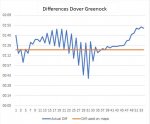
Tide differences at secondary stations and tidal flows are often referenced to the nearest standard port giving a difference on Dover as an alternative. Two different Yachtmaster instructors have told me that it doesn't matter which you use and have insisted that this is correct. However, you will certainly get different answers depending on which you use. If this were not the case, all standard ports would need to experience constant differences on Dover through the lunar cycle. It only takes five minutes with the almanac to ascertain that this is not the case. Indeed it'd be surprising if it were. For SW Scotland tidal maps Reeds gives differences on Greenock followed by differences on Dover in brackets. The values would have you believe that the difference between Dover and Greenock is +01:20. If it were you'd get the same answer for two methods. Back in 2018 I extracted the data and did a plot of the differences between Dover and Greenock for a full lunar cycle. (This was done from Admiralty Total Tide, which agrees perfectly with Reeds.) For that lunar cycle the differences between the two standard ports varied quite a lot. The mean difference was +01:27 with a maximum of +01:53 and a minimum of +00:39. So you could get a difference of 20 to 25 minutes depending on whether you used Dover or Greenock. I'd expect that the tidal wave in SW Scotland is more like that at Greenock than at Dover, and would surmise that you'd be best to use its differences rather than Dover's. It has been amply stated already that these things are approximate and influenced by a wide range of factors, but I feel this is "in principle" correct. I can't remember the exact dates for the graph.


 ), while the log showed only 4.5 knots through the water, and both the plotter and Reeds + paper chart insisted it was slack water!