
Tidal time differences

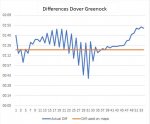
Tide differences at secondary stations and tidal flows are often referenced to the nearest standard port giving a difference on Dover as an alternative. Two different Yachtmaster instructors have told me that it doesn't matter which you use and have insisted that this is correct. However, you will certainly get different answers depending on which you use. If this were not the case, all standard ports would need to experience constant differences on Dover through the lunar cycle. It only takes five minutes with the almanac to ascertain that this is not the case. Indeed it'd be surprising if it were. For SW Scotland tidal maps Reeds gives differences on Greenock followed by differences on Dover in brackets. The values would have you believe that the difference between Dover and Greenock is +01:20. If it were you'd get the same answer for two methods. Back in 2018 I extracted the data and did a plot of the differences between Dover and Greenock for a full lunar cycle. (This was done from Admiralty Total Tide, which agrees perfectly with Reeds.) For that lunar cycle the differences between the two standard ports varied quite a lot. The mean difference was +01:27 with a maximum of +01:53 and a minimum of +00:39. So you could get a difference of 20 to 25 minutes depending on whether you used Dover or Greenock. I'd expect that the tidal wave in SW Scotland is more like that at Greenock than at Dover, and would surmise that you'd be best to use its differences rather than Dover's. It has been amply stated already that these things are approximate and influenced by a wide range of factors, but I feel this is "in principle" correct. I can't remember the exact dates for the graph.
Presentation1.jpg
 
I was not talking about differences between 2 different ports. I was pointing out the differences for the same port ( the port being a major one ie Dover, not a minor one)between 4 different sets of tables.
Find 4 sources of tidal info & compare them all for Greenock & Greenock only. Then see the difference. It can be surprisingly high
 
I was not talking about differences between 2 different ports. I was pointing out the differences for the same port ( the port being a major one ie Dover, not a minor one)between 4 different sets of tables.
Find 4 sources of tidal info & compare them all for Greenock & Greenock only. Then see the difference. It can be surprisingly high
Ah. As far as I can see Reed's, Easytide and ATT all agree and are likely to be the best source since they use all the available harmonic data. Other sources use different data or not all the harmonics I believe. I think that UKHO licensing makes it difficult for any other source to match them. I could do so using my ATT license but it would be a blatant breach of my license. I also assume that the fact that easytide and some third party sources only predict for a week in advance is because that's all that their license for the UKHO data allows. It may be that UKHO licenses shallower data - i.e. only some of the first harmonic constants - on a different basis allowing third parties to produce less accurate predictions. However someone more knowledgeable may correct me. Regarding my previous message - if someone built a system that simply did everything on Dover differences you'd also see variation. I think the UKHO should be funded to put the data into the public domain. If the USA can do it so should we. You should not, however, curse the UKHO. It is a matter of funding. I'm sure they'd be glad not to have to sell the data. (And, by the way, you do also save a lot of money by putting the data in the public domain. You can close down your entire licensing department and employ a tenth of as many lawyers.)
 
Why does all the detail need to be in the public domain?
For advance planning, we only need to know roughly when HW is.

But a programme of yacht races, we expect to see a tide time on each date for the year, 'about two PM-sh' would do the job, but look silly.

I can get the dates of full moons for the year 2025 or even 2050 very easily and give you the broad brush picture of Portsmouth tides.
HW Portsmouth, Christmas 2049, bout mid day.
 
Ah. As far as I can see Reed's, Easytide and ATT all agree and are likely to be the best source since they use all the available harmonic data.
When they are actually sailing, I would bet a lot of people use the tidal data on their chart plotter. (Much quicker than nipping below to get reeds to look it up) I have already found differences between the data on my plotter & some Reeds main ports. If one has to make a quick change of course en route ( Say, due to a change in weather) & makes a decision to nip over a bar somewhere ( possibly on a falling tide) & that data is wrong on the plotter, that could have consequences.
People need to be aware
 
When they are actually sailing, I would bet a lot of people use the tidal data on their chart plotter. (Much quicker than nipping below to get reeds to look it up) I have already found differences between the data on my plotter & some Reeds main ports. If one has to make a quick change of course en route ( Say, due to a change in weather) & makes a decision to nip over a bar somewhere ( possibly on a falling tide) & that data is wrong on the plotter, that could have consequences.
People need to be aware
HW times need to be quite a long way out in most places to alter the depth of water very much within the hour either side.
And the weather can change things significantly anyway.
People should take care about believing the tidal info on plotters, for instance the tide predictions for Portsmouth are for the tide gauge in the Navy base, they are not accurate up at Portchester or anywhere outside the entrance, likewise the streams can be miles out if you zoom in too much.
 
People should take care about believing the tidal info on plotters

People should beware of putting excessive faith in any tidal predictions! Whether they be plotters, websites, books or charts, they're still only predictions - approximations with limited geographic validity, and taking no account of all the other factors that affect water depth and flow.

Sometimes you just have to raise your eyes from the books and gadgetry to look outside the boat to observe what the water is actually doing!

And if you're using tide predictions to get over a cill, use the tide to get somewhere, or whatever, you need to build in enough flexibility in your plans to allow for the tide being a bit earlier/later/higher/lower/faster/slower than predicted.

Which puts me in mind of a time off Brittany a few years back, where the GPS showed we were doing 14 knots over the ground (confirmed by the rocks flying by :eek:), while the log showed only 4.5 knots through the water, and both the plotter and Reeds + paper chart insisted it was slack water!
 
When the tide is low in Portsmouth, the pilots on the ferries aren't getting the depth from a Raymarine plotter or an Almanac, they're asking QHM for a tidegauge reading.
I suspect HMS Big Liz sends a boat ahead with a lead line or two...
 
Top