
Thin wire joinning

PabloPicasso

Well-Known Member
Joined
12 Feb 2010
Messages
2,976
Visit site
A few years ago I found joining very thin NMEA 0183 cables a bit problematic. There seemed to be no easy way of making reliable connections. N2K has resolved a lot of the issues here, thankfully.


But I have fitted a new low power LED masthead light and the cables are very thin. Again, too small to get a good connection with crimps. There is also not enoigh space in the base to fit three crimp connectors easily.

What is the proper way to connect ultra thin electric cables on a boat?
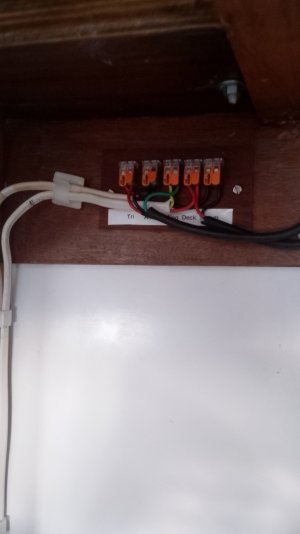
 
Are you connecting inside the boat? If so this is how I do it

Spoiler alert Not approved by certain people here but works just fine. Clean simple, stable as the connections are in a nice warm dry place.
 

Attachments

  • IMG_20251230_135029.jpg
    IMG_20251230_135029.jpg
    184.5 KB · Views: 65
Are you connecting inside the boat? If so this is how I do it

Spoiler alert Not approved by certain people here but works just fine. Clean simple, stable as the connections are in a nice warm dry place.
Wago 221 has a minimum cable size of 24 AWG (0.2 mm2). If there is any motion, they tend to either slip or break the wire in the smallest sizes. that said, I used WAGOs to connect my masthead light 5 years ago (since I had to extend the base above the wind instrument, I created a nice big, dry wiring box and provided for strain relief).

As for the OP, WAGOs are bigger than crimps. Will the crimps fit if you stagger them?
 
Are you connecting inside the boat? If so this is how I do it

Spoiler alert Not approved by certain people here but works just fine. Clean simple, stable as the connections are in a nice warm dry place.
Nothing wrong with Wagos, in the right place. The issue some people here had with your installation is the lack of appropriate support. But you know best.
 
Nothing wrong with Wagos, in the right place. The issue some people here had with your installation is the lack of appropriate support. But you know best.
You are just guessing it is inadequate - and it is not for all the reasons that I explained - but of course your guesses are better than actual fact! Come down and have a look for yourself if you don't believe me.
 
Possibly. But not fun at the masthead. But yes.
It can be done, I used solder and some liquid insulation to fix a windspeed indicator wire up there.
My only hiccough came when an Instructor from a nearby Coast Guard (US) Training Centre arrived in a massive rib filled with students and to show them just how good a helmsman he was, he zoomed-up at high speed and threw a 180* turn to kiss neatly up against the hull of our anchored boat.
When he enquired of Lesley "Good afternoon madam, is the Captain on board?" Rather than her answering verbally, Les silently pointed upward, towards me, clinging desperately to the rigging at the wildly swaying masthead. At which point the guy muttered "Ah, he looks busy... I leave him to it for now." before departing far more slowly; while I couldn't see for myself, Lesley reckoned that the expressions on the students' faces were a picture, all striving desperately not to burst out laughing.
 
I'm not convinced that IDCs are so bad, and nor that they aren't routinely used by many, perhaps without realising.

Ethernet connectors, such as RJ45 are all IDCs and used on every radar, marine or not, and of course in all the industrial and office buildings all over the world. I everyone here has some - in the BT home hub and connecting the fibre box to the home hub at home, and for several functions on board.

And in your PC and TV, ribbon cable is connected with IDCs. Sure your chart plotter doesn't use them?

Also in your car, where IDCs are widely used nowadays.
 
Last edited:
Top