The Wide Wide World of Through Hulls!

The Real Flipper

Well-Known Member
Joined
16 Feb 2022
Messages
185
Visit site
Eventually I will learn to simply not look anywhere I have not carefully looked before, because every time I do- issues!
LOL.
So this time it's through hulls. Now I was told by vendor and surveyor that the through hulls were done in 2019, new ones fitted.
Now I look closer and they actually don't look so swell.
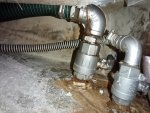
The first one is in the engine compartment and seems to have rust.
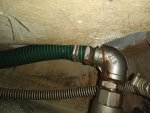
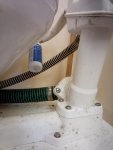
The second two are accessed through a little 4 inch by 6 inch cut away under the heads, and they don't look so swell either.
By the way the heads stinks and I keep the door closed because it's surprisingly strong. The boat has no holding tank, as you can see, from the heads out.
The second two look like a nightmare to replace as its only possible to get one hand in there at a time and there is no access from any other direction that I can see without of course removing the engine.
Not to get ahead of myself, what do you guys think?
Once again, any suggestions much appreciated :)
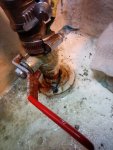
 
Usually ships side valves are Brass or bronze though some ball valves are a chrome type finish. Unfortunately many have steel hand wheels or levers that often become rusty. Are your valves brass/bronze or steel. Is the rust and discolouration starting at the handles? Do the valves operate smoothly between open and closed.

Any chance of pictures?
 
We crossed..... Thanks for the pictures. The smaller valve does have a rusty handle which should clean up It seems it has also been used as an earthing point? The larger ball valves appear fine so long as they operate.
The rust on the toilet fittings suggests leaks at the joints and this might be the source of the smell. I see that the discharge from the toilet goes straight to the ship side valve with no anti syphon loop . There could be problems with backflow here when heeled if this is on a yacht where the toilet seat is only just at or above sea level.


Ball valves should be operated from time to time in order to keep free.
 
Probably alright but dependes on your charachter,like it looks abit of a mess al round so as a detailed you might take all the skin fitting out and clean up and check and rebed.Possibly it might be worth consideration not trying to go boating this year and generally get stuff in good condition
 
The WOG 1000 stamp (water oil gas ) 1000 psi are usually all 316 stainless, ball included. Just the handle 304. So good valve choice for saltwater. Agree brown stain looks like exess sealant run . Skin fittings .....well thats a different matter would need to investigate further
 
@ Vyv,
Am I correct in thinking that bronze and SS316 are close enough to each other on the galvanic table that these valves would be ok on bronze thru hulls, assuming that’s what they are?
thanks,
Nick
 
Last edited:
@ Viv,
Am I correct in thinking that bronze and SS316 are close enough to each other on the galvanic table that these valves would be ok on bronze thru hulls, assuming that’s what they are?
thanks,
Nick
Yes I think you should be quite safe. There is a long history of copper and stainless steel in combination in seawater with no particular problems. Copper is slightly anodic to bronze, which suggests that the bronze/stainless combination is safe. Many bronze propellers on stainless shafts are not protected by anodes and last for decades.
 
The WOG 1000 stamp (water oil gas ) 1000 psi are usually all 316 stainless, ball included. Just the handle 304. So good valve choice for saltwater. Agree brown stain looks like exess sealant run . Skin fittings .....well thats a different matter would need to investigate further
+1, skin fittings look like they are original items, definitely not replaced 2-3 yrs ago. How old is the boat, what are they?
 
+1, skin fittings look like they are original items, definitely not replaced 2-3 yrs ago. How old is the boat, what are they?
I was just about to add the same. If I were in your shoes I would be checking out the through hulls at the next lift out.

Mine were 20 year old and were showing signs of dezincification.
 
Y Many bronze propellers on stainless shafts are not protected by anodes and last for decades.

When my prop lost it's electrical connection with an anode it had noticeable decay after just 1 or 2 seasons.

A previous insurance survey picked up on a stainless machine screw to hold a bronze cutless, and I was required to change it. Since then I have seen a similar age stern tube on the same boat (with stainless screws) crumble.

Not convinced I would want a mix of metals unprotected after seeing these - perhaps it depends on exactly what mix of 'yellow metal' is in the circuit?
 
So the consensus seems to replace the skin fittings. Funny now I remember being told repeatedly they were new through hulls and looking at the parts on the outside of the boat and noticing they were obviously old. This is going to be a joyous job because some of them are actually fibreglassed in. The one off of the little v-birth sink for example. So I wonder how this might be done, for example cutting them out with a dremmel, but then not damaging the through hulls?

I'm planning to pull the boat out in the spring to fully strip the hull down and do a new antifouling, that's not on top of 6 other layers of anti fouling and prone to chipping when they power wash it. And to deal with some osmosis issues. Anyway so if the through hulls don't actually look like they are leaking, and that really is just thread sealant then I should be able to clean it up somehow and keep an eye on it. Any recommended cleaners for this job?

We crossed..... Thanks for the pictures. The smaller valve does have a rusty handle which should clean up It seems it has also been used as an earthing point? The larger ball valves appear fine so long as they operate.
The rust on the toilet fittings suggests leaks at the joints and this might be the source of the smell. I see that the discharge from the toilet goes straight to the ship side valve with no anti syphon loop . There could be problems with backflow here when heeled if this is on a yacht where the toilet seat is only just at or above sea level.

Ball valves should be operated from time to time in order to keep free.

I'll check the valves and see if they move OK.
Also I didn't mention but the hoses are really long and go into a space under the sink where they each form a big loop before going to the through hulls.
I suppose this is the 'anti syphon loop'? I'll take pics next time to make sure.

Now if I can figure out how to track down that smell! There are areas in the boat for example at the chart table station where a panel on the side can be removed to access wiring and I really notice the smell coming out of there as well. That space runs down to the bilge I assume. I need to add a holding tank anyway, eventually so I've just been keeping the heads door closed and the heads unused. But I will have to revisit this...

Also yeah there is an earthing point. The wire is cut though so I have another job on the list to trace that wire. Behind the engine there are a couple wires grounding so I'm hoping it was just re-routed. Fingers crossed!
 
IMHO There’s no reason of justification to connect electrically to through hulls. Decent quality bronze or DZR ones not connected electrically to anything else don’t need galvanic protection.

Some of the hoses in your pictures look decidedly dodgy and some don’t seem to be double clipped. (Best practice is to double clip all underwater hoses is my understanding.)
 
The thru hulls are the skin fittings. The valves are the bits on the inside that screw onto the thru hulls.
Depending on what they’ve been installed with, you should be able to unscrew the Valve from the thru hull.
If they’ve been assembled with Sikaflex then it can be a challenge!
 
Oh, and when you re-install the valves, make sure you can turn the handle!
Your second image looks like it has the handle directly beneath the hose tail of the adjacent valve, so I’m not sure you would Be able to close it anyway!
 
When my prop lost it's electrical connection with an anode it had noticeable decay after just 1 or 2 seasons.

A previous insurance survey picked up on a stainless machine screw to hold a bronze cutless, and I was required to change it. Since then I have seen a similar age stern tube on the same boat (with stainless screws) crumble.

Not convinced I would want a mix of metals unprotected after seeing these - perhaps it depends on exactly what mix of 'yellow metal' is in the circuit?
Most fixed propellers are made from manganese bronze, which is actually a 60/40 brass. Cutless bearing housings are also brass. Bronze resists corrosion far better, e.g. bronze cannon recovered from wrecks after centuries of immersion.
 
Top