
Kelpie
Well-Known Member
I was worried about that but no, I can't say they do. The induction zone is quite small. Annoying when you use a big pan of course.Do the pan clamps get hot from all the inductive magic moon waves flying around?

I was worried about that but no, I can't say they do. The induction zone is quite small. Annoying when you use a big pan of course.Do the pan clamps get hot from all the inductive magic moon waves flying around?

Assume Butane as a cooking gas. The low limit for combustion is 1.6% in air. The upper limit it 8.4%. You need to have you gas leak percentage in air between these figures or you won't get a big bang. What you need is a really bad gas leak then you are totally safe ?Next thing someone will be telling me not to try and heat up a tin can, or boil an egg in a microwave. Oddly enough there are some meals I do entirely with a microwave to avoid firing up the primus or alcohol burners.
Another poster did mention a 2 burner alcohol stove, and it's good news that a born again Origo 3000 is back in production in Germany. It's called the Spritzcooker 3000. I did think about buying one, or the 1500 single burner version, BUT found a French alcohol burner (It's a real good classic from Napoleons days), for only 20 quid, plus a fiver for gold paint, as it was a tad on the rusty side!
Gas hobs might not impact the global greenhouse effect, but gas explosions sure do, as does the need to install all that gas sniffing, auto shut off and bomb proof vented and drained gas bomb locker. I've been a tad too close to both petrol vapour and Propane gas explosions on boats, so I'm not going to use either methods of trying to kill myself or my passengers.

Yesterday I brought to boil 1 liter of water in a 1200W jug in 3 minutes. (I hope my maths are OK here (not allowing for losses))
1200W at 240V = 5 amps or
5 X 240/12 = 100amps at 12V
Therefore in 3 minutes I used 100amps/20 = 5Ah
Surely that is not a lot when my battery bank will be 560Ah?


There’s more to cooking than raising the temperature of food. Efficiency is nice but I’d rather have tasty meals. Gas hobs on boats have effectively zero impact on global gas usage. Granted it can be hard to source but in my opinion worth it.
 you have but burning Propane for cooking produces a surprising amount of water during the combustion process.
What do you mean by a suitcase generator ??
Hope you are not trying to blow up your boat with anything that drinks petrol, or does not have on overboard exhaust system.
As you say, not allowing for losses. Simpler to allow for losses and use the rule of thumb guide, dived the AC watts by 10 to get DC amps. Your 1200W kettle will draw about 120A from the batteries. 6ah for the 3min.
560ah is your stored power, of which you wouldn't look to use more than 50% and the 560ah will decrease over time. Stored power is more relevant to how long you can survive without any power generation. More importantly is how you replace/keep up with what you are using. If you fall short of the amount of power you use, no matter how big the battery bank, your batteries will go flat.

Hello Clive
At our club EFYC there is a 30ft Farr set up entirely for electric living. He claimed it has 1000w of solar on a gantry (I doubt it is that much) with electric induction cooker etc. he bought the boat as is and I can not comment on the success of the whole idea as I know he has not done much living on board. However I would agree that avoiding a gas installation will make your boat more safe and save on certification costs for the gas system". So yes go electric /solar with spirit stove back up. Yes it is a bit hard to avoid petrol storage. ol'will

I'd rather not have gas and if I find I can do without it I'll ditch it. Maybe there's no hurry to plumb it up? Good thinking!HI Clive
My only experience of gas is in the requirement for our club marina that a boat must have a certication for the gas system safety. This part of a program to ensure safety of all boats in the marina. (club insurance thing I imagine) therefor I imagine 2 rocks marina will also require same. Does this mean you are going gas? I would avoid if possible although of course many boats have gas. I would think a mix of spirit stove and electric might suffice for you. However much depends on your sailing style. I know you want to set up for long term self sufficient cruising. By contrast for my little boat I seem to to sunk into short sailing (racing) habit (not what I envisaged when I bought it) so have removed the single burner spirit stove and outboard. So at least no fire risk. So yes I would advocate you launch the boat and get some use out of it when with experience you will find what you really want. ol'will
Did you read comment #4? (I think I covered your point there)
What do you do when you run out of LPG ?
), so as long as we have fresh food stuff we are able to sit in splendid isolation - the fresh fruit and veg runs out long before the gas.
We carry 2 x 8kg cylinders, plus a little 1kg emergency one. After 20 years - we have not yet run out. We know the tare weight and know how much we have left. Admittedly we are not sailing round the world, non stop. Our primary requirement is fresh green vegetables and fresh fruit (to keep scurvy at bay
Now what is the alternative to fresh fruit and veg, Wombok cabbage soon gets boring. We can be self sufficient in protein, fish, crays - but not veg and to a lessor extent, fruit
There are factors other than power/fuel that dictate a return to civilisation if you want to live in the 21st Century.
For us gas is not the major determinant.
Jonathan
I'd rather not have gas and if I find I can do without it I'll ditch it. Maybe there's no hurry to plumb it up? Good thinking!
Just a further thought! If I don't install LPG gas the self-draining locker for the LPG bottles would make a perfect locker for the outboard petrol.
for whom 2 showers a day is a birthright.

 ). Don't worry - you will get used to it.
We heat hot water from our 720w solar bank that supplies the domestic batteries. Once the batteries have gone to float we can use surplus solar capacity. We have a 27 litre vertical calorifier. The vertical part is important. It can be heated by the engine but it also has a 1200w 220v immersion heater. We can heat hot water from the diesel generator. We do this if we are running the generator to make water from our 220v RO system. Otherwise we use solar.Well I've got my Daughter, S-I-L and kids coming up for the w/e so I spent a day cleaning up the galley and shower/toilet (and small washing machine).
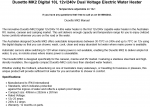
I am going to heat my water in a Duetto HWS. I know people from the UK would be aghast as they seem to go for calorifers on their auxiliary motor. I don't want to start the Perkins up all the time so I will have to rely on the Gentrax 3.5kWinverter generator. BUT I'm working on a solar powered HWS! I've got all the parts including pump and 17W solar panel. One day I'm going to put it all together
View attachment 122719
View attachment 122720
We heat hot water from our 720w solar bank that supplies the domestic batteries. Once the batteries have gone to float we can use surplus solar capacity. We have a 27 litre vertical calorifier. The vertical part is important. It can be heated by the engine but it also has a 1200w 220v immersion heater. We can heat hot water from the diesel generator. We do this if we are running the generator to make water from our 220v RO system. Otherwise we use solar.
The 1200w immersion, heater if fed from a 110v source, becomes a 300w immersion heater. This is quite doable for 720w of solar. We use a cheap 110v inverter with a changeover switch and a 1hr timer to supply the immersion heater. A couple of hours of running in the afternoon is giving us sufficient water for two showers and washing up each day. The vertical calorifier is vital for this set up since it allows heating of just the top of the tank. Stratification is your friend.
If you have a large horizontal calorifier, this won't work unless you have a lot of solar and the ability to feed the immersion heater at 220w simply because the sunny part of the day is not long enough to heat all the hot water in the calorifier at reduced output.

560ah is your stored power, of which you wouldn't look to use more than 50% and the 560ah will decrease over time. Stored power is more relevant to how long you can survive without any power generation. More importantly is how you replace/keep up with what you are using. If you fall short of the amount of power you use, no matter how big the battery bank, your batteries will go flat.
Did you read comment #4? (I think I covered your point there)
What do you do when you run out of LPG ?