The ideal blue water yacht

Some say that bluewater boat is the one you have and actually untie the lines and cruise away. I am still not 100% sure my Shipman 28 is the one. At least she has skeg hung rudder...
You’ll be perfectly safe then...:giggle:
We, on the other hand are doomed. Our rudder is a spade design with only the tinyest protection near the hull.
 
That sums it up for me but I don’t understand Coopec’s ‘like’ as it contradicts what he said before...

I call out fin keeled boat a ‘moderate fin’.

I’m not sure whether encapsulated or not really alters the price of fish. It’s how well it’s secured that matters. After all you could encapsulate weakly and engineer the bolt on extremely strongly. Making generalisations doesn’t help. (But I seem to have said that before.)

I "liked" it because I realise now we all have different definitions of what a "fin" keel is and I broadly agree with laminar flow's definitions of "fin" keels and " traditional with a deep forefoot, cutaway forefoot or moderate long keels "

I trust that clears up your confusion. (If you have any further concerns regarding keels I'd be happy to help) (y)
 
I "liked" it because I realise now we all have different definitions of what a "fin" keel is and I broadly agree with laminar flow's definitions of "fin" keels and " traditional with a deep forefoot, cutaway forefoot or moderate long keels "

I trust that clears up your confusion. (If you have any further concerns regarding keels I'd be happy to help) (y)
Well that clears that up then. It appears we were all talking at crossed purposes all along. Imagine that happening on an Internet forum. :rolleyes:
 
Designs have become so extreme, we really need to standardise a few extra categories to define them, eg twin versus bilge, shoal versus full, stick an intermediate between full and fin where the former is built into the shape of a v-ed hull and the latter is simply flat with a bolted on plate. As I understood coopec was referring to.
 
Designs have become so extreme, we really need to standardise a few extra categories to define them, eg twin versus bilge, shoal versus full, stick an intermediate between full and fin where the former is built into the shape of a v-ed hull and the latter is simply flat with a bolted on plate. As I understood coopec was referring to.

I agree with you.

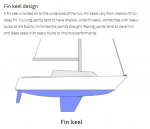
According to this article my definition of a "fin" keel is wrong. But if the "fin " keel was 6" (20%) longer would it still be considered a "fin" keel?

Screenshot_2020-11-26 Keel design - options to consider when choosing a yacht - Safe Skipper B...png
Keel design - options to consider when choosing a yacht - Safe Skipper Boating & Safety Afloat Apps for phones & tablets
 
Actually, yes ... something along the lines of where are you going and you must be very brave to be going all that way in this etc., etc ... across that big scary ocean in that little boat... ... The internet does not hold a monopoly on nonsensical chatter.


Willy Ker told a good story.

He had his Contessa 32 shipped across the Rockies from British Columbia so he could sail down through the lakes.

As the boat was unloaded into the water, two spectators were talking:

One said: "That looks an handy boat"

His mate said: "Yes, but far too small for the Great Lakes"

The previous season he had rounded Cape Horn, sailed in the far South and then up the Atlantic Seaboard of America to beyond Alaska. Thus sailing in Arctic and Antarctic waters in the same year.

?

.
 
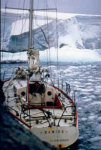
I thought these three young guys did well.

Screenshot_2020-11-26 The Voyage Of The Damien.png

By Creed O’Hanlon

In May, 1969, a small sloop named Damien slipped its mooring within the French harbour of La Rochelle, on the Atlantic coast of south-west France, and made its way seaward through the 12th century fortified stone walls that protect its entrance. Once across the narrow channel between the harbour and t............

The Voyage Of The Damien – Small Craft Advisor Blog
 
I had a quick scour of the internet, between scraping the rust spots off my steel, and came to the conclusion that the first layer or two (of the internet) is full of the same old cruft being recycled 10 times by fairly superficial and uninformed copy and pasters/graphic artists.

For example, using the RM Yacht boats as misleading examples of "bilge keelers".

I'd call an RM Yacht, a 'twin fin keel' and be pedantic about the difference between bilge and twin keelers.
As the boat was unloaded into the water, two spectators were talking:

One said: "That looks an handy boat"

His mate said: "Yes, but far too small for the Great Lakes"
And the third who was a member of YBW added, "And watch out for the coral reefs".
 
Last edited:
I have owned a true long keel , a bilge keeper, a fin and spade and a long fin . They each have had their limits ..?

Reading as a kid the “ received wisdom” of Haslar, Knox Johnson , Shane Acton, ridgeway, Blythe and indeed Chichester , Rose, Slocum, Gerbault, Pigeon, Hiscock and on ( and on and on?) it became abundantly clear that the right mental attitude and preparedness is far more important that the size or shape of the boat, per se..
More important to Just Go, rather than Go Right..
And all types of boat are blurry unpleasant to repair in hot humid places when you bump into things. Or equally when things “ oops, so sorry” bump into you ...?

Actually , on this last basis, my one ton bilge keeler was probably the most appropriate blue water boat of all. Because it could be wiggled , beached and dragged up into impossibly shallow secure spots when hurricanes approached ( as they did, again and again and a third time ) and thus avoid all contact with anchor draggers, and marinas and docks and pilings all coming loose and moving around en mass and then piling up in a terrible , mutually destructive tangle..
Funny old logic though innit?
 
Last edited:
I have owned a true long keel , a bilge keeper, a fin and spade and a long fin . They each have had their limits ..?

Reading as a kid the “ received wisdom” of Haslar, Knox Johnson , Shane Acton, ridgeway, Blythe and indeed Chichester , Rose, Slocum, Gerbault, Pigeon, Hiscock and on ( and on and on?) it became abundantly clear that the right mental attitude and preparedness is far more important that the size or shape of the boat, per se..
More important to Just Go, rather than Go Right..
And all types of boat are blurry unpleasant to repair in hot humid places when you bump into things. Or equally when things “ oops, so sorry” bump into you ...?

Actually , on this last basis, my one ton bilge keeler was probably the most appropriate blue water boat of all. Because it could be wiggled , beached and dragged up into impossibly shallow secure spots when hurricanes approached ( as they did, again and again and a third time ) and thus avoid all contact with anchor draggers, and marinas and docks and pilings all coming loose and moving around en mass and then piling up in a terrible , mutually destructive tangle..
Funny old logic though innit?

Where did you come across hurricanes?

I read a lot of Alan Lucas's books and he said he has been caught out in a cyclone (hurricane) in North Queensland and he has had to seek shelter in a mangroves and tie the yacht up to branches/trees and that is when he emphasized the importance of large , strong deck cleats
 
Caribbean
Two real bad b’stards Luis and Marilyn thankfully waaasy back..
And next year the Atlantic seaboard ( Chesapeake bay)
Then , later , Florida but different boat ,actually much more worrying with a deep keel because ‘ we are all in this together ‘.. as it were..
The only advice that works , IMHO is just simply Don’t Be There. Everything else is a percentage game of your luck/other people’s luck !

That painstakingly, lovingly put together blue water capable boat has taken just too long to put together to risk trashing all those dreams and happy memories ?
 
Well I'd hardly call that a fin keel! Is it encapsulated or bolt on?

This is what I meant by a fin keel (lousy photo I know but I didn't have much choice as most of the fin keels
have snapped off?)]

What about this one!! WOW!!

View attachment 103743

Yawn. The bottom picture is of course a “Formula 1” equivalent race boat. But in fact, percentage wise I suspect a higher proportion of Open 60s have successfully sailed round the world, south of all the great capes, than probably any series of cruising yachts.
 
Dont
Yawn. The bottom picture is of course a “Formula 1” equivalent race boat. But in fact, percentage wise I suspect a higher proportion of Open 60s have successfully sailed round the world, south of all the great capes, than probably any series of cruising yachts.
Don’t confuse the issue with facts. :rolleyes:
 
All this discussion with regard to to bluewater boats and I am surprised nobody has mentioned Amels. Purpose built bluewater cruising boats designed for a couple to sail around the world as an off the shelf production boat. Not my cup of tea but lots of people love them
 
Last edited:
I agree with you.

According to this article my definition of a "fin" keel is wrong. But if the "fin " keel was 6" (20%) longer would it still be considered a "fin" keel?

View attachment 103764
Keel design - options to consider when choosing a yacht - Safe Skipper Boating & Safety Afloat Apps for phones & tablets
Yes, as the rudder remains a separate entity it would still be a fin keel (see Van de Stadt's Zeefalk). A fin keel boat with a long fin.

Biglge keels and twin keels are indeed different breeds. I once owned a M. Griffiths Water Witch, she is a bilge keeler in that she had a centre ballast keel and steel bilge plates ie. three keel appendages. In this context there are also bilge keelers with a long centre keel.

A twin keel boat has two separate, laterally arranged (ballast) keels.

In context of the ongoing blue water boat discussion: astonishingly, they all seem to float, regardless of water depth, or salt content.

I can feel some insightful automobile analogy coming on ... somewhere ... and just to conclude a previous tread on a similar topic: It is quite obvious that a Ferrari must have a Rocna anchor, a stainless one of course. Just sayin'.
 
Or, “Are you really going to sail to the Pacific in that?”
.
My wife and I were sitting in the cockpit of our Twister in a port in Brittany when a group of old people (old but probably no older than us two) disembarked from their coach and wandered along the quay on a tour of inspection. One of the old ladies, reconising the red ensign, asked if we had really crossed the Channel in that tiny boat. When we said we had, she told the others and they all crowded round taking photos and congratulating us!
 
.
My wife and I were sitting in the cockpit of our Twister in a port in Brittany when a group of old people (old but probably no older than us two) disembarked from their coach and wandered along the quay on a tour of inspection. One of the old ladies, reconising the red ensign, asked if we had really crossed the Channel in that tiny boat. When we said we had, she told the others and they all crowded round taking photos and congratulating us!
Did you anchour at night?
 
Did you anchour at night?
I have been asked that quite frequently and I always assure the interested party that of course we do, as the boat has no headlights and thus we have to keep very regular daylight hours to see where we are going and to avoid falling asleep at the wheel. Oh, and do be safe when you pull over for the night and put out the safety triangle to warn others.
 
Top