The ideal blue water yacht

And in the 'expedition yacht category, there isn't a single steel boat - they're all aluminium.

Not a single boat in any category in the budget range of the average ocean cruiser I've met and sailed with. (The Malo 36 might just squeeze in?). Plenty at the £1m plus level though... I don't want to be too cynical, but the author of that article know who pays their salary and which market that publication is aimed at.


I wonder how much the manufacturers of those boats had to pay to get a mention in the article. ?

I can't think of any steel production yacht: I'm sure they would be too expensive.
 
These days, you'd find most of those things on a decent production yacht.
...and don't forget, not all of us are buying new(ish) production yachts and using them 'as is'.

Ours is a 'boatyard queen' (on the hard since 2014!) so I am sympathetic towards Coopec's situation also!

But since we've taken ownership (1 year) we're undertaking a very complete refit, so will also be in the position of knowing where/how everything goes and upgrading pretty much everything. I've already rebuilt a lot of structural elements (engine bearers, glassing over structural floors, etc.) and will be tackling things like (rotten) bulkheads too. In terms of equipment, we'll be refitting everything we need, or can afford, for so-called 'bluewater' work.

So knowing the boat and having the best-tailored kit on boat also cannot be reduced down to a AWB vs. 'custom' debate. Ours will be a very 'custom' and largely DIY (re)-built AWB!
 
(y)

You sail in a more robust place which is important. Much of the Northern Hemisphere is suburban in sea terms.

We have cruises in company across the Atlantic where nobody is far from rescue or a helping hand. Even going across in groups, the average size of boat in the crocodile is about 50ft. Look, people say, all those modern boats going offshore! It would be of greater interest to the average bloke if they all went in 30 footers.

Setting off from Australia West or East looks like a proposition where I would think twice about a twitchy boat with two rudders a saildrive and seven foot, catch all, club footed, thin keel.
Not impossible but you have to think what and why.

.
I've read books about people who have sailed around Australia and they say a lot of it hasn't been surveyed since Captain Cook salied the waters and some "islands" are charted 3km out of place.

You can easily be 500km from civilization and the wind can come from nowhere. You can't race for port because there probably isn't one. If your anchor gets stuck you can go over the side (where great white sharks and crocodiles are) It is totally different to sailing in Europe (so they tell me)

Screenshot_2020-11-21 - accuracy_and_reliability_of_charts pdf(1).png
 
Last edited:
Not a single boat in any category in the budget range of the average ocean cruiser I've met and sailed with. (The Malo 36 might just squeeze in?). Plenty at the £1m plus level though... I don't want to be too cynical, but the author of that article know who pays their salary and which market that publication is aimed at.

To be fair that is in Yachting World, rather than YM or PBO. YW is intentionally positioned higher up the wealth (or aspiration) scale to differentiate from the other titles. And if that is not enough the Quarterly Superyacht supplement gives a peek into the boats starting 30m up ;-).
 
I've read books about people who have sailed around Australia and they say a lot of it hasn't been surveyed since Captain Cook salied the waters and some "islands" are charted 3km out of place.

You can easily be 500km from civilization and the wind can come from nowhere. You can't race for port because there probably isn't one. If your anchor gets stuck you can go over the side (where great white sharks and crocodiles are) It is totally different to sailing in Europe (so they tell me)


Totally agree.

I posted a couple of weeks ago about crocodiles sited in our harbour let alone hippos and bull sharks.

Sailing in the UK can be day sailing from port/safe anchorage to port/safe anchorage East coast of Africa that is not possible. The closest port to me is 80 mn away then over 200 nm so no day sailing from port to port.

Having sailed in the UK both before leaving and during visites back I know sailing in Europe is different. Once you go north there are very few repair facilities thats why those crossing the Indian Ocean head for Richards Bay for the repair facilities,
 
Totally agree.

I posted a couple of weeks ago about crocodiles sited in our harbour let alone hippos and bull sharks.

Sailing in the UK can be day sailing from port/safe anchorage to port/safe anchorage East coast of Africa that is not possible. The closest port to me is 80 mn away then over 200 nm so no day sailing from port to port.

Having sailed in the UK both before leaving and during visites back I know sailing in Europe is different. Once you go north there are very few repair facilities thats why those crossing the Indian Ocean head for Richards Bay for the repair facilities,

I didn't know about the East coast of Africa 'til the other day. I was having a bit of fun on the computer working out where I would sail. I figured I would head for Dar es Salaam and then work my way down the coast to Durban dropping into every port on the way. But there aren't any.....! :rolleyes:
 
I didn't know about the East coast of Africa 'til the other day. I was having a bit of fun on the computer working out where I would sail. I figured I would head for Dar es Salaam and then work my way down the coast to Durban dropping into every port on the way. But there aren't any.....! :rolleyes:

Some visitors I met in RB came direct from Seychelles to Richards Bay in 10 days sailing.

You are correct there is only Maputo, Richards Bay then Durban but there are some very nice/quiet anchorages and madagascar is very nice to visit but very little facilities for water and food and no facilities for repair. So you must be totally self sufficient sailing in those areas just like the northern west coast of Australia.
 
28 years ago I bought a flooded interior 10 year old boat that was dismasted and windows were missing.
A few people had owned it in this condition with aspirations of rebuilding but failed.
I Borrowed the money to buy it. It was very cheap.
I didn't set out to find a heavy long keel, it was more a case of what's the biggest boat I could find with what I could afford .
Since it had its rudder, shaft and skin fittings I was able to launch the boat after a little work and put it in a small boatyard on the pontoons as far easier to get on and off .
Took around a year to de seize the engine and fix,repair or replace anything else that made it useable as a motorboat.
Probably took 4 years to source a mast, sails and rebuild the interior as finances allowed.
I thoroughly enjoyed all of it and learnt so much by lots of reading and talking to others.
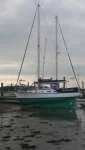
28 years later I love my boat and can visualise in my mind how Every part of it looks, is put together and works.
20190910_181939.jpg
 
28 years ago I bought a flooded interior 10 year old boat that was dismasted and windows were missing.
A few people had owned it in this condition with aspirations of rebuilding but failed.
I Borrowed the money to buy it. It was very cheap.
I didn't set out to find a heavy long keel, it was more a case of what's the biggest boat I could find with what I could afford .
Since it had its rudder, shaft and skin fittings I was able to launch the boat after a little work and put it in a small boatyard on the pontoons as far easier to get on and off .
Took around a year to de seize the engine and fix,repair or replace anything else that made it useable as a motorboat.
Probably took 4 years to source a mast, sails and rebuild the interior as finances allowed.
I thoroughly enjoyed all of it and learnt so much by lots of reading and talking to others.
28 years later I love my boat and can visualise in my mind how Every part of it looks, is put together and works.
View attachment 103407
Lovely looking, well maintained yacht! Good on you. :LOL:
 
I wrote "most of those things".

All I recognise are the toilet/shower and fridge freezer found on production boats.

IMHO the rest are expensive options.

My chosen vessel is a production boat.

As standard it has 2 X bilge pumps, one manual, one automatic. Two fridges, seperate contols, either can be fridge or freezer. All bronze skin fittings and seacocks electrically bonded to the negative battery terminals. This is possible lightening strike protection. AFAIK, the jury is still out on that one.

The auto pilot and nav gear were all extras, as would have been a watermaker.

I take the contrary view - most of the items you mentioned are expensive add ons to production yachts.
 
I wonder why so many Australians and Kiwis are buying up ex charter boats in the Med and sailing them home if the boats are rubbish and there's nothing when you get there?


Because modern yachts are in very short supply and expensive in Oz and NZ.

Check out the 'For Sale' ads.

The NZ 'Trade Me' site for example.

About a third might well be wood or GRP sheathed.

Old school high maintenance.
 
I'm rather disappointed with the level of maturity regarding this particular thread.

The discussion of what is considered the "ideal" blue water yacht, if there is such a thing at all, should be a technical one at best, were it not so that so much romantic emotion were tied up in it.

To be sure, people go with what is available, what they can afford and what they've got - that has already been determined. For those with plenty of wherewithal, insecurity and no strong personal views or experience, the yachting industry is quite happy to make suggestions and help out.

Boats for me, apart from having an obviously besotted romantic attraction, are about numbers, ratios, physics and engineering.

The by far most important factors governing performance, given a reasonably formed hydrodynamic shape, are (relative) displacement and the power (SA) to drive the boat.

For the purpose of blue water cruising, which entails long term habitation, we are looking at displacement craft.

Average(!) additional loading for cruising boats is: with 2 crew: Coastal cruising 1400kg, for offshore 2400kg.

Especially for smaller boats this increases their nominal displacement considerably and increases their Length/Displ ratio. It also, proportionately, lowers their SA/Disp ratio or power to weight ratio.

An, admittedly extreme, example, but illustrative none the less (though it has been suggested it would make a fine offshore cruiser):
A Pogo 30:
Displacement: 2800 (empty or shipping weight), SA 596 sqft, Length/Disp ratio 102 (very light, this boat will, with a code zero, plane in a F4), SA/Disp ratio 27.
Now you add the supplies: New displacement: 5200kg, Length/Disp ratio 198 (moderate). SA/Disp ratio 19 (this, while still respectable for a cruiser, would mean a significant increase in wetted area, the wide transom would, no doubt, be submerged and planing, in any kind of moderate conditions, would be off the books.

This is part of the reason that blue water cruisers have been getting larger, it reduces the relative loading, but still can easily be as much as 30-40% of initial displacement. When the Hiscocks headed off in Wanderer III, they were down some 6" on their waterline, but pure displacement hull forms take less of a performance hit.

On keels: Attaching different keel forms, given each has sufficient lift for windward ability, to the same canoe body hull has, in real world terms, very little impact on cruising performance. We are talking figures of less than 5min, best to worst) over a 20 odd mile Olympic course, 2/3 of which is to weather (Delft keel study)
Equally, twin keels have a poor reputation, yet the French, notably RM, build some that happily blow the doors off many regular fins. Wetted area resistance has, compared to form resistance, which is closely related to displacement, by far the lesser impact on speed and only in light conditions. This is easily compensated by adding some sail area.

On performance in general: Once we come to terms that the standard blue water cruising boat, is a displacement craft and that we will not be doing a lot of planing, the SA/Displ ratio becomes the single most important factor to gauge performance. The displacement used for calculation should be the one in actual cruising trim.
In regards to calculating SA, it is now common, with today's larger mains and smaller jibs, to use the fore triangle only. However, in times of the IOR, boats had small mains and large headsails and calculating thus gives the (false) impression that these boats are underrigged. I think it much more realistic and equitable to use the entire sail area that a boat would carry to windward for calculation.

Calculated in this way, we would find that there would be very little difference in open water cruising performances between boats with the same SA/Displ ratio, regardless of their underwater configuration and some supposedly formidable contenders would lose a lot of their shine.

Colin Archer calculated the sail areas for his yachts and pilot boats with the following formula : 100 -125% of DWL (in meters) squared. Try those numbers for your own flyer, just for comparison! On one of Archer's own, and in relationship to the displacement, the numbers work out to be in the low 20's, which would be significant even by today's standards.
The major gains in boat for boat (displacement) sailing speeds over the centuries have been predominantly due to their (much) improved windward ability. While some windward ability is important even for an ocean wanderer, it is not the be all and end all. Archer's gaff rigged life boats could go to weather, just not as well as a modern boat, but they could clear a lee shore in conditions I'd rather not be out in and while towing five fishing boats to safety.


The argument that fin keeled boats are unsuitable for offshore work because said keels keep dropping off, is about as correct as the assertion that long keel boats have to be slow or do not go to windward. Of course we can all point at some super heavy, underrigged ketch with baggy sails and a long keel seeking sponsorship from the living reef society and say: "There, look, told you so: slow and wouldn't go to weather if yeh carried it" Just as it's loving owner, no doubt, will be watching you through the binos in expectation of seeing you turn turtle as the fin drops off.

I once knew an elderly couple that chased their Hans Christian 38 across the Atlantic, from Gran Canaria to Barbados, in a quick 17 days, just sayin'.

As far as real life performance is concerned: look at the numbers, the real ones, not the redacted ones you find in the brochure. And above all decide what you want the boat to do and what you want to do with it and where you are going. The best part of cruising to me are the unknown edges of the sea, the ocean is just the part in between, the one I cross to get there. Once arrived, there might be other qualities I expect of my boat other than just performance.
 
Hear, hear!

Something is badly wrong when a man is ridiculed on a forum called Practical Boat Owner for building his own boat!
I'm not sure many of us have done that. I wish coopec well with his boat. If I figured I had the skills, or could invest the time and money to develop them, I'd love to do that.

Unfortunately, this thread, (after thread, after thread) starts with quotes that purport to show certain boats are unsuitable or whatever for crossing oceans. As thought wanting a production yacht that (per another post here) "may get you sailing earlier" is irrelevant, rather than being also a practical proposition (as, indeed, the article that coopec shared with us demonstrates, once you get beyond the opening paragraph).

I'm all for vive la difference; I hope sailors of Pogos, Beneteaus (Beneteaux?), Hallberg-Rasseys, JPKs, Krakens, Rustlers and IPs all have safe and enjoyable sailing. I don't feel the need to tell anyone their boat is unsuitable. As the original article suggests, I'd counsel anyone to take responsibility for understanding their boat and managing it (and themselves) according to whatever strengths and weaknesses they may have.
 
I'm not sure many of us have done that. I wish coopec well with his boat. If I figured I had the skills, or could invest the time and money to develop them, I'd love to do that.

Unfortunately, this thread, (after thread, after thread) starts with quotes that purport to show certain boats are unsuitable or whatever for crossing oceans. As thought wanting a production yacht that (per another post here) "may get you sailing earlier" is irrelevant, rather than being also a practical proposition (as, indeed, the article that coopec shared with us demonstrates, once you get beyond the opening paragraph).

I'm all for vive la difference; I hope sailors of Pogos, Beneteaus (Beneteaux?), Hallberg-Rasseys, JPKs, Krakens, Rustlers and IPs all have safe and enjoyable sailing. I don't feel the need to tell anyone their boat is unsuitable. As the original article suggests, I'd counsel anyone to take responsibility for understanding their boat and managing it (and themselves) according to whatever strengths and weaknesses they may have.

A few boats I been aboard are amateur built steel boats which have done a circumnavigation. They were very spartan but felt safe. I believe if you are going to cruise in uncharted waters (or poorly chartered waters) or where there are coral reefs then steel is the only way to go.

153207main1_coralreef_map.jpg

Reef-building corals cannot tolerate water temperatures below 64° Fahrenheit (18° Celsius). Many grow optimally in water temperatures between 73° and 84°

 
Last edited:
coopec said:
I've done things that you'd never find on a production yacht - X3 bilge pumps, lightning protection, mounts for an auto helm, fridge/freezer, bilge blower, gas alarms and water maker and a proper toilet/shower.
These days, you'd find most of those things on a decent production yacht.

Yes, I've got all that stuff on mine.

You buy your chosen production yacht with minimal extras. Then you spend a year or two getting it "offshore ready", fitting things like additional bilge pumps, a backup fresh water pump, AIS, radar, a solar system, water maker, upgrading the batteries and charging system, adding lee cloths, cooker bum strap, extra hand holds and clip-on points, etc.
 
Last edited:
Reading all these so called "essentials" for so defined boats is even more confusing. You're expanding a list of home comforts for long distance travel.

For me, the number one requirements for a "blue water boat" would be:

a) self-righting​
b) something as simple as a cabin that is properly water tight (no through channels from engine hatches etc)​
c) a very high degree of level flotation would come third​

Now, clearly most boats that have crossed oceans "safely" don't actually have these and, certainly, the bigger and more comfortable they become, they harder it is for them to be so. But, for me, when I hear the term "blue water" it doesn't mean homely long distance cruiser; it means capable of surviving the worst the sea can throw at it at least once.

So stick oversized chainplates for a drogue on that list too. If all else fails, may be you'll be able to through your fridge-freezer-icemaker over the side attached to them to save you?

Which all begs the question, are they "safe" or just lucky?

Ask the guys who never made it past Fastnet.
 
Top