The dreaded diesel bug!

stevie69p

Well-Known Member
Joined
7 Nov 2016
Messages
681
Location
Glasgow
Visit site
My boat has sadly had very little use this winter as I have been working away a lot. I had hoped to get out this weekend, but events and weather have worked against me (possibly in a good way though!).

I decided I would get a bit of maintenance done, and brought out a new primary fuel filter (the CAV type) and before dismantling, noticed a dark coloured area sitting at the bottom of the bowl. On taking it all apart and draining down, it's of an oily consistency and drops to the bottom of any fuel. I'm assuming that this is the dreaded diesel bug?

I have given the tank an "initial dose" of Starbrite bio fuel treatment and have changed the filter, bled the system and got her running, etc.... The tank is of the type that uses part of the hull and then fibreglass bulkheads to make an internal tank. It has no obvious drain at the bottom that would allow me to try to get any sludge out. It does have a small hatch it one of the top corners that can be removed. Would it be of any worth to try to get a tube of my Pela vacuum pump on to it and send to the bottom of the tank?

I'm concerned that the first bit of bouncy water I head out on, the crud gets drawn up and blocks the filter, and having changed the filter on a rocking marina berth, have realised there is probably no way it's getting done at sea...

Thoughts from the assembled panel please...?
 
I would certainly investigate the hatch to see if you can get any sort of pipe or tube right to the bottom of the tank and then see what you can suck out.
If the engine is running ok you just need to see if more gunge is getting into the bowl though, as you say, it may run clear until you start to roll about a bit.
 
If the CAV filter is correctly plumbed, the fuel in the bowl has already passed through the filter, which should remove bits of bug residue.
 
Treatment will depend on diagnosis and the fuel type. If it is low sulphur diesel which includes biofuel, then the the contamination could be a combination of organic detritus/sludge (brown/black moussy sludge), repolymerisation (oily sludge at bottom of thank), or possibly asphaltenes.

I’d dip as suggested to find out what is at the bottom of the tank and if it’s bad send a sample off for proper analysis. If not change filters and monitor closely. If filter fitted wrong way around (as per pvb’s eagle-eyed observation) first disconnect from engine and sort. Assuming engine has a secondary filter, this may be the last line of defence for expensive injectors! Common rail engines are even more at risk.

Then the cleaning, sterilising, polishing, stabilisation, treatment can be properly specified, and a suitable maintenance and fuel-specification regime can be adopted going forward. Otherwise the problem can unfortunately return and ultimately take longer to sort.
 
Last edited:
If the CAV filter is correctly plumbed, the fuel in the bowl has already passed through the filter, which should remove bits of bug residue.

It's correctly plumbed according to the arrows on the filter head anyway...

So would that suggest that the bug has developed in the fuel in the bowl while it's been lying idle (engine hasn't been run in about 3 months)?
 
Treatment will depend on diagnosis and the fuel type. If it is low sulphur diesel which includes biofuel, then the the contamination could be a combination of organic detritus/sludge (brown/black moussy sludge), repolymerisation (oily sludge at bottom of thank), or possibly asphaltenes.

I’d dip as suggested to find out what is at the bottom of the tank and if it’s bad send a sample off for proper analysis. If not change filters and monitor closely. If filter fitted wrong way around (as per pvb’s eagle-eyed observation) first disconnect from engine and sort. Assuming engine has a secondary filter, this may be the last line of defence for expensive injectors! Common rail engines are even more at risk.

Then the cleaning, sterilising, polishing, stabilisation, treatment can be properly specified, and a suitable maintenance and fuel-specification regime can be adopted going forward. Otherwise the problem can unfortunately return and ultimately take longer to sort.

Sounds like it could be an expensive process... So is whacking in something like Marine 16 to shock dose it not enough? If I go to the effort of trying to clean, sterilise, polish, etc., is putting fuel of an unknown quality (i.e. from the marina's red diesel bunker) back into the tank not just going to result in the same happening again?

The engine has a secondary filter fitted as well, which the last time I replaced it was very clean on removal. The engine is a Bukh DV20, so old technology, not common rail.
 
Sounds like it could be an expensive process... So is whacking in something like Marine 16 to shock dose it not enough? If I go to the effort of trying to clean, sterilise, polish, etc., is putting fuel of an unknown quality (i.e. from the marina's red diesel bunker) back into the tank not just going to result in the same happening again?

The engine has a secondary filter fitted as well, which the last time I replaced it was very clean on removal. The engine is a Bukh DV20, so old technology, not common rail.

It will arrest bacterial growth if that’s what is going on. But it won’t dry your fuel if wet, won’t retabilise it if old, and it won’t remove the sludge which will henceforth lie in wait to plug-up your system in a blow.

As you have an inspection hatch at the top of the tank, it would certainly be useful to suck a sample from the bottom to help try and figure out what’s going on. Posting a pic on here would also be helpful.

Also, I’d recommend swapping the CAV for something like an oversized Racor top-loading filter which can be easily inspected and changed in a jiffy if the system plugs up at an inopportune moment. If going this route, I’d also recommend reducing primary filter down to 10 Microns or whatever the secondary is. That way any plug-up will be confined to one easy to change filter, leaving the secondary effectively as a backup.

Finally, as with other chemical reactions the presence of a catalyst or heat can speed-up the natural oxidisation process. Check for the presence of copper, zinc, and their alloys in your system. Going forward I’d specify FAME-free fuel if you possibly can.
 
Last edited:
The tank is of the type that uses part of the hull and then fibreglass bulkheads to make an internal tank. It has no obvious drain at the bottom that would allow me to try to get any sludge out. It does have a small hatch it one of the top corners that can be removed. Would it be of any worth to try to get a tube of my Pela vacuum pump on to it and send to the bottom of the tank?

Yes, it would be a start, and you might discover some rubbish in the bottom of the tank. I had a similar problem many years ago. Even though I’d used conventional biocides when refuelling, after motoring for a while in a fairly rough sea, the engine faltered and stopped. The cause was a blocked primary fuel filter. Eventually, back in the marina, further investigation showed that there was a lot of gunge in the tank - unfortunately it was a keel tank, baffled, with quite a small access hole.

I rigged up a home-made “fuel polishing” system, with an old electric water pump, some plastic hose, and a fuel filter. First, I emptied the fuel tank. Then, for the best part of a day, I repeatedly tipped 25 litres of fuel back in and immediately pumped it out, from the bottom of the tank, through the filter, and into a plastic jerry can. The action of quickly tipping 25 litres in stirred up the gunge in the bottom of the tank, and some of this lodged in the filter. I needed to change the filter element several times during the day. Then I refilled the tank with clean fuel and triple-dosed it with biocide.
 
What I would do in these circumstances is what has already been advised, use the access plate or the fuel guage sender aperture to get a tube to the very lowest corner of the tank, extract 4 or 5 litres and decant in to a white plastic bucket which will show up any nasties, repeat until the fuel come out clean, seal the tank and replace filters if you have not done it already. Let the extracted diesel settle and pour off the clean stuff to go back into the tank. Use a tun dish (aka funnel) with a fine mesh filter. Dose with your favourite poison.
Of course you will have a small amount of dirty diesel left which you should not be tempted to use to start your next garden bonfire.
 
Last edited:
I would suggest using a pela or syphon to remove diesel from the bottom of the tank until it's coming out fairly clean.
Then agitate the tank to remove any sludge or slime.
I used a sort of flail made from a grp rod with a bit of old rope on the end. Spun in a drill, it seems to move anything that was likley to head for the filter
Then keep pulling fuel from the bottom of the tank until it comes out clean.
If you can see into the tank, you will know what you're up against.

You need to flush the lines and change the filters.

I would advise against adding any snake oil until you know it's pretty clean and free of water. I don't think these things are always helpful.

Lots of us have knock up polishing systems, not sure it's really worth it for one boat. But it makes it all easy.

The best defence is to sample the bottom of the tank twice a year and remove any water.

Any dirty diesel you remove can be allowed to settle. I put it in polyethylene milk bottles. Then pour off the clear stuff, let it settle again and put it back in the tank.
I filter it using a cheap fuel filter.
 
Last edited:
Thanks all for input so far. I will open up the access next weekend and see if there is any visibility and if I can see what I'm dealing with. It is at least above where the lowest corner of the tank is located. The filter that I removed has been in for a full season and although dirty, wasn't actually clogged. From memory, when I changed it last season it was similar, though I did add some treatment to the system throughout the season.

I'll see what comes out from the bottom with the Pela, and go from there...

I think that I will look into replacing the CAV set up with a Racor, as I have never been a fan of the CAV. Too fiddly with the individual seals.
 
Thanks all for input so far. I will open up the access next weekend and see if there is any visibility and if I can see what I'm dealing with. It is at least above where the lowest corner of the tank is located. The filter that I removed has been in for a full season and although dirty, wasn't actually clogged. From memory, when I changed it last season it was similar, though I did add some treatment to the system throughout the season.

I'll see what comes out from the bottom with the Pela, and go from there...

I think that I will look into replacing the CAV set up with a Racor, as I have never been a fan of the CAV. Too fiddly with the individual seals.

Do report back and let us know how you get on.

I have the same boat (LM27) and same limited tank access. I haven't had any problems yet, but have run the tank down to near empty with a mind to have a look-see.
 
If the CAV filter is correctly plumbed, the fuel in the bowl has already passed through the filter, which should remove bits of bug residue.

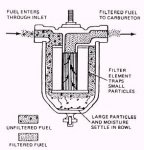
I must be misinterpreting this image of the Delphi filter then. To me it appears that the dirty fuel is in the bowl and is filtered as it exits the bowl on its way to the engine. Am I missing something?
 

Attachments

  • delphiFlow.jpg
    delphiFlow.jpg
    18.2 KB · Views: 3
I must be misinterpreting this image of the Delphi filter then. To me it appears that the dirty fuel is in the bowl and is filtered as it exits the bowl on its way to the engine. Am I missing something?

Yes, that's a petrol filter! 'to carburetor being the clue.

The standard CAV type diesel filter does indeed filter the fuel before it enters the glass bowl at the bottom. It works by encouraging droplets of water to coalesce together into big drops as the go through the filter. They fall into the bowl instead of carrying on in suspension.

Racor type filters are expensive to run, as the elements are much dearer than for the humble CAV. Some Racors are centrifugal devices which separate the water that way.
The problem is, on a small yacht engine using 1.5 litres an hour, the fuel isn't going fast enough for a filter designed around 100 litres an hour or whatever.
 
There are two common misunderstandings regarding additives:

Biocides (eg. Biobor JF). Although resistance can build, they are generally very effective. They will kill the bug, however, they will not correct the conditions that allowed bugs to flourish (water) or remove the dead bodies. In fact, the dead bodies will tend to break free and clog up fuel lines, filters, pumps, and fittings, unless the tank is cleaned FIRST, to remove most of the biomass. This is why many swear that biocides make things worse. You've got to remove the biomass and fix any leaks.

Other additives (AKA snake oil). Some are very good, some are snake oil, and they only help if you get the one you need. I am more familiar with US brands, but I have tested Soltron (Startron in the US) and it is good at keeping a clean tank and preventing corrosion. Others may do nothing helpful in a case like this.
 
Similar recent experience, though I only have a water separator as a primary "filter".
The engine started to cut out repeatedly just as I was returning to home berth after a very bumpy trip on the recent gale-force Sunday. The engine literally died for the last time as I was about to go astern on final approach, so we arrived at the finger rather briskly, with no engine, and I stepped ashore to secure amidships before she rode forward and up over the main walkway. It probably would have looked quite cool to a casual bystander, and luckily I had my trousers tucked in to my boots to conceal evidence of panic.

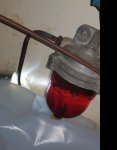
Anyway, this was the state of the primary "filter":
filter1.JPG

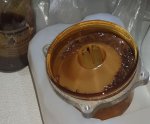
Removing it (massive PITA - not something I would want to do at sea):

filter2.JPG

So, rather unpleasant, but not, you would have thought, enough to stop the engine.

I drained the tank via the sight-glass tube, which draws from the lowest level. A little sludge, but again, nothing too unpleasant.

It is 4 years since I drained, removed and painted the tank. Since then I always draw off about 2l of fuel from the sight tube and check for water and gunge at least twice a year. None found. Ever. I also always add Marine 16 with every top up of fuel.

Before filtering and replacing the fuel I thought I would have a quick visual check, preferrably without removing the 16 nuts on the tank hatch, so pulled out the fuel return tube and inserted an endoscope (really cheap little one off ebay - plugs into an Android phone).

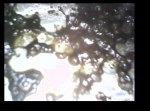
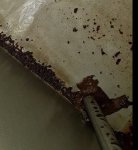
Trouble in sight: Tank1.JPG

So I bit the bullet and removed the hatch to clean the tank. Oh yeah, baby! Tank2.JPG

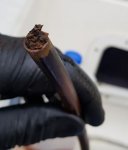
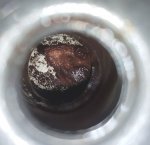
In fact, the fuel inlet pipe (which you have to bend slightly to remove while the tank is in situ) was totally blocked: Pipe1.JPG

I mean totally: Pipe2.JPG

Worryingly, the secondary filter showed signs of having trapped some gunge, too filter3.JPG

I replaced the secondary filter, then cleaned the tank and filtered the fuel back into the tank. I then primed up to the injectors and ran the engine up for a few minutes, only to have it cut out again. There was , a small amount of fresh gunge visible in the primary filter. I removed and cleaned the primary again and this time blew a little bit of gunge out of the short section of pipe from tank to filter.

This time, the engine ran until I stopped it, and I didn't see any sign of gunge in the primary. I am, however, concerned that the pipe from primary to secondary may have a latent blockage, so I'll change the secondary fuel filter (again!) and I really need to replace that water separator with a proper primary filter, CAV or Racor. I like the top-loading Racor, but with a little engine (VP2003) I'm worried about the earlier comment that the Racor really needs a stronger flow than the meager 2l per hour we consume.

So...apart from giving me an opportunity to get this off my chest, how does it help the OP?

Probably not so much. Other than to say that a cheap little endoscope off ebay is probably worth getting. And even regular doses of Marine16 aren't a guarantee of keeping the dreaded bug at bay.

Oh, yes - and it took me at least 2 pints of London Pride to get the taste of diesel out of my mouth, so plan your post-maintenance regime accordingly.
 
...
Probably not so much. Other than to say that a cheap little endoscope off ebay is probably worth getting. And even regular doses of Marine16 aren't a guarantee of keeping the dreaded bug at bay.

Oh, yes - and it took me at least 2 pints of London Pride to get the taste of diesel out of my mouth, so plan your post-maintenance regime accordingly.

I'm wondering if some soapy continental lager would be more effective at removing diesel taste?

I'm not sure what kind of filter I'd fit from scratch. Racor expensive, CAV fiddly....
I wonder about some of the filters in modern cars. Some have water traps with sensors to detect excess water.
Pleased to hear you 'got away with it'!
 
Top