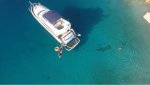
Thanks to MYAG

Hurricane

Well-Known Member
Joined
11 Nov 2005
Messages
9,856
Location
Sant Carles de la Ràpita
Visit site
I've just got home from a couple of months away on the boat and that stunning photo in the Sept issue of MBY with all those yachts anchored back to the rocks reminded me that I need to post this.

Some on this forum may remember a couple of seasons ago, I met with MYAG from these forums in Carloforte.
MAPISM will definitely remember.
MYAG does extreme anchoring - more extreme than me anyway.

So, I watched with interest when I was invited on a short trip with MAPISM and Mrs MAPISM.
MYAG's anchoring systems were significantly bigger and stronger than the ones originally installed on our Princess
This clip shows him reversing back to anchor to the rocks.


And this was the result - safe anchoring.

serve.php


Soon after this trip, we borrowed a floating rope from MYAG and took Jennywren over to the same spot.

serve.php


serve.php


It was clear that we needed to upgrade our kit and change the way that we anchor.
So, during the following winter season, we upgraded our kit - bigger anchor - bigger chain - upgraded windlass - and added floating ropes.
But until this summer, I didn't realise just how much it would help us.

The plan this year was to leave our home berth in Sant Carles in late July and head over to Mallorca.
Stay a week or so to change visitors and then pop across to Ibiza for a few weeks before heading back home sometime in late August.
Mallorca is relatively safe - you can usually alternate between Santa Ponsa and Palma Nova depending on the wind/swell.
And if necessary, you can usually find space in one of the many marinas.
But Ibiza is packed during these months so marinas are generally out of the question.
Even if we could get in, the berthing fees would be eyewateringly expensive.
Knowing all this, and with a careful eye on the weather forecasts, we set off from Mallorca.
The forecasts indicated that about a week after leaving Mallorca, there would be strong easterlies so we headed round the west side of Ibiza.
San Antonio would be the obvious place to go if there was any bad weather from the east so we popped in to see what could be booked.
We were told that they didn't take bookings at this time of the year but there is a daily waiting list that we could join if we were to telephone at 09:00.
Then they would either find us a berth or a buoy.
I contacted San Antonio marina several times to check this.

Anyway, off we went to some stunning anchorages, eventually spending three days in Saona (Formentera).
The forecast was now showing winds increasing from 20 knots so we moved up to a buoy in Espalmador.
Espalmador itself is protected from the east but the land is low lying and would be exposed to the stronger winds that were due a few days later.
So, I contacted San Antonio at the correct time to go on the waiting list and was told that they had just changed their rules - the wouldn't now allow any motor boats on their buoys and the marina was full.
San Antonio harbour has always been somewhere that you can anchor but recently, the Club Nautic in San Antonio has been given permission to move anchored boats out and offer them buoys instead. I think it was disgraceful of them now to stop motor boats from anchoring or using the buoys, especially as there was a storm coming.
All the other Ibiza marinas were full.

So, we were faced with, either staying where we were or seeking a safer anchorage.
After a couple of phone calls to my yachtie friends, we opted to find a safer anchorage.
Maybe if we were unlucky, we could come back to Espalmador (the "man with the RIB" looking after the buoys in Espalmador was really helpful)

This was the plotter's AIS display display on the south of Ibiza so something big in the weather was definitely going to happen - everyone was looking for shelter.

serve.php


We headed to Poroig - a small bay where we had spent a pleasant night a few years ago.
As we entered, I couldn't beliebe my eyes - I saw an ideal spot.
The Rocna anchor went straight into sand giving us time to think.

serve.php


Would this be safe when the big winds came.
A pleasant Spanish family on a similar sized boat offered some useful suggestions but I immediately thought of MYAG from a couple of years ago.
So, out came our floating rope.
With lots of chain in the locker, we simply "wound" ourselves back towards the rocks until our rope reached.
We actually rigged two lines

serve.php


Then we tightened everything up using the stern docking winches- something that MYAG had said to me
This was the chain - so tight it was pulled off the bow roller - tensioned directly onto our chain stopper/lock.

serve.php


And this was the final result - photo taken taken a few days later.

serve.php


The bad weather came as predicted, about 4 hours later.
There were two storms - one in the evening and one about 2 o'clock the following morning.
Rain is my biggest fear - it brings very strong local winds.
This was the rain just before the storm - I didn't take any photos during the actual storm.


We were tucked in nicely under the cliffs so we only recorded 30 knots but I reckon it could have been 50 knots out in Espalmador.

The following morning we heard that six yachts had broken up in Saona (where we had been a couple of days before) 11 miles from us.
Out of the three local restaurants/beach bars, only one was open for business the next day. One of them had been completely washed away - JCBs were digging it out when we went round in the RIB.

So, yes - we had made the correct decision - moving to a safer place.
We eventually stayed there for three days whilst the sea settled.

But - now for the scary bit.
We knew that we were close to the bottom when we "wound back" but it was definitely the best thing to do to escape the storms.
I took this video with my cheap underwater camera - I've also added a few clips from subsequent days.


Does this mean we are now members of the "Extreme Anchoring Club"?

So, a BIG thanks to MYAG for suggesting that we set our boat up for this kind of thing.
Without this extra kit on board, I'm not sure what we would have done.

And finally a couple of last pics.
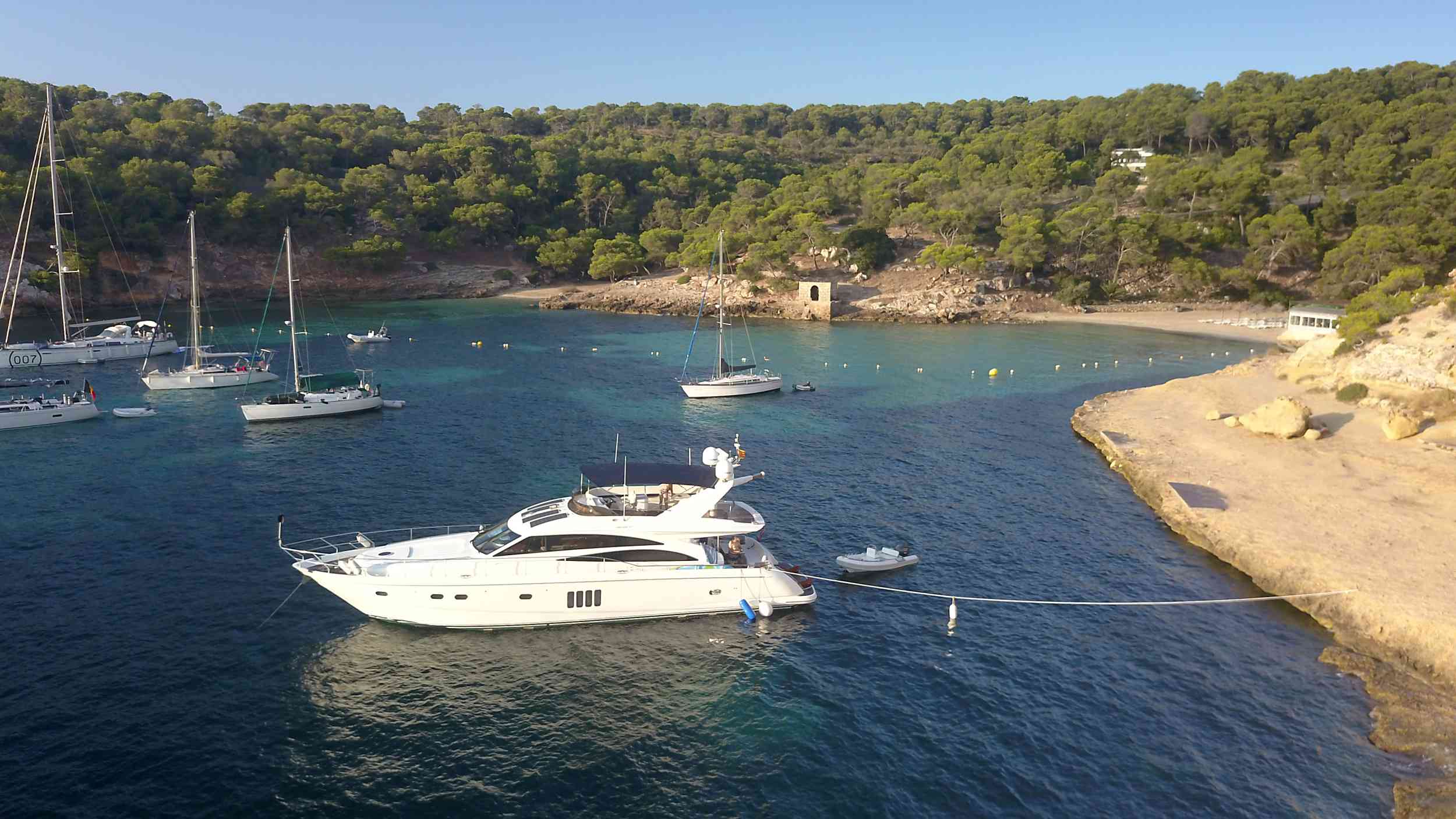
This was in Cala Portals - somewhere you wouldn't expect to tie back to the rocks.

serve.php


serve.php
 
In that photo in portals vells (cala portals) youre pretty close to where the tourist trip boats tie up,you can see the two concrete landing pads just on the rocks on your starboard side, i presume you were not in their way? But it looks like you would have been very close
 
Flip! Wasn't there much surge with 30knots of breeze? I guess not or you would have been in the 'extreme anchoring - no sterngear' club.
 
In that photo in portals vells (cala portals) youre pretty close to where the tourist trip boats tie up,you can see the two concrete landing pads just on the rocks on your starboard side, i presume you were not in their way? But it looks like you would have been very close

Yes, it was a problem - after we had anchored, a yacht did the same along our starboard side!!
They had problems with the trip boat - we dropped our shore line and waited until all the day trippers had gone back to the night clubs in Palma.
Then we reattached the line - the pic was taken in the morning just before we left for Santa Ponsa.
 
Flip! Wasn't there much surge with 30knots of breeze? I guess not or you would have been in the 'extreme anchoring - no sterngear' club.

Yep - but I was working off local experience - the boat to our starboard anchors there for most of the summer.
During the day, we had to let one of our lines go so that boats could access the tiny beach.
That boat took our shore line during the day and gave it back for the night - really helpful family.
With both lines on, our boat was more stable and the extra line put us in a slightly deeper position.
 
well done Mike, haven't seen MYAG anchor but you may be at the lunatic end of the extreme anchoring.

I expect the locals were sure there's not any significant waves created in the bay else you do have a problem.
I'd chicken out half a meter of depth before though...

How long is your floating line?

You're right now that I also upgraded anchor (alone) this year I was confident going 30m from the shore with my 50m yellow floating line.
starting at around 10m deep or thereabouts I'd drop 60m of chain and I'd end up at 3m water at the stern.
If there's a cross wind when trying to moor you have to get one on the helm keeping boat where it should be and someone else to dive in with the rope (or use the dingy). After the rope is secured on the rocks (or trees) I get it on the cleat and use the anchor winch to stretch them both (dont have stern cleats). Works a treat as you only need 4-5m of chain to tension the thing.

Love the feeling of privacy you create this way :D

cheers

V.
 
How long is your floating line?

I bought 118m of the stuff from the guys who run MAPISM's marina.
For a long time it stayed on the cardboard drum that was supplied with it but I plucked up the courage to cut it into two pieces.
I thought of cutting it 60/40 but then I wouldn't know which piece I had so 50/50 was how it was cut.
This way it doesn't matter which one I pick up.
So that makes each piece nearly 60m long and thats about the right length to handle in these situations.
We could easily join the two together if we needed a longer one.

I keep one of them in the funny flat locker in out bathing platform.

When we anchor, SWMBO often jumps in and checks that the anchor has set.
So, it is easy for her to pick up an end of the floating rope when she get back and take it to the shore.

I don't think we would attempt to set this up with just the two of us.
In the above situation, there were four of us on board and we had all done it before.

Recovering it all when we moved on was a lot easier - just the two of us then.
We recovered the extra line using the RIB then slipped the other whilst winding in on the anchor windlass.
In fact that was the only time this year that we used our Bluetooth headsets (SWMBO on the bow - me on the stern)
Eventually, I had to let go of the stern floating rope and we recovered that with the RIB later.
We didn't run the engines until we were back out into deeper water (for obvious reasons).
 
MAPISM will definitely remember.
You bet! :encouragement:

Very nice report M, thanks for sharing the experience.
This year, considering how my season went so far, you are making me rather envious - storm aside, that is!
But that's another story.

Ref. shallow water anchoring, wow, that's impressive indeed.
Not only for the limited depth per se, but considering also the very bad weather predicted.
I assume you knew the place well enough to be sure that it wasn't exposed to surge or rip current, which could have made the boat pitch?

I've anchored in similarly shallow waters in several occasions, but never in such bad weather and/or for overnighting.
You might remember this couple of videos which I posted in the past, for instance - see from 1:33 onward in the first, and 2:22 in the second.
Btw, both those spots should ring a bell to you, by now... :cool:

 
Stern to anchoring is more or less daily practice to me and my crew (who is most of the time my son). It takes some experience to do it but, as Vas stated, it gives you very nice privacy and comfortable sleep at night.

For the ones who are interested to upgrade their anchoring gear, let me inform you the sets I use in my boats:

47 feet motoryacht - 18 tons
Chain: 100 meter Cromox chrome 10 mm - 8000 kgf breaking load
Windlass: 1700 W Quick
Anchor: 27 kg Ultra
Stern lines: 2 x 70 meters - 12 strand braided - Floating - Breaking load 5000 kgf


72 feet motoryacht - 45 tons
Chain: 120 meter galvanized chain 10 mm - 8000 kgf breaking load
Windlass: 2000 W Lewmar V5
Anchor: 60 kg Ultra
Stern lines: 2 x 70 meters - 12 strand braided - Floating - Breaking load 8000 kgf

Some notes:
- Lines should definitely be floating, otherwise they will sink and will be caught by propellers some time within the process.
- I prefer 12 strand braided lines as they have more flexibility and they are more handy when you need to pull with hands.
- Even though good to have, aft capstans are not a must. Just release the chain 5-10 meters more, lock the stern lines and then tighten the chain until the stern lines are tight as well. Do not injure your back to have a tight stern line.
- It is very good to have maximum length of chain that your chain locker space and your windlass capacity permits. Most of the time more than 50% of the holding is done by the chain weight, not by the anchor. The more you release chain, the better you sleep. If your chain locker space is limited, prefer chrome polished chains. They flow and don't make a hill of chain in your locker, allowing you to have much longer chain in your locker. I have to mention that they are much more expensive than regular galvanized chains.
- When choosing the anchor, it is best to have a chat with the local boaters at your cruising ground and learn which anchor works the best at that area. Usually Ultra and Rocna have good reputation for Med areas.

Finally, this is what mean when I mention about privacy. Between the stern lines, it becomes like your private pool:

IMG_0102.jpg
 
Please don't flame me for this Mike but, since this is a boaty forum and its about discussing boaty matters, I have to say that I think what you did in Poroig was questionable to say the least. We did a lot of anchoring in our 4 seasons in Croatia taking lines ashore and I certainly wouldnt trust that system for holding the boat safely in a big blow. First the reason that people do it is not for safety but for space. You can get a lot more boats in an anchorage if they are all tied to the shore

The reasons that I dont like this anchoring system in a big blow are these. You might well choose an anchoring spot where you think the forecast wind is coming from the stern and therefore blowing you off the shore but the trouble is that winds dont often behave exactly as forecast. If the wind veers such that it is blowing beam on there is a side load on your anchor which it isnt designed to resist. I have experienced this in Croatia where a neighbouring boat got blown on to mine in the night when the wind unexpectedly shifted through 90deg. It was mayhem. Then if the wind veers 180deg and is blowing your boat towards the shore you are a sitting duck if your anchor drags because you are seconds from grounding

So for me, anchoring and taking lines ashore is fine in light winds but in a big blow I'd much rather be in the middle of the bay swinging to the anchor with maximum chain out and with room to drag and if the anchor didnt hold then I'd have time to get it up and motor out to sea if necessary

All entirely IMHO and I'm interested to hear other peoples' opinions

Btw where is MYAG? Anybody heard from him recently? If he's reading this, I hope he's fine
 
Please don't flame me for this Mike but, since this is a boaty forum and its about discussing boaty matters, I have to say that I think what you did in Poroig was questionable to say the least. We did a lot of anchoring in our 4 seasons in Croatia taking lines ashore and I certainly wouldnt trust that system for holding the boat safely in a big blow. First the reason that people do it is not for safety but for space. You can get a lot more boats in an anchorage if they are all tied to the shore

The reasons that I dont like this anchoring system in a big blow are these. You might well choose an anchoring spot where you think the forecast wind is coming from the stern and therefore blowing you off the shore but the trouble is that winds dont often behave exactly as forecast. If the wind veers such that it is blowing beam on there is a side load on your anchor which it isnt designed to resist. I have experienced this in Croatia where a neighbouring boat got blown on to mine in the night when the wind unexpectedly shifted through 90deg. It was mayhem. Then if the wind veers 180deg and is blowing your boat towards the shore you are a sitting duck if your anchor drags because you are seconds from grounding

So for me, anchoring and taking lines ashore is fine in light winds but in a big blow I'd much rather be in the middle of the bay swinging to the anchor with maximum chain out and with room to drag and if the anchor didnt hold then I'd have time to get it up and motor out to sea if necessary

All entirely IMHO and I'm interested to hear other peoples' opinions

Btw where is MYAG? Anybody heard from him recently? If he's reading this, I hope he's fine

Points taken, Mike
In Porroig, we anchored first (swinging).
But you can imagine how full the area was.
At the time, there were several boats tied back so swinging (potentially) against them would have been a risk.
During the first storm a 20m(ish) boat came in to pick up his permanent mooring buoy (far too late).
The load on his single point (mooring) was enough to pull the mooring completely out - he was left with no option than to go out into the bay.
It was a worry to watch - and there was nothing we could do to help.
Interestingly (we were only 100m from him) - all our lines were "bar tight" with no hint of slipping.
The wind was easterly and if you look at Porroig you will see it is very sheltered from that direction and that our stern lines would have taken most of the load.
Our emergency plan was to cut the stern lines and the wind would have taken us back out onto the anchor alone.
Believe me we felt very safe.
 
If the wind veers such that it is blowing beam on there is a side load on your anchor which it isnt designed to resist.
All good points M, except this one, imho.
With a LOT of chain deployed, also with strong crosswind, the pull on the anchor still remains essentially longitudinal to the boat, if you think about it geometrically:
Let's assume that the gusts are strong enough to make the boat swing sideways by 4 meters each side (which is already going to be a scary situation indeed!).
With 80m of chain deployed, even assuming that all of it is bar tight above the seabed, the angle of pull at the anchor end is going to change by less than 3 degrees each side, i.e. negligible.
Side load can be MUCH more relevant with the boat left swinging around the anchor, obviously.

I'm not saying that in a huge blow the anchor could not drag, but if it would, I believe that 99% of the reason would be the increased load due to the snatch effect of the boat pushed back and forth by gusts, rather than because of the side load, which is irrelevant.
In this respect, your point still stands, though - and if you would argue that the difference is academic, I couldn't disagree... :rolleyes:

But once you have a good anchor and a lot of chain, with the lines and the chain very tight, I don't think there's a way to improve the boat stability in crosswind with lines astern, other than deploying two anchors.
In fact, I also used this technique a few times in Croatia, and whenever we were planning to stay for long (once up to a dozen of days in a row) I always deployed both anchors of my old lady, using almost all of their 100m chain each side, at an angle of 45 degrees or so.
Luckily, we never experienced winds as strong as those that M mentioned, but in some occasions when other boats anchored in the same way with a single anchor were swinging sideways in a very visible way (1+ meter, if not more), the reference point I took on the seabed under our hull never moved one inch.
Yet another reason to regret the boat change btw, but hey-ho! :ambivalence:
 
The keyword is "lots of chain". Once you lay lots of chain to the seabed, it is difficult to have an anchor drag. And, if you will have it, you will have a lot of time to think, plan and act. Because an anchor drag will not get your boat hit the shore in 10 minutes. You will realize it long before.

When I go to sleep, I set the anchor drag alarm and set it to minimum radius, which is 19 meters. There are very few cases when the alarm is triggered and it is mostly because of GPS accuracy issues.

This issue is not a very simple one. It has many dimensions starting from checking for the wind, choosing the location, analysing the surface depth, surface terrain character, trust to your gear, etc. But once all is done correcty, it is a safe mooring style.
 
Points taken, Mike
In Porroig, we anchored first (swinging).
But you can imagine how full the area was.
At the time, there were several boats tied back so swinging (potentially) against them would have been a risk.
During the first storm a 20m(ish) boat came in to pick up his permanent mooring buoy (far too late).
The load on his single point (mooring) was enough to pull the mooring completely out - he was left with no option than to go out into the bay.
It was a worry to watch - and there was nothing we could do to help.
Interestingly (we were only 100m from him) - all our lines were "bar tight" with no hint of slipping.
The wind was easterly and if you look at Porroig you will see it is very sheltered from that direction and that our stern lines would have taken most of the load.
Our emergency plan was to cut the stern lines and the wind would have taken us back out onto the anchor alone.
Believe me we felt very safe.

Fair enough Mike. Every skipper has to do what they feel is right. Porroig is obviously well sheltered in easterlies. Entirely FWIW I have anchored off the long beach between Espalmador and Formentera in strong easterlies. Not many boats seem to anchor there and there is a lot of wake from passing ferries but it is sheltered from easterlies and if you drag you'll drift all the way to Alicante:D

Btw, I'm still really pleased with my Rocna. It doesnt half stick and seemingly in any type of seabed. Very worthwile purchase for sleeping easy at night on the hook
 
Side load can be MUCH more relevant with the boat left swinging around the anchor, obviously.
Yes obviously but then the boat will swing freely and will most of the time be aligned with the wind. When anchored with lines ashore in a beam wind, there is constantly a big side load on the chain because the boat is always presented side on to the wind

In fact, I also used this technique a few times in Croatia, and whenever we were planning to stay for long (once up to a dozen of days in a row) I always deployed both anchors of my old lady, using almost all of their 100m chain each side, at an angle of 45 degrees or so.
Yes I can accept that 2 anchors at 45deg would be a very safe situation with lines ashore and its what a lot of boats in Croatia equipped with 2 anchors did but we poor people with boats having only one anchor didnt have this option;)

One other point I didnt mention was that if the wind does change through 90deg the boat is beam on to the swell and it can get very uncomfortable compared to freely swinging. Of course now I've got a gyro I dont care

Btw another tip from MYAG that he showed me. He had a handheld electronic distance measuring device which he used to measure his distance from the shore in order to plan exactly where to drop his anchor. I found it quite difficult to estimate my distance from the shore when anchoring with stern lines which occasionally resulted in running out of chain before the boat was anywhere near the shore or not deploying enough chain
 
Btw, I'm still really pleased with my Rocna. It doesnt half stick and seemingly in any type of seabed. Very worthwile purchase for sleeping easy at night on the hook

I dragged my Delta anchor for the first time in 10 years this summer during a squall in Villefranche, 40kts+ of wind. Fortunately it was daytime, and with no-one behind me I just let it drag, but I probably moved about 50m in the space of 10 mins before the anchor set solid. I had 40m out in 10m depth, so I've resolved to get minimum 5x out in future if staying overnight (I normally do anyway), but i'm also toying with the idea of fitting a Rocna. Do you think the Rocna is noticeably better at getting through weed, as i'm sure this was the reason I dragged in VF?
 
Btw, I'm still really pleased with my Rocna. It doesnt half stick and seemingly in any type of seabed. Very worthwile purchase for sleeping easy at night on the hook

Me too - I believe we have the same size (55 Kg)
The only time it didn't set properly was in Cala Malgrats (next to Santa Ponsa) - when we checked there seemed to be about 3" of sand over slab rock.

However, we have found that to get it to set quickly we need a bit more chain out than usual otherwise it just jumps.
Eg in (say) 5m we need 25m to 30m of chain and it goes in first time - in this case, 20m doesn't work.
We tend to anchor close in next to yachties who don't tend to deploy as much chain so sometimes we have to adjust the chain length after the anchor has set so as to swing with them.
Once in, it sticks like glue - and having had a Delta before, I wouldn't go back.
Just an observation.
 
I dragged my Delta anchor for the first time in 10 years this summer during a squall in Villefranche, 40kts+ of wind. Fortunately it was daytime, and with no-one behind me I just let it drag, but I probably moved about 50m in the space of 10 mins before the anchor set solid. I had 40m out in 10m depth, so I've resolved to get minimum 5x out in future if staying overnight (I normally do anyway), but i'm also toying with the idea of fitting a Rocna. Do you think the Rocna is noticeably better at getting through weed, as i'm sure this was the reason I dragged in VF?

Put it like this. When I first bought my current boat, I changed the standard fit 30kg Bruce to a 60kg Delta and I thought nothing was going to shift that but I was wrong. In 2 seasons we had 3 drags in stiff winds, 2 of which were in soft sandy bottoms in NE Sardinia in which the Delta just seemed to plow through the seabed (like its supposed to I guess!) and the 3rd time in a weedy bottom in SW Sardinia where I dont think it could get through the weed. That last experience prompted me to change it for a 55kg Rocna and in 2 seasons we havent had a drag with it. I'm a little bit hesitant to say its definitely better than the Delta because I havent tested it in the same anchorages in the same wind conditions in which the Delta failed but I have a lot of confidence in it and its never let me down so far. It seems to be the best of both worlds in that its got a pointy end to get through the weed but at the same time its got a big face area so that it doesnt get dragged through soft stuff. It also seems to be well designed in terms of digging itself in v quickly. I really have to be careful about setting the Rocna because it sets so hard and quick. In fact thats the main reason I fitted a chain stopper

The only downside for me, apart from the fact that its a pig ugly bit of ironmongery, is that it is so wide that it fouls the bow mooring lines in some marinas if they are close together
 
Eg in (say) 5m we need 25m to 30m of chain and it goes in first time - in this case, 20m doesn't work.
I dont ever let out less than 25m whatever the depth, mostly because 25m is the first mark on the chain! Also I avoid anchoring anywhere near yotties mainly because I know we are going to let out more chain than them and swing around more. Apart from that, I know the plink plink from my icemaker and phut phut from my genny irritates them;)
 
The only downside for me, apart from the fact that its a pig ugly bit of ironmongery, is that it is so wide that it fouls the bow mooring lines in some marinas if they are close together

Having used a Delta, Spade and Rocna in the same areas I found both the Spade and the Rocna significantly better than the Delta. The Spade is the most expensive, but less bulky and ugly. For some boats the difference is easily worth paying because of issues you mention, for others the Rocna makes sense.
 
Top