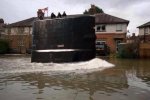
Thames floods

One reason why the EA may not open the floodgates and let the river flush out more quickly, is a concern about bank erosion, especially on the outside banks - if they let the water run too fast, people's gardens will vanish.

But they may have to consider it. We were down at Penton Hook over the weekend. Arrived Saturday and the road to Staines was passable if you drove down the middle.

Access to the pontoons required wellies - about 8-10 inches deep to get out to A pontoon.

Overnight it blowed like billie-oh.

Retied the boat Sunday morning, with an additinal bowline.

We escaped at around 1pm. By then the water was kneedeep to the pontoon and about two inches deep across the grass. It certainly overtopped by boots by two-three inches and mine are 20 inches high at least.

In fact it came close to the top of the binliner gaiters we made.

The access road to the marina was at least six inches under water. We left the car at a high point in the car and took a taxi which had to drive on the pavement to get through.

When we left the report was for the level to rise further. We had planned to go out to the boat Wednesday night for the rest of the week, but have put off that idea until Saturday.

Even wondering is we'll have to use the dinghy to get to the pontoon, wind and current permitting.
 
What do you mean , another reason why the ea may not open the floodgates ?

All thames weirs have been fully open ( we are told to say open , and not the correct terminology of 'drawn' so that the simpletons will understand ) for ages !
 
They used to fairly regularly but I am fairly confident in saying that it would not have made the slightest bit of difference here..

+ 1000

Lady from the Thames area on the radio this morning.
Downstairs is flooded.
She has retreated upstairs with supplies.
No whinging No bleating No blame.
Just her and the old man and apparently a few bottles of wine.
Previous owner told them they could be flooded but they bought anyway due to beautiful location.
 
They used to fairly regularly but I am fairly confident in saying that it would not have made the slightest bit of difference here..

On what grounds do you say that? Hopefully the EA have been out and about identifying where the choke points are which are stopping the water from draining straight away - and planning a strategic dredging campaign for the summer. If the flow can be improved at the choke points, the water will arrive at the weirs a little quicker, the water flow over the cills will be a little deeper, and the water will get away a little faster!
 
On what grounds do you say that? Hopefully the EA have been out and about identifying where the choke points are which are stopping the water from draining straight away - and planning a strategic dredging campaign for the summer. If the flow can be improved at the choke points, the water will arrive at the weirs a little quicker, the water flow over the cills will be a little deeper, and the water will get away a little faster!

The fact that it's been raining almost non stop since Jan 1st ...
 
On what grounds do you say that? Hopefully the EA have been out and about identifying where the choke points are which are stopping the water from draining straight away - and planning a strategic dredging campaign for the summer. If the flow can be improved at the choke points, the water will arrive at the weirs a little quicker, the water flow over the cills will be a little deeper, and the water will get away a little faster!

Remove the choke points and downstream gets flooded even quicker and worse. What you need are choke points that give controlled flooding in specific areas.

Many years ago I wrote the software that controls flooding around Milton Keynes, basically there are gates in the bottom of the rivers that divert water into holding reservoirs (Willen Lake being one of them) to slow river flow down. In effect it is an artificial choke point and the "flooding" is contained in a lake. Never really followed up on it, but as far as I know the areas downstream of MK haven't suffered.
 
Remove the choke points and downstream gets flooded even quicker and worse.

Which is why the removal of choke points has to start at the bottom.....:)

The sheer volume of water coming down would require more than the whole of the Thames Valley to be turned into reservoirs to hold all this water, and if there weren't then any houses well, flood the lot - who cares!! We have old gravel pits, two of which are now part of the river, a third was topped up when the river was at its peak, and a fourth small one, which has no water flowing in or out of it, is bigger than normal and flooding into a field in a small way, because it is in the water table which is well up.

No doubt come August, if it's anything last year, our grass will all be browned off and we will be praying for rain!
 
Brill MJF that would dredge the river too
Especially if it is New Clear powered!:rolleyes:

Our local councils used to clean the ditches by the side of the road, keep them clear of weeds and saplings but that just does not happen any more. Around here, they are all mostly full of debris, weeds and often a good selection of small trees. 2 years ago we had a bit of a standing water issue across a nearby road and after it froze over, an accident occurred and shortly after this the council arrived, dug a ditch both sides of the road leading off into the forest and all of a sudden the problem disappeared.
In Holland, where, interestingly, help has now arrived from, they clean out their roadside ditches/small channels every year to keep them free of debris and weed. They have a special machine rather like a small JCB with a 2x fork like grab on it which is on a small powered pontoon and it just goes along the ditch and drags all the **** out onto the verge where it is collected and taken away. For a country that is so far below sea level they seem to have it all sorted.
 
Top