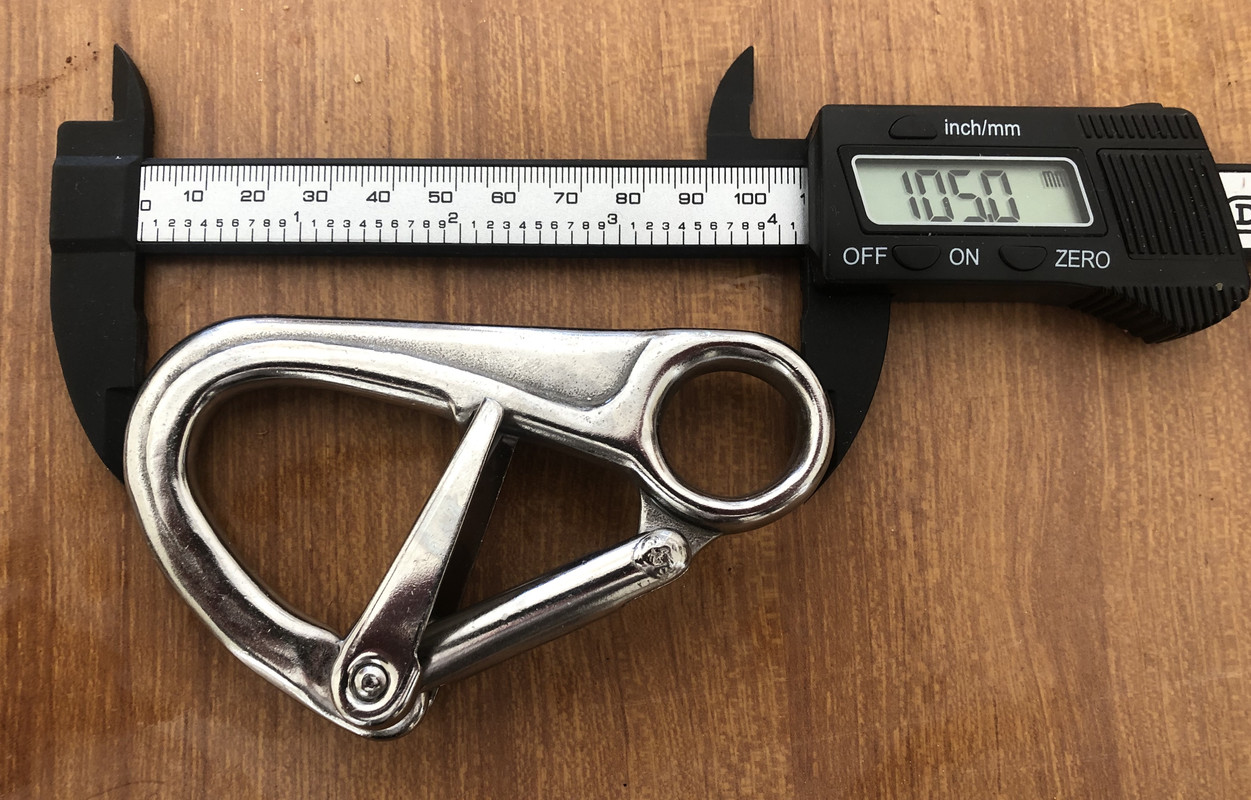
Tether Hooks

Apart from hooks, there is this standard requiring 2k kgf breaking load on tethers: where does it come from?
A load of 2 tons halfway the spine of a human being -where most LJ harness attachment are- would most surely break it in two: given lifejackets, plb and all sort of locating beacons, from the regulatory point of view wouldn t a lower breaking strength tether be better, leaving the person alive in the water instead of hanging paralysed on the side of the boat? (Referring to the 1.9ton load on the spine, *not* the never fall overboard story)

That would require a chapter to explain. I have published a number of articles on the dynamics. Much of it is safety factors (WLL is 5-10x below the BS) and allowances for wear. Sufficient to say that the requirements are proven in theory and practice, and that a few worn tethers and harnesses have broken, suggesting the number is not too great.
 
2 completely separate issues developing

Helmets

There appear to be 2 applications

One is to protect the head when doing mast work, and from personal experience head protection would be, is, invaluable. I use a helmet if I need to do mast work at sea

Secondly related to the tether thread - there is a considerable danger with any sea running for an individual put over the side to allow recover of an unconscious MOB for the recovery individual to have their head hitting the hull.

Head hitting the boom - more of an issue, but not to be ignored, on smaller yachts. I don't see yachtsmen wearing helmets for this situation - as it could occur at any time and yachtsmen are unlikely to put a helmet on as soon as they raise sails - and keep it on until they drop sails.


The second issue is standards, testing and sailing.

Sailing seems to adopt standard from other industries, some of which are inappropriate. Some standards, from other industries, that are appropriate are not adopted. Some equipment is unique to sailing - and has no standards.

Thinwater has mentioned standards adopted for climbing and these standards are more stringent than that for sailing - yet it is the same kit. (Slight drift) - we have a fixation with chain strength (that is commonly what chain size is about) yet people use undersized shackles. People use swivels - and there is no side loading specification - and guess how swivels often fail. Manufacturers test inappropriately for sailing - and use that data as part of a marketing tool. Some sailing equipment is not tested, or if it is none of the data is published.


But returning to the thread

If you go overboard in 'blue water' particularly, but not exclusively, at night your chances of recovery and survival are very low.

Stay on the boat!

and having a reliable tether, jackstays, hard points etc - and using it, them - is fundamental.

The cost of the kit - tether, hook, harness, LJ, PLB are expensive - when I crew offshore, I take my own (in the same way I take my own foul weather gear). Its not that I don't expect the owner to supply the kit - I know that in most cases mine will be better.

On the Clipper yachts all the safety gear is supplied. I did wonder if you were a crew member what the position would be if you refused to use their kit (specifically tether) and demanded to use your own.

Jonathan
 
The helmet thing was more of a tickler. I would not have looked into it unless I had been asked to.

On my cruising cat, my uses might be as Neeves suggested, but in truth I never had one available anyway. The boom was above the hard top.

Racing boats and small boats are different. They turn quickly. The boom is nearly always low enough to swat you. Boats speed in double digits are commonplace.

Finally, there is the subject of children and college kids. A dinghy boom is generally not lethal, but it can be bad, and the sailors are both inexperienced and distracted.

No single answer. That said, I still think the US Sailing statement is political.
 
In some ways, the requirements of a sailing helmet might be more like that of a bike helmet (one hard hit), but with better coverage.
What you have described here is almost precisely what is offered by climbing polystyrene helmets. They work on the same principle as a bike helmet (energy absorption through destruction of the foam) but are especially good for withstanding side impacts (which is a risk in climbing if you fall and swing into the rock).

To address Neeve's point about low participation in this thread, we did have an extensive thread about this very topic not so long ago:
https://www.ybw.com/forums/showthread.php?493148-MAIB-harness-report
 
What you have described here is almost precisely what is offered by climbing polystyrene helmets. They work on the same principle as a bike helmet (energy absorption through destruction of the foam) but are especially good for withstanding side impacts (which is a risk in climbing if you fall and swing into the rock).

To address Neeve's point about low participation in this thread, we did have an extensive thread about this very topic not so long ago:
https://www.ybw.com/forums/showthread.php?493148-MAIB-harness-report

Thank you for the link; I somehow missed the earlier discussion, which I have now read through. Having been a "customer" of the MAIB in my day job a couple of times, I have a great deal of respect for them, and if they are taking their time there will be a good reason for it.
 
Last edited:
I'll raise a point which seems to have been missed along the way, regarding the microcrystalline structure of alloy carabiners.

It was discovered many decades ago, during research into climbing 'crabs', that microscopic nicks and scratches on the surface of alloy 'crabs' have a serious effect on the Ultimate Load they can carry without failure. This is due, as I recall, to the surface treatment of the products being significant in the overall performance of the designs, and that microscopic as well as visible nicks and scratches have deleterious effects. I also seem to recall that exposure to salt.... i.e. salt water.... enhances this degradation.

Climbers of a certain vintage were very wary of getting their expensive 'crabs' wet on seacliff climbs.

This is a topic for engineers, but the research has previously been done. Perhaps it will re-emerge.
 
No aluminium hooks for me, then. On the subject of barely visible degradation, I looked carefully at my webbing jack stays and saw one spot where I strongly suspect that someone had trodden on the webbing whilst wearing shore shoes, perhaps with a bit of grit on the heel, and slight damage had started. Perhaps a point to bear in mind.
 
I have found this paper on aluminium in marine environments:

http://www.almet-marine.com/images/...viour-of-aluminium-in-marine environments.pdf

I would summarise its conclusions as being that it is perfectly possible to design aluminium parts for use in marine environments (see: all our masts, aluminium hulls) but that items which have not been specifically designed for this use may be at risk. NB it is perfectly safe to use aluminium climbing equipment in a marine environment (assuming you are using it correctly) so long as you perform visual inspections of your kit. Massive deposits of white crystalline alumina or seized carabiners would be cause for concern, but can easily be avoided by washing in fresh water after use. I am not sure how salty the environment inside cabins is and whether this would affect long-term storage onboard.
 
For anyone reading the above article:

Most, many components used in the marine industry and manufactured from aluminium alloy use the 5083 alloy. From memory Fortress anchors use the 6061 alloy (its certainly a 6000 series), I suspect because it is more amenable to extrusion. The Guardian anchor is not anodised (but the Fortress is - people who use the Guardian do not complain of corrosion). Most items of climbing equipment are made from the 7075 alloy - as it is, or was, one of the strongest aluminium alloys. 7075 is now a bit 'old hat' (I think it originated in Japan and was used to manufacture Mitsubishi fighter planes in WWII). Stronger aluminium alloys based on lithium as one of the alloying elements are now available and used extensively in civilian aircraft (and I assume military aircraft) Boeing and Airbus. 7075 (and many of the Lithium aluminium alloys) cannot be welded nor bent.

I have not seen any corrosion data for the newer lithium aluminium alloy but 7075 is not as corrosion resistant as the series 5000 alloys - Our aluminium Excel anchor has a 7075 shank and has been sitting on our bow roller for over 5 years and the anchor itself is around 10 years old - the shank has not dissolved into a pile of aluminium hydrate. Our shank is not anodised and anodising would improve corrosion resistance. In terms of a tether hook (which if aluminium will be made from the 7075 alloy)- good housekeeping should ensure longevity, grease 'hinges', wash in fresh water, store dry (in the same way you care for your LJ :). I can see some potential for accelerated corrosion, for example carabiner gates, where the spring might initiate corrosion (but only if left to fester in the damp) - TLouth7's point about good design. We have taken that point to heart and replaced our stainless bolts that secure the 7075 shank to the fluke and replaced with 7075 bolts (the bolts are not load bearing). Presumably climbing equipment manufacturers are careful over this issue - as most climbing at some stage involves rain or snow.

I cannot comment on scratches on the strength of 7075 - has anyone any reliable data on the failure of aluminium (which will be the 7075 alloy) climbing equipment? It is very difficult to see how any item of climbing equipment will not be scratched and scored at some point so if scratching is an issue I would have thought reputable manufacturers would issue warnings. and the users (climbers) would have regular forums about maintenance, dangers and failures.

As an aside - 7075 does not bend, yield, it snaps like glass - failure would be an actual break. I k.now - I've tested it (and the fracture surface looks like broken glass).

7075, and especially the lithium aluminium alloys are expensive.

Jonathan
 
The advantage would be that you could use one of the many aluminium carabiners that are available, rather than being limited to the stainless offerings. As far as I can see that would mean either Gibb-type (have failed at alarminly low forces) or screwgate (not really appropriate).

Edit: there are in fact stainless crabs that would work for a tether (NB I cannot confirm that they are certified for this use). For example filter by material in the Kong offering:

https://www.kong.it/en/2-products/items/f1-carabiners
 
Last edited:
For a small item of boat equipment like a tether hook I don’t see any benefit to using aluminium rather than stainless steel - unless of course you are the sort of racer who used titanium shackles until Dyneema came along...

I've been using steel carabiners onboard on tethers for years(with a grigri), quick wash and occasional spot of oil & they're fine.
 
A grigri on a tether? Guess I'm missing something.
GriGri on a harness into short length climbing abseil line, instantly adjustable lanyard length so you can get it as short as you want, works great, clip off to the mast and lean back with both hands free. The grillon would probably be much better suited as it's designed & rated as an adjustable work positioning lanyard.
 
GriGri on a harness into short length climbing abseil line, instantly adjustable lanyard length so you can get it as short as you want, works great, clip off to the mast and lean back with both hands free. The grillon would probably be much better suited as it's designed & rated as an adjustable work positioning lanyard.

Hey that's a great idea! Something to be implemented immediately :encouragement:
 
Last edited:
For a small item of boat equipment like a tether hook I don’t see any benefit to using aluminium rather than stainless steel - unless of course you are the sort of racer who used titanium shackles until Dyneema came along...

The answer is very simple - and as posted. Climbers who need lots of carabiners will not carry 20 stainless models - simply too heavy. They carry alloy models. The heroes carry alloy models and its the heroes you see on the big walls - so its the heroes who offer the advertising. There are a myriad of alloy (sorry aluminium alloy) designs and only a few stainless most of the stainless designs have remained unchanged for 40 years. The climbing industry has adopted big time 7075 alloy, jumars, deadman, carabiners and are geared up to use the material (manufacturing) to its best advantage. I use jumars, 7075 alloy, for mast climbing, I use a 7075 descendeur (figure of 8), I use alloy carabiners for mast work (I have not found a use for a 7075 deadman yet :).

Its horses for courses.

Frankly, whereas I don't suggest the practice, I'd rather be whacked by an all alloy carabiner than a stainless one - but each to their own.

For tethers - you use the best design, rather then worry about the material.

The article quoted was generalising and my post was qualifying that general link - not suggesting 7075, or any aluminium alloy, was the ideal and not negating the use of stainless. I was simply pointing out - 7075 can find application on a yacht - safely.

Jonathan
 
A problem with those elasticated tethers I found was when it's clipped on to a U bolt at ankle height it wasn't long enough to reach my harness without pulling. It gave me a back ache pulling against it whilst standing up and steering.

When I replaced my boat's jackstays I kept the old ones and now setup with two webbing lengths a side to separate strong points. A very large shackle rides on both one clips the tether to the shackle which rides easily on the webbing.
 
Top