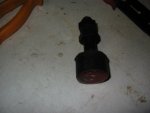
Testing Seafarer Transducer

Intermittent faults are of course a total **** to find !

If you listen close by the transducer, can you hear a faint regular ticking ?

In all my experience and the regular questions on here I don't think I've ever heard of a transducer itself failing, so the wiring and display unit seem more likely.

Having checked the continuity of the wiring and security of connections, would it be possible to borrow someones' display unit to try ?
 
I have an older version which does not give accurate readings. How do you test the transducer in the boat? It seems likely there is an intermittent fault. With a multi-meter? if so how?

I dont think you can do anything with a multimeter.

Try the instrument with a known good transducer or the transducer with a known good instrument. ...... about all I can suggest.

Heard it suggested that if its working you can hear the transducer clicking but never personally noticed it.

Compatible with the current Nasa instrument AFAIK.

Instructions scanned and available for Seafarer 3 if needed.
 
A circuit tester should show if the wire is continuous, but it's not so easy with co-ax; do take off and remake the connections if possible, transducer leads tend to live in puddles of bilge water.

Yes one can hear the transducer ticking when it's going, but it's quite faint; ones' ear has to be very close without too much background noise, it's a faint rapid ticking a bit faster than one a second, the figure 90 a minute rings a bell.

I should have asked, how is the transducer fitted ?

If through the hull, check for any growth - or splashed a/f paint - on the transducer face; if it's mounted inside the hull in a tube full of castor oil, check the oil level - this stuff leaks easily and any air between transducer and the inner hull will certainly give inaccurate vague readings.

I have found simply sticking a transducer to the inner hull with silicone sealant works very well; that is a modern fishfinder transom mount transducer* , fitted inside the aft hull at a fairly flat point.

* No great leap in technology and it still ticks away quietly so I don't see why a traditional disc on a stalk transducer shouldn't be stuck with sealant, except a scarfed tube mount allows fitting in more veed hull sections - ie forward.
 
Seafarer Transducer

image0-001.jpgThank you for these replies which have given me a couple of things to check. Unfortunately, it is hard to access. In the photo of a similar transducer, the top plastic nut has disintegrated so will need to cut the cable to get a replacement on, which may be best done at the top end, threading it down. Not knowing, I have painted over the exposed surface underneath with anti-fouling, so that could be another thing to attend to next time I slip the boat.I am unsure of how the co-axial outer cable terminates.Is it abruptly, going 'nowhere' with only the centre cable connected?
 
I was about to say I had a spare to check the rest of the system out, then I realised we are in opposite hemispheres..

Of course there are many reasons why a Seafarer in good working order might give spurious readings from time to time eg if the gain is too high picking up fish or fresh/saline interfaces, or reading the second echo as the first etc. Are you happy that you've discounted these?
 
Last edited:
Agree with the post about inaccurate readings being due to gain settings or fish or crud in the water. Does yours have a digital readout as well as the spinning light? The spinning light is the best way of tuning out double echoes. Mine has a repeater with digital readout and until I got he gain set right there were some curious readings. Too much and you get double echoes, too little and you get nothing. Its useful to know how much water you should be in!
 
View attachment 40099Thank you for these replies which have given me a couple of things to check. Unfortunately, it is hard to access. In the photo of a similar transducer, the top plastic nut has disintegrated so will need to cut the cable to get a replacement on, which may be best done at the top end, threading it down. Not knowing, I have painted over the exposed surface underneath with anti-fouling, so that could be another thing to attend to next time I slip the boat.I am unsure of how the co-axial outer cable terminates.Is it abruptly, going 'nowhere' with only the centre cable connected?

The co-ax should have connectors - screwed onto the wire at the display end which keep the central bit central, but ' trap ' the outer shielding into the outside of the connector.

It's much simpler than it sounds, and one can bunch the outer shield into a short ' wire ' as long as it's in contact with the outer connector and isolated from the inner core - watch for stray almost invisible wire strands.

However if the transducer is painted over that's the first thing I'd sort, clean it off and see what results you get, hopefully may be that simple.
 
There are a couple of points I need to add to this discussion as the problem is now solved. Firstly, however apart from the 'spinning light' on the main unit, I have a hinge mounted extension unit that I can swing out in the companionway that is digital. Initially these two were even showing different readings. My electronics friend who sails with me occasionally made some suggestions and he was absolutely right. I discovered that the connecting cable to the transducer had an excess of length, so I chopped off 7 metres: secondly, I fitted a new connector between cable and unit that is "above average" quality. It now works fine and I only need to scrape some paint off the transducer next slipping and perhaps it will be even better.
 
Intermittent faults are of course a total **** to find !

If you listen close by the transducer, can you hear a faint regular ticking ?

In all my experience and the regular questions on here I don't think I've ever heard of a transducer itself failing, so the wiring and display unit seem more likely.

Having checked the continuity of the wiring and security of connections, would it be possible to borrow someones' display unit to try ?

turn on the radio on LW 200
 
In all my experience and the regular questions on here I don't think I've ever heard of a transducer itself failing, so the wiring and display unit seem more likely.

The Seafarer transducer failed on my last boat. Well, I suppose it could have been the wire to it, but it still had the original moulded plug on the instrument end and all but the last two feet or so off it lived in dry lockers.
 
Top