TESTING MY WOODWORKING ROUTER WITH A MULTIMETER

coopec

N/A
Joined
23 Nov 2013
Messages
5,211
Visit site
I use my ½ inch router upside down in a router table. I hadn't used it for about two years but when I switched it on it seemed to struggle and made a noise as if the bearing was slightly seized. I gave the collet bearing a squirt of WD40 and now it won't work at all.

Before I toss the router out I want to do a series of tests with the multimeter. I can't get to the copper of the cables so I was thinking of poking pins through the plastic insulation and testing (very carefully) before and after the ON/OFF switch and also if I'm getting power to the variable speed control (before /after)

Is there any way I can check if the field windings are stuffed? I've checked to see if the brushes are OK and not surprisingly they are (the router hasn't done much work)

Are there any other tests I should do before I toss the router in the re-cyle bin?
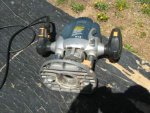
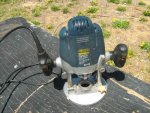
IMG_2024__1607408958_111.220.38.19.jpg IMG_2023__1607408713_111.220.38.19.jpg
 
imho, 90% of such tools failing goes down to internal wiring around the on/off/rpm pot. How about opening where these are and checking with a multimeter?
I guess after the squirting of wd40 the collet does turn reasonably freely, right?

V.
 
Do you understand the role of testing using resistance (ohms) ?

I've often used that to check the continuity of (say) a switch or windings. I could use it to check the continuity of the cable from the two pin plug to the switch on the router for example. I could use it to check the continuity of the commutator windings and the field windings if I knew how. My knowledge of electric motors goes back to my Meccano Set days (very basic)

But that would be the limit of my knowledge
 
imho, 90% of such tools failing goes down to internal wiring around the on/off/rpm pot. How about opening where these are and checking with a multimeter?
I guess after the squirting of wd40 the collet does turn reasonably freely, right?

V.

Quite freely now.

What you say might be a good start before I start thinking of more complex possibilities.

Thanks
 
If indeed the collet was seized and then freed by wd40 then yes most likely problem around the switch or the brushes.
However one failure mode for electric drills (then presumably a router also) is a short in the armature between turns. This results in a peculiar slow running with a kind of pained hissing sound and if you can see it, much sparking from the brushes. The shorted turns result in very high current through the brushes hence the sound and sparks. Also destroys the brushes PDQ.
This defect can only be tested and demonstrated by using a "growler" Multimeter is no good. This is an electromagnet with exposed pole pieces fed by 50 hertz AC. The removed armature is laid into the pole pieces and each pole piece pair is exposed to the growler pole pieces. A good sector of armature ie pole face to commutator segment will just sit there. If there is a short in the turns you have in effect a transformer with shorted turns (loaded). The whole thing goes mad growling etc due to the load. Only electrical workshops will have a growler. I had a series of armatures fail on a Black and Decker drill long ago. Perhaps this problem does not appear these days with better manufacturing and insulation.
However if this is the problem you are up for a new armature which realistically means new router. ol'will
 
If indeed the collet was seized and then freed by wd40 then yes most likely problem around the switch or the brushes.
However one failure mode for electric drills (then presumably a router also) is a short in the armature between turns. This results in a peculiar slow running with a kind of pained hissing sound and if you can see it, much sparking from the brushes. The shorted turns result in very high current through the brushes hence the sound and sparks. Also destroys the brushes PDQ.
This defect can only be tested and demonstrated by using a "growler" Multimeter is no good. This is an electromagnet with exposed pole pieces fed by 50 hertz AC. The removed armature is laid into the pole pieces and each pole piece pair is exposed to the growler pole pieces. A good sector of armature ie pole face to commutator segment will just sit there. If there is a short in the turns you have in effect a transformer with shorted turns (loaded). The whole thing goes mad growling etc due to the load. Only electrical workshops will have a growler. I had a series of armatures fail on a Black and Decker drill long ago. Perhaps this problem does not appear these days with better manufacturing and insulation.
However if this is the problem you are up for a new armature which realistically means new router. ol'will

Thank you William

I have actually heard of a 'growler": I think my Dad had a starter motor checked out once.

I had wondered if I was a bit too liberal with the WD40 and wet the motor windings and caused a short circuit? The GMC Router was very cheap but it is fantastic ergonomically. I think I might have to get another cheapie. Maybe I'll look at Ryobi ($149) or Makita ($189). Those two are around 1600W, plunge and 1/2 inch

Thanks for your advice.
 
Last edited:
Is it full of saw dust inside, stuck in the bearings, rotor and brushes? this could absorb moisture and spraying with WD40 may have just turned it into a sticky gum.
If it has not been able to turn easily it may have burned out in the few seconds it took to try it but I would have expected it to smell pretty bad if that was the case.
I always think of this with one of my routers that's fitted under the bench in the line of fire for all the dust.
 
Is it full of saw dust inside, stuck in the bearings, rotor and brushes? this could absorb moisture and spraying with WD40 may have just turned it into a sticky gum.
If it has not been able to turn easily it may have burned out in the few seconds it took to try it but I would have expected it to smell pretty bad if that was the case.
I always think of this with one of my routers that's fitted under the bench in the line of fire for all the dust.
+1 on that. I would take it to bits and have a good shufti at all the working bits, work em about individually clean everything and try again.
 
Is it full of saw dust inside, stuck in the bearings, rotor and brushes? this could absorb moisture and spraying with WD40 may have just turned it into a sticky gum.
If it has not been able to turn easily it may have burned out in the few seconds it took to try it but I would have expected it to smell pretty bad if that was the case.
I always think of this with one of my routers that's fitted under the bench in the line of fire for all the dust.

I really gave it a blast of compressed air which would have removed any sawdust but maybe a bit late. Apparently routers are not designed to be run upside-down and therfore they recommend regular cleaning (which I didn't do)

Thanks for that
 
Too late to suggest a contact cleaner rather than WD40?

I've come to resent WD40 dominance as an "all'n'verything" spray and use proper products for releasing, cleaning & lubrication. Hate when you go to some inevitably Indian run hardware store & it's all they got now and they have no idea what release oil etc is.

You've got to take it apart, clean it, and blow it all out now.

Some isopropanol's useful, & compressed air if you haven't a compressor.
 
+1 on that. I would take it to bits and have a good shufti at all the working bits, work em about individually clean everything and try again.
Maybe I will do that but I'm looking at a possible replacement. I'm looking at two cheapies:

Renegade Industrial 1500W Electric Plunge Router $135
Amazing value for such a useable machine! These big powerful routers are designed with the trade user in mind & ha ...
Shipping Weight: 7.0Kg

Ryobi 1600W Plunge Router $149
Weight3.95kg

Comparing weights the Ryobi looks like a toy.

Any thoughts?
 
I have a Ryobi. Fairly constant use over 14 yrs. Switch did conk after about 10 and it is a bit noisey, but otherwise works fine. Also have a big Ryobi angle grinder. Heavy beast , but no hassles over 15 yrs of dusty building work.
 
Too late to suggest a contact cleaner rather than WD40?

I've come to resent WD40 dominance as an "all'n'verything" spray and use proper products for releasing, cleaning & lubrication. Hate when you go to some inevitably Indian run hardware store & it's all they got now and they have no idea what release oil etc is.

You've got to take it apart, clean it, and blow it all out now.

Some isopropanol's useful, & compressed air if you haven't a compressor.
Something wrong with Indian run stores then?
 
I have a Ryobi. Fairly constant use over 14 yrs. Switch did conk after about 10 and it is a bit noisey, but otherwise works fine. Also have a big Ryobi angle grinder. Heavy beast , but no hassles over 15 yrs of dusty building work.

I have a Ryobi variable speed drill. Often when I plug it in the drill starts turning (not fast) but I can't stop it. I had trouble with an orbital sander which they replaced under warranty. They took the sander off the market later.
 
Most routers are not designed to be used inverted due to direction of cooling air sucking dust in. After one of mine packed up with seized bearings, I now use a Triton which is designed for inverted use in the table and has the advantage of built in height adjustment from above.
 
Top