Testicular navigation

Joking aside, navigating by swell patterns is a well known component of Polynesian traditional navigation; it's one of the things represented on their stick and string "charts" (which are actually more like a mnemonic device). However, all such methods are only one component of a navigational system. You use something like swell patterns, sunset and sunrise direction, trade winds etc. to ensure that over the long distances you're heading in the right direction. You confirm your position from time to time by hard landmarks (islands, reefs), but using these depends on having short range means of navigating, such as presence of land birds, clouds over islands etc. All-in-all its similar in principle to the old practice of running down a latitude and then coasting to a final destination - you use a long distance method that will get you to within range of the more precise short range techniques.

I should say that I'm grossly simplifying Polynesian navigation; it was almost entirely passed on by oral means, and encompassed a vast range of natural phenomena that we tend to be unaware of or ignore. It took years to train a Polynesian navigator, and they were of very high standing within their society. Except for the few voyages where they set off into the blue - e.g. the voyages of the first Maori and those who settled Hawai'i - Polynesian navigators knew where they were going, how they were going to get there and what they'd find when they arrived - even if they'd never been there before. Their oral learning encompassed all of that.

Finally, the Polynesians were also masters of living off the sea, so they weren't too worried if a journey took longer than expected.

I use this almost every time I'm out - I use long range techniques to get close enough to the Pye End buoy to see it, and then eye-ball the channel marks into the Walton Channel.
 
Joking aside, navigating by swell patterns is a well known component of Polynesian traditional navigation; it's one of the things represented on their stick and string "charts" (which are actually more like a mnemonic device). However, all such methods are only one component of a navigational system. You use something like swell patterns, sunset and sunrise direction, trade winds etc. to ensure that over the long distances you're heading in the right direction. You confirm your position from time to time by hard landmarks (islands, reefs), but using these depends on having short range means of navigating, such as presence of land birds, clouds over islands etc. All-in-all its similar in principle to the old practice of running down a latitude and then coasting to a final destination - you use a long distance method that will get you to within range of the more precise short range techniques.

I should say that I'm grossly simplifying Polynesian navigation; it was almost entirely passed on by oral means, and encompassed a vast range of natural phenomena that we tend to be unaware of or ignore. It took years to train a Polynesian navigator, and they were of very high standing within their society. Except for the few voyages where they set off into the blue - e.g. the voyages of the first Maori and those who settled Hawai'i - Polynesian navigators knew where they were going, how they were going to get there and what they'd find when they arrived - even if they'd never been there before. Their oral learning encompassed all of that.

Finally, the Polynesians were also masters of living off the sea, so they weren't too worried if a journey took longer than expected.

I use this almost every time I'm out - I use long range techniques to get close enough to the Pye End buoy to see it, and then eye-ball the channel marks into the Walton Channel.


You mean you don't stand on the foredeck legs akimbo waiting for the left knacker to swing to the right, I am surprised.:p
 
I use this almost every time I'm out - I use long range techniques to get close enough to the Pye End buoy to see it, and then eye-ball the channel marks into the Walton Channel.

I can see you now, bare steerage way in a thick pea-souper wot was with you all the way from Zeebrugge, pulling your granpa's yellow so'wester down tight around your ears, drawing your old grey oiled-wool guernsey around your thin, wizened frame against the damp night chill - then slowly, remorselessly, the East Coast mud beneath reaches up and grasps your keel. You sigh, lean over the battered gunnel, scoop up a handful of gooey muck, and take a long sniff.

"We're all right, me 'earties. I knows 'zackly where we be. We's just by Foundry Reach, b'ain't but nary a furlong from The Old Harbour Lights. But the tide's away, me 'arty mattocks, an' so there'll be no Adnams for us tonight. Nor fried Norfolk Onion rings, neither. Best break out the baked beans and Belgian beer, and make like Ould Peyton. We'll be here for the night....."

;)
 
I can see you now, bare steerage way in a thick pea-souper wot was with you all the way from Zeebrugge, pulling your granpa's yellow so'wester down tight around your ears, drawing your old grey oiled-wool guernsey around your thin, wizened frame against the damp night chill - then slowly, remorselessly, the East Coast mud beneath reaches up and grasps your keel. You sigh, lean over the battered gunnel, scoop up a handful of gooey muck, and take a long sniff.

"We're all right, me 'earties. I knows 'zackly where we be. We's just by Foundry Reach, b'ain't but nary a furlong from The Old Harbour Lights. But the tide's away, me 'arty mattocks, an' so there'll be no Adnams for us tonight. Nor fried Norfolk Onion rings, neither. Best break out the baked beans and Belgian beer, and make like Ould Peyton. We'll be here for the night....."

;)

Not quite! I'm not that good, though I did once navigate my Dad's Halcyon 27 from Arbroath to Dunbar in fog (in anout 1968, so long before modern satellite navigation). But I did cheat - I used radio beacons to get cross bearings on my DR track, to confirm my assumptions about speed over the ground. The scariest bit was being uncertain about the east-west error on my track - we were keeping a VERY careful listening watch for Bell Rock!

If fog came down while I was heading for Stone Point, I'm afraid I'd turn round and head for safe water until it lifted. There's no way I'd try and go through there without being able to see. It would be easy enough to anchor in Hamford Water.
 
If fog came down while I was heading for Stone Point, I'm afraid I'd turn round and head for safe water until it lifted. There's no way I'd try and go through there without being able to see. It would be easy enough to anchor in Hamford Water.

An interesting corner, with something of a history of DR 'foggy, foggy dew' navigation in small engineless boats. Isn't that Dulcibella's home ground? I can just make out 'Arthur Davies' ghost drifting along, drudging on the making tide, to an isolated anchorage deep in The Backwaters..... behind Ambrose Point, perhaps, or up by Bramble Island.

I'm reminded of The Blessed Tom C's famous 'touch and go' technique, Of course, he didn't invent it, nor does he claim so. But.... it is another time-wizened 'tool in the toolbag' of small-boat seamanship that you don't get on RYA Courses..... unless, of course, you are lucky enough to have a hairy-arsed ould East Coast instructor who knows every withy and corncrake's nest from Southend to Skeggy, and the landlord's name in every traditional pub from the Lobster Smack at Holehaven to the Trawlerman at Thorpe Haven.... ( and a fair few of the daughters, too ) and he chooses to show you how to get to them.

You don't get them skills down West Country.... ;)
 
An interesting corner, with something of a history of DR 'foggy, foggy dew' navigation in small engineless boats. Isn't that Dulcibella's home ground? I can just make out 'Arthur Davies' ghost drifting along, drudging on the making tide, to an isolated anchorage deep in The Backwaters..... behind Ambrose Point, perhaps, or up by Bramble Island.

I'm reminded of The Blessed Tom C's famous 'touch and go' technique, Of course, he didn't invent it, nor does he claim so. But.... it is another time-wizened 'tool in the toolbag' of small-boat seamanship that you don't get on RYA Courses..... unless, of course, you are lucky enough to have a hairy-arsed ould East Coast instructor who knows every withy and corncrake's nest from Southend to Skeggy, and the landlord's name in every traditional pub from the Lobster Smack at Holehaven to the Trawlerman at Thorpe Haven.... ( and a fair few of the daughters, too ) and he chooses to show you how to get to them.

You don't get them skills down West Country.... ;)

"Touch and go" doesn't work too well with a fin keel! MAke a mistake and you're tipped over at 45 degrees for a tide, and if you happen to tip down slope, you MIGHT not come back up so easily. Barges on the Humber and tugs on the Clyde have been lost that way.
 
"Touch and go" doesn't work too well with a fin keel! Make a mistake and you're tipped over at 45 degrees for a tide, and if you happen to tip down slope.....


48138499558_8e304d7aa9_z.jpg


"You can't beat it, Carruthers.. A good sail, a quiet drink, than a row in the moonlight back to a snug little cabin."


I have the view that most famous East Coast sailor is not Captain Cook RN, but one Michael Peyton Esquire, late of North Fambridge.....;)
 
"Touch and go" doesn't work too well with a fin keel! MAke a mistake and you're tipped over at 45 degrees for a tide, and if you happen to tip down slope, you MIGHT not come back up so easily. Barges on the Humber and tugs on the Clyde have been lost that way.
That actually happened to me in the channel up to Gravelines..I got my timing wrong, tried to motor up the channel against the last of the ebb but touched and immediately keeled over..downhill!
Spent a horrible few hours in a chaotic mess, spreaders scraping the gravel on the other side of the channel, trying to seal up all the possible holes with anything like sticky tape, grease, putty etc, wondering if she would refloat, and she did thank god. The locals had gathered to watch but my faithful little Hurley just gained a few scratches.. and I learned a few things..
 
Polynesians navigated their canoes by the stars and other signs that came from the ocean and sky. ... Clouds, swells, and other natural signs helped. Many island including the Caribbean and Pacific have clouds over them
 
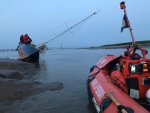
Like this, just yards from his mooring! Sara was on stand bye if needed ..........they werent, he lifted safely and made his mooring !35240508_1403537083081166_1499775723332698112_n Pill stand bye!.jpg
 
Like this, just yards from his mooring! Sara was on stand bye if needed ..........they werent, he lifted safely and made his mooring !View attachment 78716

There was one of those in the entrance to Chichester Harbour as we left last Sunday. About 100 yards off the eastern shore, in about a foot of water. He was luck, it was very calm

Many years ago, long before chartplotters on small boats or on apps on phones, after a very wet, windy and exhausting passage from Brighton, I was sharing the helm with the skipper, while a couple of oxygen thieves who were also crewing were hiding below. As we approached Chichester, which neither of us knew, we called down to ask if there was anything we needed to know. "No, just go straight in"

Fortunately the local inshore lifboat was out on exercise and saw us. Next thing we knew, they were alongside and put a man aboard to pilot us in. East Pole would have been a bad place to go aground in that weather.
 
48138499558_8e304d7aa9_z.jpg


"You can't beat it, Carruthers.. A good sail, a quiet drink, than a row in the moonlight back to a snug little cabin."


I have the view that most famous East Coast sailor is not Captain Cook RN, but one Michael Peyton Esquire, late of North Fambridge.....;)

That actually happened to me in the channel up to Gravelines..I got my timing wrong, tried to motor up the channel against the last of the ebb but touched and immediately keeled over..downhill!
Spent a horrible few hours in a chaotic mess, spreaders scraping the gravel on the other side of the channel, trying to seal up all the possible holes with anything like sticky tape, grease, putty etc, wondering if she would refloat, and she did thank god. The locals had gathered to watch but my faithful little Hurley just gained a few scratches.. and I learned a few things..

Like this, just yards from his mooring! Sara was on stand bye if needed ..........they werent, he lifted safely and made his mooring !View attachment 78716

All exactly why I don't take chances with a 1.6 metre draft and a fin keel! If its a new place, I try and enter on a rising tide, and estimate tides very conservatively.

If I'd been in the position of the last one above, I'd have been even further over. I'd probably be OK (high freeboard, self-draining cockpit and no openings to below decks except the hatches), but probably isn't definitely!
 
Last edited:
I imagine it was inevitable this technique could only have evolved in the warm waters of the Pacific. It's certainly an approach the North Atlantic Vikings could never have developed :)
 
Top
