Terrible news from Clipper

More a case of fundamentally bad practice of working outside the lifelines. Bring the sail in.

Reality check?

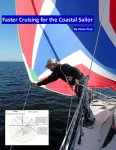
a. The guard line is at my waist, not my knees. See it in my left hand? That was the point of the post. Given the height of the guardline, the position of my left hand, and the calm weather, the tether was over kill just for a picture.
b. Calm weather. Just adding a sheet.
c. Tight chest tether. The free board at this point is over 4 feet.

I could feint in that position and my feet wont even get wet. I have tested this. That is the beauty of running higher guardlines when practical. More to the point, it's really hard to fall over a waist-high line.

Yup, if it were blowing the chute would come in, but it's way under 10 knots. The reason I was adding a chute, is that it had been hoisted with only one sheet to relieve weight from the clew. Common practice in light air.
 
Reality check?

a. The guard line is at my waist, not my knees. See it in my left hand? That was the point of the post. Given the height of the guardline, the position of my left hand, and the calm weather, the tether was over kill just for a picture.
b. Calm weather. Just adding a sheet.
c. Tight chest tether. The free board at this point is over 4 feet.

I could feint in that position and my feet wont even get wet. I have tested this. That is the beauty of running higher guardlines when practical. More to the point, it's really hard to fall over a waist-high line.

Yup, if it were blowing the chute would come in, but it's way under 10 knots. The reason I was adding a chute, is that it had been hoisted with only one sheet to relieve weight from the clew. Common practice in light air.

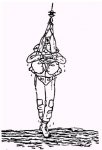
a. The guard wire is nowhere near your waist. Look at the photo.
 
Guardline. Look again guys, you missed it. There is a purple and white Kevlar line at my waist that my hand is on. That is not running rigging, that is a guardline rigged to the shrouds and stanchions. This was common practice in the days of sail. It has deflected a bit out board, because I am leaning hard on it and it is long, but it's stronger than the guardlines.

Faster%u00252BCruising%u00252BCover%u00252Blow%u00252Bres.jpg

Harness. Yes, I should be tighter, no excuses except it was comfy and the weather was very light. It was adjusted for heavy clothes and I had been too lazy to adjust it. However, I bet it is as tight as most you see, when the poofyness of foul weather gear is subtracted. It is a very light harness and shifts easily. I have also been hoisted by it. However, in testing I have also learned that it is impossible to adjust a harness tight enough so that you can still breath and not be able to slip out if you raise your arms. At the time I was climbing regularly, could do 15 pull-ups followed by 15 chin ups with out lowering to the ground, ad still I could worm out of any harness. Crotch straps are the thing if you lift you arms. In fact, one of the main responsibilities of a rescue swimmer hoisting a person using a horse collar is to hold their arms down.

image182.jpg

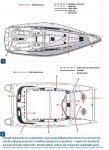
I think it would be helpful to the group if we would all post images of our systems. My jacklines are well in from the edge waist high along the beam. They are terminated 6 feet back from the bow and 10 feet forward of the transom (center cockpit), with 6 additional hard points on deck and two smaller jacklines near the mast. I could critique it all, pointing out minor flaws, but it serves my purposes well.

So post em'.

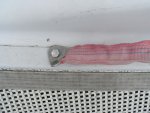
(Just to beat you to it, that is NOT a webbing jackline. That is a UV cover over a shackle and lashing.)
1.%u00252Bbolt%u00252Bhanger%u00252Bmakes%u00252Bstrong%u00252Bno-drill%u00252Bjackline%u00252Ba.jpg
world-cruising-1.jpg
 
Last edited:
That's not a guard line it's a lashed up bit of stupid.

Let's not be school yard. That doesn't move the ball forward.

Specifically, what requirement is not met? It is deflected, but I am leaning hard. I believe the tension and deflection are within spec. It is stronger than required and is supported at the maximum permissible distance. It is high modulus line, which is permitted by OSR for multihulls.

Please post a picture of how you would do this. We are interested.
 
Last edited:
I've obviously leaned over the guardline a hundred times and can feel the pressure on my waist in my sleep. Why would I say it were there if it were not? Wouldn't it have been more polite to write "I can't see it, can you explain?"

I still can't see it, and your explanation is implausible, but as long as you're happy.......
 
The hope is that in the time between now and when the MAIB report is issued we have all ensured that whatever might have gone wrong on Clipper, as many options as possible, are discussed and thrashed to death so that we might all ensure those potential weaknesses do not exist in our own systems. In the fullness of time we can amend, what we might do now, in the light of what the MAIB report advises.

Currently there seems no criticism of Clippers jackstays which for the bow jackstays are quite near the lifelines, or hard points (though there maybe a shortage of good hard points on the bow) and the finger of doubt has been pointed at the hook - or how the hook was attached.

Thinwater has pointed out that in specific circumstances the hook used, from Spinlock, will fail. He has also suggested that the Kong Tango hook does not have this weakness and he repetitively says he does not like the Spinlock/Gibb type hooks as tape can be incorrectly caught in the mouth. No-one else has made a positive contribution as to why the hook failed - so we are left with Thinwater's explanation. We know what Clipper has said - but no-one has tested that scenario. Coincidentally on the Spinlock website they show a lifejacket/harness used on the Volvo race with what looks like a Kong Tango hook (its not a hook they show otherwise on their website). The images of the hooks used by Volvo that I have seen do not look like a Spinlock hook but do look like a Kong Tango. The suggestion to me is that Volvo have chosen Kong in favour of Spinlock.

I also note that on the Volvo yachts they simply do not carry 'extra' tethers (and hooks) - in fact their tethers and hooks seem parsimonious. However despite the loss of life on Clipper as a result of a hook/tether/misuse scenario there is no indication they have changed their policies - this suggest they are comfortable with their hooks (but this is a personal deduction - and maybe influenced by my conclusions I have, maybe erroneously, developed from this thread)

In the absence of further confirmation I'm retiring my Spinlock hooks (and some older Gibb hooks) in favour of Kong Tangos - I just have to find out if they are held in stock in Oz. In the meantime we will be using 2 tethers and 2 hooks.

My decision is based on: Thinwater's tests, Thinwater's own use of the Kong Tango, the apparent use of the Kong Tango by Volvo (in preference to a British made Spinlock) and damning - the absence of a picture of the Spinlock hook on their own website when they promote their Volvo harness/lifejacket (this may have been a stupid oversight on their part - but I don't like stupidity (or lack of attention) from companies who sell safety gear.

Our Jackstays are down the deck, 'under' the lifelines, or as close as makes no difference - but at the bow we have jackstays that run from the mast to the bows, meeting the other jackstays. We have further jackstays in the cockpit roof (which also make good handholds, they are just above head height( and make excellent clothes lines! We have copious 'U' bolts in and around the cockpit. A problem for us is that we have a 2 step deck, a narrow lower one to which the stanchions are attached and a higher, inner, one about the same height as the top of the stanchions.

I'm not enamoured with Thinwater's 'high' jackstays - but if he is happy, for himself and crew, I for one will not argue - given he is the only one to have done any tests and shared them with us. High jackstays are something we need to look at - and I may conclude that Thinwater's is the best option - but before I comment I need to look as to how it might work for us.

If you have a better jackstay arrangement - please share. I'm crossing Bass Strait soon, hopefully in decent weather, but I would like options that I can discard if I'm not comfortable. My interest in this thread is purely selfish. I have no interest in criticising anyone else decision, but I am interested in the why's and wherefore's. I can make my own decisions without being critical and belittling.

Thinwater has not advised what other tests he might have scheduled - but I would hate to think that the only way we might find out what he has done is when an article is published in an American magazine to which most of British forum members will not subscribe. We would then need wait for the MAIB report - which I guess will be after the end of the primary UK sailing season.

it is incredibly easy to be critical (one of the sad weaknesses of forum) - very difficult to make positive suggestions.

But don't shoot the messenger

Jonathan
 
Last edited:
I'll offer a few thoughts.... which are not intended as solutions, but hopefully will 'add some salt to the stew'.

I've had a Google Images look at some commercial fall restraint systems, perhaps over 100 images. In every last one of these, the people shown are wearing full harness - which I'd describe as shoulder and chest and thigh straps. There must be a reason, and that's probably embedded in the accepted Standards for such systems. Rock climbers also wear 'full harness', typically of a webbing waist and adjustable thigh loops, and a separate chest harness which is attached to the former by one of several means. Again, Google Images helps with visualising. I feel we might benefit from adapting some of these arrangements.

What do bowmen on 'first division' racers wear?

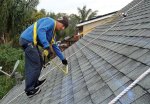
I have a simple ( i.e. cheap ) commercial fall harness which I used day after day last summer, while scraping by hand the moss from my roof tiles. That's two-handed work. The harness, once adjusted, was comfortable in extended use over several weeks.

Further, not one of the many commercial systems displayed uses other than wire rope. No webbing save in the personal tethers. Again, there must be a reason, enforced by regulation. Perhaps we should understand that reason....

I'm not aware that any of the approved snaplinks, when clipped direct to the wire rope, have failed in service. Perhaps someone with access to H&S Executive types - here or there - might delve for relevant information rather than opinion. Same thing with climbers' fall arrest gear - and sports climbers are falling off climbing walls hundreds of times each week, all over Europe and The States. Perhaps there's a body of experience and knowledge there to be tapped.

The 'fall trajectories' illustrated are interesting, but IMHO all suggest an essentially near-horizontal vector. From my own experience, I have more than once had a violent vertical vector which resulted in injury ( broken ribs, and fingers ) while working foredeck as we worked through lumpy short seas. On each occasion the boat/bows were initially rising fast - and thus so was I - then they snapped hard down as a large sea passed aft under the C of G of the boat. I stayed several feet airborne 'up there' for a time, before descending at velocity.... landing hard on a different part of the deck/pulpit structure to that I had just left. Perhaps that happens more often than we have so far considered.

This is not the first time in 50 years of sailing that the components of some personal tethers/harnesses/jackstays ( jacklines ) have been found wanting. Perhaps we need some radical creative thinking on the topic of staying attached to the boat when it gets lumpy, instead of a continued tinkering at the edges of methods shown quite frequently to have failed users when truly needed in challenging conditions.
 
^^

Just a little clarification:

Rock climbers nearly never wear wear full body harness. Only children and occasionally aid climbers; children because they lack a well defined waist, and aid climbers because the weight of gear tends to pull them over backwards (that latter is an approximate, but the fine points are irrelevant to this discussion). In fact, the main reason industrial harness must be full body is that you can't bet they all have a defined waist (beer gut) or that they will wear a seat harness properly (they need to be snug).

That said, if crotch straps are already required by some races, I'll be interested to see where this goes. I have mixed feelings, since I know I would be much less inclined to actually wear a body harness.

There is no requirement for steel cable. Many construction systems use rope. Steel cable is simply more durable in many industrial settings (I have designed such systems for truck and train loading operations). In construction rope is far more common than cable (the rope is greater than 1/2" by US OSHA code). I have never seen webbing as a traverse line in industry.

1_Fall-safety.jpg

The fall trajectory image was just a magazine eye catcher intended to get people thinking. I agree that reality is more complicated.

I agree that a considerable re-evaluation of standards, from the ground up, makes more sense than a piecemeal approach. A reading of this thread lists a good half dozen things worth investigating. Based on past MAIB reports I have read, I think they will look at the whole story. However, it is up to the sailing community to supply the pressure for full investigation of standards, both as they exist and more comprehensive standards. It is also quite normal for standards to have recommendations in the appendix that are not proscribed, but simple good solid recommendation; some of this may fall in that catagory, since details can be boat specific and difficult to codify.

We should also be prepared for the full process to take several years. Standards changes are slow, which is often a good thing. Lots of time to think it through.
 
Last edited:
Zoidberg and thinwater,

I think you're both onto something; I certainly recognise the ' being left airborne then landing on a different part of the foredeck '.

Re fall systems as in the construction industry, I thought it was quite normal for the ' Latchway ' system to be used, this was originally mooted for boats after the 1979 Fastnet but was a bit pricey ?

I'd have thought this rather handy on an ocean racer.

I have to say much as I like the simplicity, efficiency and old school hard work of hanked headsails, that's on my 22' - when I had a 30' with a big rig and small crew I'd have happily taken a chance with a good roller system.

I wonder if despite the large crew and ' we're all hairy arsed rufty tufty sailors ' ethos of the Clipper, there ought to be a different sail handling system for boats such as this - such as a big self draining trough / well in the foredeck to dump big headsails into and a quick efficient low risk way of getting a storm jib up ?

NB they're only racing the same types of boat so there wouldn't be any penalty.

Just thoughts.
 
Last edited:
Let's not be school yard. That doesn't move the ball forward.

Specifically, what requirement is not met? It is deflected, but I am leaning hard. I believe the tension and deflection are within spec. It is stronger than required and is supported at the maximum permissible distance. It is high modulus line, which is permitted by OSR for multihulls.

Please post a picture of how you would do this. We are interested.

I would bring the sheet inboard to do whatever was required.

You are giving the impression of being a complete idiot.
You ponitificate about the best clips, yet pose for photographs while wearing a harness in a sloppy incompetent fashion.
 
I would bring the sheet inboard to do whatever was required.

You are giving the impression of being a complete idiot.
You ponitificate about the best clips, yet pose for photographs while wearing a harness in a sloppy incompetent fashion.

Post something positive.

I made no apology for why the harness was loose. It was wrong.
 
Last edited:
Zoidberg and thinwater,

I think you're both onto something; I certainly recognise the ' being left airborne then landing on a different part of the foredeck '.

Re fall systems as in the construction industry, I thought it was quite normal for the ' Latchway ' system to be used, this was originally mooted for boats after the 1979 Fastnet but was a bit pricey ?

I'd have thought this rather handy on an ocean racer.

I have to say much as I like the simplicity, efficiency and old school hard work of hanked headsails, that's on my 22' - when I had a 30' with a big rig and small crew I'd have happily taken a chance with a good roller system.

I wonder if despite the large crew and ' we're all hairy arsed rufty tufty sailors ' ethos of the Clipper, there ought to be a different sail handling system for boats such as this - such as a big self draining trough / well in the foredeck to dump big headsails into and a quick efficient low risk way of getting a storm jib up ?

NB they're only racing the same types of boat so there wouldn't be any penalty.

Just thoughts.

Latchway-type systems are intriguing. I don't know how they could be made to work or if they could be better than other systems, but I do have a few details that might help.
* They can be heavy and cumbersome. This is tolerated in industry but would not likely catch on sailing. Many racers don't even like chest clips because they bang their knuckles grinding.
* Corrosion. I'm not aware of any that are built for seawater, but this could be solved.
* Inertial reel. These are set to catch free fall. If you are just sliding, slack keeps feeding. You would need to set the max length at ~ 6 feet.
* Sliding along a rail. You can get washed the length of the deck. It's happened, and for that reason, many prefer work station tethers. This is a weakness of jacklines as well.
* The slider can be configured to grab one way. But that can be awkward, since it takes a hand to move the slider.
* Other lines on deck. In general a jackline runs over tracks and adjusting lines and under sheets (details vary, but obviously the jackline must be under lines that lift off the deck and over more fixed lines so that a sailor can slide by. This would require some thought with any kind of rigid system.

Another frequent suggestion is adjustable length lanyards. These are common in industry for positioning. But would we take the time to adjust them? Heck, speaking for myself, I'm too lazy to adjust my harness in light weather :).

I wonder if more hard points (u-bolts or bolt hangers) and the training to use them might be the simple solution. Just an opinion. Everything more complicated seems to have inherent weaknesses. The down side of hard points is that the tether must be elastic (not a rubber band--like a climbing rope), capable of absorbing impact, since there is no other elasticity in the system, other than you ribs. Current tethers are very low stretch and there is no impact force limit on the drop test (there is a force limit for both industry and recreational climbing drop tests). Before the clipper accident (which is unknown at this time) all known tether failures were on hard points, not jacklines. The reason is that the jackline provides energy absorption. Was lack of energy absorption a factor in the Clipper failure? Maybe, but unknown. If he was on the jackline (this is not 100% know to my knowledge--might have been clipped to something else), it would have been so close to the bow anchor that there was little stretch. However, the overload indicator on the tether did not pop, giving us an upper limit.
 
Zoidberg and thinwater,

I think you're both onto something; I certainly recognise the ' being left airborne then landing on a different part of the foredeck '.

Re fall systems as in the construction industry, I thought it was quite normal for the ' Latchway ' system to be used, this was originally mooted for boats after the 1979 Fastnet but was a bit pricey ?

I'd have thought this rather handy on an ocean racer.

I have to say much as I like the simplicity, efficiency and old school hard work of hanked headsails, that's on my 22' - when I had a 30' with a big rig and small crew I'd have happily taken a chance with a good roller system.

I wonder if despite the large crew and ' we're all hairy arsed rufty tufty sailors ' ethos of the Clipper, there ought to be a different sail handling system for boats such as this - such as a big self draining trough / well in the foredeck to dump big headsails into and a quick efficient low risk way of getting a storm jib up ?

NB they're only racing the same types of boat so there wouldn't be any penalty.

Just thoughts.

I think you raise some very valid points.
The problem with the Clipper boats appears to be a bad combination of amateur crew, big boats, travelling very fast, in rough conditions, with a self-imposed requirement for physical manual handling of big sails in adverse conditions.
I've exchanged a few mails with my antenna installation bod.
His take on it is that in his work, if you had to traverse something remotely like that deck, you would have your hands free. There would be handholds. You would not be carrying a big bag of tools, let alone a fair share of an untamed genoa. If anyone falls on their harness, there is an internal enquiry. Which might result in the worker not having a future at height.

I don't think there is a general problem with harnesses and tethers in 'everyday' yachting.
I think there is an increasing 'all the gear and no idea' problem in the various branches of 'pay'n'play' yachting.

It seems to me that what is needed on a boat like the Clippers is a safe method of working which greatly reduces the reliance on simple jackstays and tethers. Some boats do this with 'granny rails' at the workstations, e.g. either side of the mast.
Could a rail be put down the middle of the deck for instance?

Back to basics.
What are the necessary operations?
How can they be done safely?
Can those which cannot be done safely be eliminated?
What makes the difference between somebody doing something safely and unsafely?
 
To be honest I was thinking of the latchway system more for its ability to cross jackstay securing points, rather than the free-fall bit by which time things would definitely be pear-shaped !

I don't know about the ones in use today, but at the LIBS just after the Fastnet disaster, '80 I suppose, they were being promoted for this.
 
My understanding is that the Clipper training for new crew is very good and they ensure everyone knows exactly how to change sails and use the safety equipment. People are nominated as swimmers, for MOB, and practice that as well - which is more than most leisure sailors will know or do. Simon Spears, the MOB, was a sailor - his experience did him no good, I don't recall the name but the UK yachtsmen lost in the Sydney Hobart was a yachtsmen of high regard and was wearing 2 tethers, most of the people lost on the Fastnet were experienced - I'm suspicious of the condemnation of amateurs and the paying guests - experience has not helped in the past.

Previously the MAIB damned a varied and sometime cavalier attitude to safety on Clipper - though from the little I saw this might have changed, in the extreme.

There is no need to travel the length of the deck without hand holds, there is a lifeline which is beefy, much more beefy than on any production yacht, but there is no need to walk - you can crouch or crawl - however wimpy it might appear. Central guard-rails are used on pilot boats (and on RNLI boats?) but they would really get in the way when changing sail.

The truth has been made that these yachts, or the business model, only works with bodies in berths - which is underlined when you go on board, they are floating dormitories. Simply tiers of bunks. Small galley, really no bigger than you might find on a 40/45 production yacht, and a large nav station under and to the aft of the cockpit. The suggestion is that hanked on sails are there to give the crew something to do - I find this difficult to believe, even if it has a ring of truth. I cannot believe the weather systems through which they sail are so variable that they are constantly changing sails. When they do change sails, yes, a big crew is needed the headsail is enormous - but it could be on a furler and the only sails that might need to be handled could be smaller, all on the inner forestay (which might then be able to incorporate a granny rail) or on a furler on the bowsprit (which in general will only be used in more benign conditions).

I suspect on the Sydney/Hobart leg, the Hobart/Whitsunday leg and legs to China - sail changes were/ will be rare. The big sail changes are in the higher latitudes (and they went as high as 44 deg south (hardly high) - which are the bits of water with the maximum danger. So - hanked on sail changes are going to predominate in the most dangerous waters and the crew are going to be bored to tears, apparently, on the safer legs - has no logic (nor rings entirely true) to me.

But surely the answer is not to 'make' work that introduces unnecessary risk - but find new work that can be stimulating and useful - and with our focus on global warming monitoring weather systems and temperatures and reporting them to forecasters (to compare forecast with reality) is not something that is original.


None of this focusses on the issue that sailing safety gear appears to be sold to the lowest Standards, these low Standards do not test for the eventualities that might (and possibly commonly, tape caught in jaw) occur. Moreover there is better equipment, apparently available, that many have never heard of. Finally the specific safety equipment of the type the focus of this thread is looked at in isolation, hooks, tethers, hard points, jacklines - but it should be considered and specified (where possible) as a complete and integrated system - not something to be put together piecemeal.

The previous MAIB investigation of the accidents on Clipper focussed at Clipper and answers for 65/70' yachts are not necessarily valid for a 30' or 45' yacht. I'd say there is a real need for a more integrated study of the topic for smaller yachts. (and multihulls) PBO/YM and PS all seem eminently suited to make a stab.

Jonathan
 
^^ I believe you are referring to Glyn Charles of the Sword of Orion. The full report (below) is 331 pages and I have not read it recently. the relavant parts are p209 - p275.
http://www.ussailing.org/wp-content/uploads/DARoot/Offshore/SAS%20Studies/Sydney%20to%20Hobart%20Race%20Coroners%20Report%201998.pdf

In a nutshell, he was clipped to hard point and the stitching on the tether failed at about 6.7 KN (based on testing undamaged remains of the tether). New tether of the same model tested at 9-10 KN. The standard at the time was 22 KN for webbing and 11 KN for the clips (strange but true).

The coroner concluded that his injuries were probably so severe, resulting from the rollover, getting tossed around, impact with the tether, and possibly being struck by the boom, that he would not have survived in any case. At least that is how I read it. A very severe rollover.

The whole report is interesting reading. It covers a number of boats, many accidents, and one horrific storm. Very sad.
 
Top