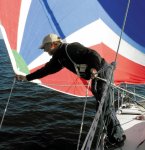
Terrible news from Clipper

There is a hint in this thread that somehow the leisure sailing industry is negligent or ignorant in designing safety equipment to keep a person on onboard. In my own industry, drilling oil wells, I have seen the evolution of fall protection gear since 1990. When I joined a drill crew we used 'belly busters', 'man riding' and safety harnesses that were constructed of 2" wide webbing, big buckles with limited adjustment options, braided steel wire encased in plastic that rusted; the harness / lanyards actually contributed to killing you should you fall from height. There was no control over quality and maintenance consisted of jet washing the canvas fabric. It was the personal opinion of the Toolpusher that decided when the harness / belt was worn out. There were times when I had to climb the derrick, move along the girders and tie back or fit equipment; I tied on when I got to the area I had to work as the safety lanyard was a single hook. If I fell there was a high probability that if it took longer than 20 minutes I would die as a result of reduced blood flow. It took a couple of deaths from this and paralysis from falls being arrested rapidly for the industry to react.

Today we eliminate all man riding (lifting in a bosuns chair type device) by designing derricks with good access. The harnesses are designed to be fully adjustable, they have rescue loops that can be dropped down so that the suspended person can put their feet in and stand up to take pressure off the groin area and maintain good blood circulation. The tethers are designed to stretch at a rate that decelerates the fall velocity at a safe rate, positive indication devices of overloading or fall restraint action, the hooks have one handed double acting locks, everything has a unique serial numbers and traceable to a QA technician and have a dispose by date, many drilling companies only allow personnel who have completed practical training to use a harness and work at height. Despite this, last year the industry had a general recall of a manufacturers product when it was discovered that the ladder climbing device could fail in the open position and not stop a fall. Self Retracting Lanyards (SRLs) are hung from areas where working at height happens regularly e.g. above equipment and typically extend over 30m: some snap to a halt and some limit the fall speed to a maximum and some decelerate a fall to zero velocity. There are many other aspects around working at height that have been addressed.

My point is that a highly regulated industry has taken many years to come up with safe working practises and equipment associated with falls from height. I see no reason why the leisure industry would act any different. Of course, now that there are fatalities it may force a change if consumers demand it and are prepared to pay for it.
 
I'm a cynic - the consumers are going to shrug their shoulders and know it will never happen to them, so why get upset.

I agree with Blowing, but that is not going to change anything. It is interesting that there was more heat and passion over Rocna (and some recent passion on the KTL and Sailaboutvic threads) than over (possibly) preventable deaths on yachts.

I have a passing interest in height safety as the people I use to test equipment, chains and shackles etc, also specialise in height safety equipment. Commercial/industrial height safety equipment, particularly harnesses, are light years ahead of that available for yachting. The harnesses would not suit yachting as the webbing is a bit too wide - but why effort has been made for the mining,, construction, energy (think wind farms) and this has not spun off to yachting - mystery.

Thinwater seems to indicate that improvements have been made for rock climbers - which is not that far removed from yachting (lots of climbers retire and take up sailing).

Go figure.

I wonder when PBO will initiate an investigation of equipment, not specifically hooks - but the whole integrated package.

Jonathan
 
My view is that equipment that meets a standard should do what people expect it to do, not break under light load, and it should be robust enough to allow for realistic forms of operator error. Something that climbing and sailing have in common is that clips are often made in tough conditions. Does it look like I have two hands free? Is it possible that I am tired, afraid, and my fingers are cold (in this case I was in control, but there are times it gets quite hairy, climbing in a blizzard at altitude)? I've done both, and clipping when leading some thing hard is more difficult and a fall much more likely.
Leading%u00252Bin%u00252BWhite%u00252BOak.jpg

If the sailor chooses not to use a tether, that is fine with me. I don't always use one and I don't always wear a PDF. If a racer wants to build something light weight and wear that instead, that is on him, rules of the race permitting. I am fine with risk. But certified equipment should do what I expect it to.
 
My point is that a highly regulated industry has taken many years to come up with safe working practises and equipment associated with falls from height. I see no reason why the leisure industry would act any different. Of course, now that there are fatalities it may force a change if consumers demand it and are prepared to pay for it.


Coming from a slightly similar industry not sure I completely agree with all of that. In live event / theatre rigging back in the day it was a standard practice to have a couple of pints of old wife beater for lunch then climb back up 80' to the roof , harness usually but an optional extra.

Very different these days of course, though the basic fall arrest lanyard has connectors very similar to sailing lanyards - but everyone (should) knows - don't side load them!!! Obvious when you're looking down to the little bald patches way below with some healthy fear which is not so instinctive on a boat but the result can be the same - game over.

To make a connector able to withstand such hefty side loads, have it light enough to wear day in day out, be able to easily attach one handed dog tired at a cost which is realistic is a very tall order indeed, you need to design something which can and will be used day in day out as well as just strong.

Much of the knee jerk reaction on these threads is to look for just one target to put all the blame on, but the universe doesn't really seem to work that way, the causes can well be multiple and possibly unexpected. Southern ocean for months must push statistics to seldom visited areas, extreme conditions day in day out for months at a time. Not that this should just be put down to just bad luck or anything.

Little real data available, but one thought is if someone experienced in working at height had an afternoon to run around the boat in Gosport they might have came back with - "Guys, really unlikely but if this, this and this happens then that connector could get jammed and side loaded - bad bad bad." Or maybe it was obvious, or maybe it was so unlikely that no one could have spotted it. We don't know yet.

End of the day it's much more complicated than putting all the blame onto one aspect of a piece of equipment.

Personally solo offshore I use a lightweight climbing harness with steel carabiners & a grigri, lanyard is always as short as it can be; though that's probably not really the ideal solution for most people who have no experience of rope access kit and instinct which gets learned along the way.

If you want something strong, tried and tested then use a steel screwgate caribiner.

Then complain that it's too hard to use...
 
If the American and European standard are different and are different for different 'industries', firemen, sailors - I have to wonder why - given they are used as, or for, fall protection. If the American standards are higher - I'd rather be a wimp and an American :) - though I might have considerable difficulty at immigration - just as a starter :( and I'd need to learn how to spell!

The standards should be the lowest minimum and hopefully some manufacturers have a higher specification. It would be interesting, in the fullness of time, to see a spreadsheet of standards, for the 'main' different countries, the main industries/applications, how these standards match to specifications from different manufacturers and how these specifications compare with actual test results.

It would be great if they only did as one British Yachting magazine did , and have a guy jump overboard at 4 knots, tethered by one, and see what happens. Sorry I can't remember which magazine that was, or when. Does anyone else here know?
The amount of use a harness gets is often porportionate to how easy and comfortable it is to use. The top of shoulder attachment doesn't dig into your ribs, so it is comfortable to wear 24-7 at sea. Using a flat tether like seat belt, also has that advantage.
At sea I drag about 100 feet of 3/8th poly astern hooked to the tiller with a shock cord stopping it from pulling the helm hard over.That way if I fall over I can stop the boat. I tack it with the boat ,so the boat will round up rather than bear off.
 
Last edited:
When sailing back from Long Island to the UK a few years ago, the metal ends of the tethers we purchased at West Marine, failed/bent even under normal load conditions, so some tethers are definitely not effective.

The founder and CEO of West Marine tried a circumnavigation with all West Marine gear.It kept breaking and breaking on every leg. When he got home and a friend of mine, one of their salesmen went to a meeting in Frisco, where the CEO had assembled all his suppliers, and screamed at them;
"MY CUSTOMERS ARE NOT YOUR GUINEA PIGS!"
He was extremely angry at the crap he had been conned into selling cruisers for so many years, not realizing what crap it was.
 
The founder and CEO of West Marine tried a circumnavigation with all West Marine gear.It kept breaking and breaking on every leg. When he got home and a friend of mine, one of their salesmen went to a meeting in Frisco, where the CEO had assembled all his suppliers, and screamed at them;
"MY CUSTOMERS ARE NOT YOUR GUINEA PIGS!"
He was extremely angry at the crap he had been conned into selling cruisers for so many years, not realizing what crap it was.

Still happens

An anchor was introduced relatively recently, it had a mild steel shank (after all the brouhaha over Rocna), it bent, they replaced with a High Tensile shank. But knowing they had anchors with better shanks being shipped they still sold the old anchors with the mild steel shanks. No-one thought this was in any way immoral (except me - and I was accused of a vendetta). I could go on.

Jonathan
 
I thought sewn webbing was only rated for a single load event.

One issue with safety equipment generally is the psychology of people using it who might become involved in situations under a false sense of security. It's often better to not put oneself in a dangerous situation with safety gear. I know that unexpected things happen on yachts, especially when racing, but that's the whole point, get that sail down in good time, avoid that weather.
 
I thought sewn webbing was only rated for a single load event.
Is it possible you are thinking of webbing shock absorbing lanyards, where the shock absorption section can only absorb one major hit? For this reason and several others, I prefer lanyards of inherently shock absorbing material to sewn absorption sections.

Industrial tethers are also designed to trigger at too high a force; they are rated based on a full body harness. With only a chest band, the trigger force would logically be only about 1/2, or less than 500 pounds.
 
It would be great if they only did as one British Yachting magazine did , and have a guy jump overboard at 4 knots, tethered by one, and see what happens. Sorry I can't remember which magazine that was, or when. Does anyone else here know?
The amount of use a harness gets is often porportionate to how easy and comfortable it is to use. The top of shoulder attachment doesn't dig into your ribs, so it is comfortable to wear 24-7 at sea. Using a flat tether like seat belt, also has that advantage.
At sea I drag about 100 feet of 3/8th poly astern hooked to the tiller with a shock cord stopping it from pulling the helm hard over.That way if I fall over I can stop the boat. I tack it with the boat ,so the boat will round up rather than bear off.
Had a chat with my mad aerial acquantance today. He's been known to be a long way aloft fixing things like phone base stations.

The top of shoulder harness point has zero fall rating according to some industrial standards.
The chest harness point is rated for a few feet. Say a fall of about 3 feet.
The back harness point is rated for more, say about 10 feet.

A lot of harnesses for the likes of aerial riggers have multiple points of attachment, the shoulder and waist points are for stopping them reaching the edge, not for arresting a fall.
If you fall on a single shoulder harness, if it doesn't take your head off, it will likely break your neck at a much shorter drop than is safe with a chest harness point.
But, to balance this, yacht harness use is not always much like falling off a cliff, a lot more sliding down a slope and being dragged through water.
 
Had a chat with my mad aerial acquantance today. He's been known to be a long way aloft fixing things like phone base stations.

The top of shoulder harness point has zero fall rating according to some industrial standards.
The chest harness point is rated for a few feet. Say a fall of about 3 feet.
The back harness point is rated for more, say about 10 feet.

A lot of harnesses for the likes of aerial riggers have multiple points of attachment, the shoulder and waist points are for stopping them reaching the edge, not for arresting a fall.
If you fall on a single shoulder harness, if it doesn't take your head off, it will likely break your neck at a much shorter drop than is safe with a chest harness point.
But, to balance this, yacht harness use is not always much like falling off a cliff, a lot more sliding down a slope and being dragged through water.

This doen't help you much if the chest tether drowns you quickly,or the back tether doesn't let a single hander reach the tether , and pull himself aboard, all factors the numbers crunchers can't calculate mathematically .
This is a very common screw up from relying on number crunchers, rather than logic which is beyond the reach of numbers crunching. In the tests I mentioned, they said hitting the water at the end of the tether was a light tug, not the sudden jolt they expected.
Not relying on webbing means making the entire harness out of rope, a huge disincentive to wearing it full time, or as often as one should, which would increase the risk.
 
Last edited:
I thought sewn webbing was only rated for a single load event.

One issue with safety equipment generally is the psychology of people using it who might become involved in situations under a false sense of security. It's often better to not put oneself in a dangerous situation with safety gear. I know that unexpected things happen on yachts, especially when racing, but that's the whole point, get that sail down in good time, avoid that weather.

That is why I like my 3 ft high solid lifelines and chest high temporary lines at sea (easily removed in port.)
 
Still happens

An anchor was introduced relatively recently, it had a mild steel shank (after all the brouhaha over Rocna), it bent, they replaced with a High Tensile shank. But knowing they had anchors with better shanks being shipped they still sold the old anchors with the mild steel shanks. No-one thought this was in any way immoral (except me - and I was accused of a vendetta). I could go on.

Jonathan

Just like a grocer here in Comox ( Johns Independent Grocers ) Who, I have just been told, relabels expired chicken and puts it back on the shelf with new expiry dates.
Not hard to weld a new shank on..IF you have been forewarned. That is why some prefer to build their own boats ,so they know exactly how it is put together, no surprises.
 
That is why I like my 3 ft high solid lifelines and chest high temporary lines at sea (easily removed in port.)

Can you post a picture of your solid lifelines please and the chest high ones if they are rigged up?
 
Had a chat with my mad aerial acquantance today. He's been known to be a long way aloft fixing things like phone base stations.

The top of shoulder harness point has zero fall rating according to some industrial standards.
The chest harness point is rated for a few feet. Say a fall of about 3 feet.
The back harness point is rated for more, say about 10 feet.

A lot of harnesses for the likes of aerial riggers have multiple points of attachment, the shoulder and waist points are for stopping them reaching the edge, not for arresting a fall.
If you fall on a single shoulder harness, if it doesn't take your head off, it will likely break your neck at a much shorter drop than is safe with a chest harness point.
But, to balance this, yacht harness use is not always much like falling off a cliff, a lot more sliding down a slope and being dragged through water.

I don't think you understood him, or he didn't explain it well. For example, parrachute harnesses are shoulder top and can handle some of the greatest loads. This is obvious.

How much impact a harness can manage (not how far you fall) depends on how the harness distributes the load. Harnesses that include the hips and legs can manage the highest impacts. Those that only use the chest or waist, hardly and force at all.

The difference in attachment points depends on how you want to hang or fall. The advantage of the shoulder or back attachment is that you don't hit the back of your head (construction falls and lowering into confined spaces). The advantage of a waist tie is that you are in a better work posture and you don't bang you face and knees (rock climbers and rope access workers).

Thus, on a boat the correct attachment point depends on what you are doing. Up the mast, front of waist. On deck, center of chest. In the water, this is still up in the air (towed back would be best, but when trying to help your self back on board, center of chest).

No single answer, which is why tower harnesses have multiple points. I hope this helps.
 
Last edited:
Last edited:
Would it not be a heck of a lot simpler and safer, to design the boat's systems so that crew do not to have to be on the foredeck for routine sail changing?
 
Would it not be a heck of a lot simpler and safer, to design the boat's systems so that crew do not to have to be on the foredeck for routine sail changing?

I think you and I call them furlers :)

They have a forestay, inner stay and a prodder to take a Code Zero. Plenty to allow them to ring changes.

We used to use hanked on sails, and I note hanked on sails are not unusual on racing yachts (I assume because the sail might be a better shape and it reduces windage and weight aloft). Are there other reasons?

But for yachts all of the same design I cannot see that it matters - they could all use furlers and they would be equally disadvantaged (and equally reduce the need for so many visits to the foredeck)


As an aside - storm jibs are commonly all hanked on - and the last place you want to be when you need a storm jib - is on the foredeck.

Jonathan
 
Top