Terminals on heavy battery /starter cable

Only if the surveyor is a bell end.
Hahahahahahaha! You've made me laugh out loud.
I do seem to pick them!

I reckon the run from starter battery to motor is 1.5 metres now as opposed to over 5 metres before, also it was crap where the isolators were under the companionway they were always getting soaked.

Surveyor will still pick holes in it. I'll just do a Churchill dog like I always do, nod my head while disagreeing.
 
Last edited:
I crimped and soldered all the connections when I increased the size of the domestic bank on my old boat from 2 to 6 batteries. First, I crimped the terminals on to the cable. Then I wrapped wet kitchen paper around the insulation close to the terminal, held the terminal in a blowtorch flame and applied solder through the little vent hole in the terminal. There was minimal damage to the insulation. The cable didn't seem inflexible afterwards.

Interesting thanks. I might practice with some scraps of wire see what the results are like. Was that on your old hr352? Did that have the same setup as my 38 with the isolators under the steps?
 
Interesting thanks. I might practice with some scraps of wire see what the results are like. Was that on your old hr352? Did that have the same setup as my 38 with the isolators under the steps?

Yes, that was on the 352. The engine and domestic isolators were under the companionway. I put the 4 extra batteries under the starboard berth in the aft cabin.
 
Yes, that was on the 352. The engine and domestic isolators were under the companionway. I put the 4 extra batteries under the starboard berth in the aft cabin.

Cool. I've got the starter battery and 4 x 120 ah gel batteries in the original box under the port berth in aft cabin. If I ever add more I'd put them where you did. Don't suppose you can remember anything about your (engine) exhaust system can you?
 
Cool. I've got the starter battery and 4 x 120 ah gel batteries in the original box under the port berth in aft cabin. If I ever add more I'd put them where you did. Don't suppose you can remember anything about your (engine) exhaust system can you?

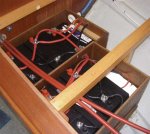
I built battery boxes to restrain the 4 extra batteries (and the original starter battery), see pic.

I remember the exhaust system. Why?

batteries.jpg
 
Those are very heavy, Yngmar, what did you need such high current capacity for may I ask ?

As contessaman pointed out, battery cables aren't sized for their current capacity but to keep the voltage drop at acceptable levels, both when drawing large loads (windlass up to 100A for several minutes, inverter spikes 350A, etc.) and when charging them (50A constant).


That looks a lot like the one I've written about above. Works fine.
 
I've gone for the 16T sucker in the end it was only a few quid more. Looks like it has crimp dies for 50, 60 and 70 mm sq cable amidst the set of 11 dies.

http://www.ebay.co.uk/itm/16Ton-Hyd...628955?hash=item282d3c761b:g:eYkAAOSw32lYuA6p

I'll report back if its any good / rubbish. Interesting point on secondary use as rigging chopper if you could make / obtain cutting jaws for it. Saying that I've always got an angle grinder on board so I'd probably use that if the worst happened.
 
Yes, you can improve the crimp by also soldering the joint. Indeed, Trojan Batteries recommend this method (see http://www.trojanbattery.com/pdf/WP_BatteryCableGuide_0512.pdf). Using adhesive-lined heatshrink will help keep moisture out and improve the appearance.

Nahh, I'm gonna call nonsense on Trojan for that one:
The images, non soldered, note the part of the connector between crimp and terminal post. if the colours are to be believed it is colder than even the (heat) insulated cable even a long way from the crimp.
The crimped section appears to be generating more heat than the terminal post. a proper heavy duty crimp is almost a cold weld and will be a far better contact than can be achieved with a terminal post.
They state that only the outside of the cable will be in contact, while this is true it completely fails to acknowledge that the inner strands will be making very good contact with the outer ones.

I admit that it is very easy to produce a poor heavy duty crimp, but when done properly there isnt a better connection.

Anyone interested may perform a couple of destructive tests.
Crimp a terminal on a few inches of cable, strip the insulation and splay the strands. If the strands can be pulled out its a bad crimp. In a good crimp the strands will break before coming out.
Next saw through the crimp across the cable. Does the middle look like strands (bad crimp) or a solid block?
Lastyl split the crimp long ways and inspect the strands, If they are round its a bad crimp. In a good crimp they will be deformed.
Crimp a terminal on a few inches of cable, strip the insulation and splay the strands. If the strands can be pulled out its a bad crimp. In a good crimp the strands will break before coming out.
 
I built battery boxes to restrain the 4 extra batteries (and the original starter battery), see pic.

I remember the exhaust system. Why?

View attachment 63146

Cool thanks for the photo.. Is that teleflex remotes for the steering? Mines all edson cables and pulleys everywhere. Re: the exhaust did you have the VP rubber muffler / watertrap under the floorboards in aft cabin and then your exhaust hose going up in a big loop in the space between to wood trim and the transom to form a swan neck? Just wondering if what I have is original you see...
 
Quick check please. Yngmar suggests Silicone Grease on terminals.

The Bavaria paper says silicone grease is an insulator !


Here's a discussion paper from a guy who seems to know what he's talking about.

http://www.w8ji.com/dielectric_grease_vs_conductive_grease.htm
....
That seems to me to be complete twaddle. And he needs a new battery for his yellometer.
There is a huge difference between 'conductive grease' and 'anti-seize' grease with metal in it.
You can get (electrically) conductive grease. We use it in certain high power electronics applications.
I don't think it has any relevance to what we want here though.
http://www.mgchemicals.com/products...ductive-greases/silver-conductive-grease-8463

I've found metal-loaded anti-seize grease to be good for battery terminals on motorbikes which get wet.
AIUI, the grease fills gaps that would otherwise get water in. The water then causes corrosion, which often swells and forces the contact apart.
The conduction is always metal to metal, but isn't 100% of the mating area, there are almost always voids to get water in.

Decent crimps have a high% of metal to metal contact. If you make a dummy one and saw it in half, it should look like solid metal. All the strands of the cable molded into each other.

For things that are going to get wet, I like to apply a light oil or silicone of some sort, e.g. GT85, or something similar that fills the little voids in the crimped cable but doesn't get everywhere or leave a sticky surface that attracts dirt, which holds moisture etc.
I don't believe in applying the grease/oil/silicone before crimping, but I expect any crimping worth the name will force the lubricant out of the way.

Those sub-£20 hydraulic crimpers look OK, in the past I've used an Ormiston talurit tool when stuck, but those are now a lot more than £20!
I've also soldered big cables with no problems. I squeezed the terminal to minimise the solder gap and used a blowtorch and wet rag.
If in doubt, do a test piece and check for strength and then cut it open to see what's happened. I'd rather take it to the man, but sometimes that's not going to happen!

Silicone grease generally is an insulator. You can buy it with high voltage credentials if you want, but a layer of dust and dirt on the surface voids that!
 
You will need a seriously heavy crimper to do battery cable ends. Not worth buying one for a one off, but find an auto (or marine!) electrician who has the kit. cut your cables to length and have him crimp the terminals.


Agree 100%. A smaller set of hydraulic crimpers for the boat by all means but this is one job you don't do very often so why not give it to someone who does and who has all the gear. It'll take them 10 minutes or so, that all.

I'm a great fan of soldering but wouldn't recommend it for that size of crimp as you'd need to use an hell of a lot of heat to get the whole thing up to temperature and probably end up damaging the insulation. No harm in tinning the cable but really you just need to be sure the conductors and crimp are clean. Ideally you'd be using pre-tinned cable anyway.
 
Nahh, I'm gonna call nonsense on Trojan for that one:
The images, non soldered, note the part of the connector between crimp and terminal post. if the colours are to be believed it is colder than even the (heat) insulated cable even a long way from the crimp.
The crimped section appears to be generating more heat than the terminal post. a proper heavy duty crimp is almost a cold weld and will be a far better contact than can be achieved with a terminal post.
They state that only the outside of the cable will be in contact, while this is true it completely fails to acknowledge that the inner strands will be making very good contact with the outer ones.

I admit that it is very easy to produce a poor heavy duty crimp, but when done properly there isnt a better connection.

Anyone interested may perform a couple of destructive tests.
Crimp a terminal on a few inches of cable, strip the insulation and splay the strands. If the strands can be pulled out its a bad crimp. In a good crimp the strands will break before coming out.
Next saw through the crimp across the cable. Does the middle look like strands (bad crimp) or a solid block?
Lastyl split the crimp long ways and inspect the strands, If they are round its a bad crimp. In a good crimp they will be deformed.
Crimp a terminal on a few inches of cable, strip the insulation and splay the strands. If the strands can be pulled out its a bad crimp. In a good crimp the strands will break before coming out.


Agree 100% - soldering is valid for smaller connectors but should not be necessary on a large crimp.
 
Cool thanks for the photo.. Is that teleflex remotes for the steering? Mines all edson cables and pulleys everywhere. Re: the exhaust did you have the VP rubber muffler / watertrap under the floorboards in aft cabin and then your exhaust hose going up in a big loop in the space between to wood trim and the transom to form a swan neck? Just wondering if what I have is original you see...

Not Teleflex, my 352 had Solimar cable steering, with the cables running in conduits only through the aft cabin.

The 352 exhaust had a Volvo Penta rubber muffler alongside the engine, on the starboard side of the engine compartment. The exhaust then went up through the starboard cockpit locker into the coaming, through a 180 degree bend, and back down to the exhaust outlet around water level.
 
The 352 exhaust had a Volvo Penta rubber muffler alongside the engine, on the starboard side of the engine compartment. The exhaust then went up through the starboard cockpit locker into the coaming, through a 180 degree bend, and back down to the exhaust outlet around water level.

Hmmm...Seems more sensible than mine. Get the high rise in early then downhill all the way to the transom... Mine is uphill all the way from the silencer to the transom. On paper what I've got is acceptable but I did wonder if there wasn't a better way and using the adjacent cockpit locker to get the height on first with a run downhill under the stbd bunk had occurred to me.. Maybe a project for another time...
 

Other threads that may be of interest

Top