temporary nav. lights? for occasional use

FairweatherDave

Well-Known Member
Joined
28 Sep 2009
Messages
2,089
Location
Solent
Visit site
My boat has no nav. lights other than a defunct all round white at the top of the mast. It is a 22ft trailer sailer (so just under 7metres) so I can get away with a torch on the sail etc etc but I was thinking of upgrading to deck level nav lights. However a proper permanently wired in set up does not appeal partly due to cost but also not wanting to mess with the structure of the newish boat/mast. I don't like those little battery emergency lights as the time you'd need them I would not have the big expensive c batteries with any charge. However my 12volt "car" battery would pretty much always have charge. Therefore my plan was to get some blocks of ply to mount basic 12v nav lights on and then use cable ties to fit the blocks to the push pit/pulpit (so they are fixed, don't flop about) and have the wiring draped (but out the way) back to the battery below in the cabin. All this (blocks, lights and wiring) would normally be removed and stored below where it would not be suffering from the elements and would therefore last longer. A bit of a pain to set up compared to a flick of a switch but given I probably might only use it a couple of times a year for perhaps an hour inside Chichester harbour, probably returning from East Head to Emsworth mooring, so pretty tame anticipated use.... although the harbour can have plenty of night traffic, ribs and fishing boats so it is good to be seen. I know the majority here will have properly installed nav lights but does anyone do this? Is it as easy to do as I describe or are there major pitfalls I have not anticipated? (PS I have left out the motoring lights issue for simplicity, wanting to focus on the pragmatics not start a colregs diversion). Thanks for any replies. Dave
 
Nav lights

I have fitted the LED nav lights P&S to the sides of the cabin of my very similar boat to yours. It has been claimed that the jib my cover the nav lights but this is not the case theya re about mid way from deck to cabin top and towards the front of the cabin side. Lights on pulpits are very susceptible to damage when hitting jetties etc but are well protected inboard on cabin top.
http://www.biasboating.com.au/p-2846-led-port-starboard-navigation-lights.aspx
They are very bright and low current. Oz dollar is about 62 pence at the moment and while you may pay VAT on top of price however you should get Oz GST 10% taken off price. But then I am sure these are available in UK. ie about 25squid for a pair plus postage.
I reckon this arrangement would be far easier than your plywood boards.
Don't even think about lights at top of mast. The wiring and plugs especially when removing mast are just too much trouble. And often not seen when close.

The stern light is another question. It needs to be mounted high above the rudder and o/b motor mount so on stern rail. commercial LED stern lights are expensive. I have built one out of 8LEDS in a jam jar. You have to get the directional LEDs to cover out to the sides as well as aft and to cover the sides at a reasonable heel angle. Hence min 8 LEDs. It is going to get a test tonight in a night race. Previously I have used an LED shed light with diffuser which gives very good coverage. I do find it easy to fit a temporary stern light but I don't think i would want temp P&S lights.
Anyway you will end up with what suits you but that is my opinion after much experience and occasional nav light use. good luck olewill
 
Last edited:
Therefore my plan was to get some blocks of ply to mount basic 12v nav lights on and then use cable ties to fit the blocks to the push pit/pulpit (so they are fixed, don't flop about) and have the wiring draped (but out the way) back to the battery below in the cabin. All this (blocks, lights and wiring) would normally be removed and stored below where it would not be suffering from the elements and would therefore last longer. A bit of a pain to set up compared to a flick of a switch but given I probably might only use it a couple of times a year for perhaps an hour inside Chichester harbour, probably returning from East Head to Emsworth mooring, so pretty tame anticipated use.... although the harbour can have plenty of night traffic, ribs and fishing boats so it is good to be seen.

While you are faffing about setting all this lot up you might just as well install them properly.
They are then available to use at the flick of a switch or two without even more faffing about and without cabled draped all over the place!

BTW
I have P&S lights, (because when I originally fitted them the bicolour version was not available)
I have a steaming light mounted on the mast
I have my stern light mounted on a flag staff which replaces the ensign staff when required. That gets it well above the outboard even when that is raised out of the water. It is powered via a plug and deck socket. A split pin ensures the light is correctly orientated.

I added a tricoluor at a later date.

LEDs were not available when I installed them & I would probably not fit them even now.
 
My boat has no nav. lights other than a defunct all round white at the top of the mast.
Fixing that would be my No.1 priority.
It is a 22ft trailer sailer (so just under 7metres) so I can get away with a torch on the sail etc
That assumes you see the 'other guy' first - an all-round masthead white allows the 'other guy' to see you first ...
I don't like those little battery emergency lights as the time you'd need them I would not have the big expensive c batteries with any charge.
You can buy 2xAA to D (sic, not C) converters on Ebay. I find it always pays to have a few fully-charged NiMH AA's around - with suitable converters they can be used to power just about anything.

The proposed idea of plywood, cable-ties and wiring draped around, sounds like a right lash-up. Fix the masthead white - it can also be used as an anchor light, and you never know when you might find yourself needing one of those if your navigation plans should ever go pear-shaped.
 
Last edited:
I reckon there's a lot of owners in a similar situation to you. Most boats are only used for day hops and very, very rarely do an overnight. However we have to be prepared for the unexpected engine failure, anchor drag or weather shift keeping us out in the dark. I did a rewire on my boat and seriously thought about using battery powered deck level lights but what to do about steaming light up the mast? In the end I wired lights up to the 12v system as the tools and bits were all out but feel there's a case for rechargeables or replacing alkalines when fitting out every year.
 
Thanks for the replies so far. I agree I am suggesting a big faff, but at the same time durability and cost are issues. I have visions of costly corrosion on the seldom used permanently mounted lights.....
 
This is really useful stuff from everyone so far. I am at the early stages so I can do whatever. I agree completely about fixing the mast head light but also with Olewill about the grief of maintaining one so it will be fixed I hope overwinter. The battery point is interesting, I have no problem with AAs but my most reliable battery is the 12volt "car" battery, which will be there if I get caught out.
 
I have visions of costly corrosion on the seldom used permanently mounted lights.....
Mine, all Aquasignal, were fitted in 1978 (tricolour 1979) Lasted until about 3 years ago and then replaced due to crazing of the lenses... no problems with corrosion.
(Actually found some cheap copies with identical lenses so was able to swap the lenses, except for tricolour, more cheaply than buying replacement Aquasignal parts)
 
My boat has no nav. lights other than a defunct all round white at the top of the mast. It is a 22ft trailer sailer (so just under 7metres) so I can get away with a torch on the sail etc etc but I was thinking of upgrading to deck level nav lights. However a proper permanently wired in set up does not appeal partly due to cost but also not wanting to mess with the structure of the newish boat/mast. I don't like those little battery emergency lights as the time you'd need them I would not have the big expensive c batteries with any charge. However my 12volt "car" battery would pretty much always have charge. Therefore my plan was to get some blocks of ply to mount basic 12v nav lights on and then use cable ties to fit the blocks to the push pit/pulpit (so they are fixed, don't flop about) and have the wiring draped (but out the way) back to the battery below in the cabin. All this (blocks, lights and wiring) would normally be removed and stored below where it would not be suffering from the elements and would therefore last longer. A bit of a pain to set up compared to a flick of a switch but given I probably might only use it a couple of times a year for perhaps an hour inside Chichester harbour, probably returning from East Head to Emsworth mooring, so pretty tame anticipated use.... although the harbour can have plenty of night traffic, ribs and fishing boats so it is good to be seen. I know the majority here will have properly installed nav lights but does anyone do this? Is it as easy to do as I describe or are there major pitfalls I have not anticipated? (PS I have left out the motoring lights issue for simplicity, wanting to focus on the pragmatics not start a colregs diversion). Thanks for any replies. Dave

How much is all of that going to cost you, and how long to set up (as in the system)? How much is your time worth? Are you really going to want to go to that trouble every time?

An LED tricolour from NASA Marine is about £50, if I recall. Very bright, and purpose built. At that price I struggle to understand why anyone would go for something inferior.
 
Fair point bbg. That route is my least preferred (but still an option) as it involves the mast and although a "trailer sailer" she spends the season on the mooring and I'm not going up the mast for any reason if there were a problem, also being 95% in the harbour deck lights are more effective for being seen.
Thanks for the reassurance on durability Vic
 
okay, head above parapet

So I am concluding permanently mounted port and starboard lights, and some kind of stern light. Now if I am motoring, from my understanding of the Colregs, the stern light can go off and I can display an allround white. That would be my repaired mast head light. But if it failed then I would plan to hoist an all round white anchor light as a steaming light (being aware that the mast would be impeding some of the "all round" aspect.)(Note I am travelling at say 5 knots in a craft under 7metres)(I do realise that some steaming lights are not all round white). Have I got it right?.....Thanks Dave
 
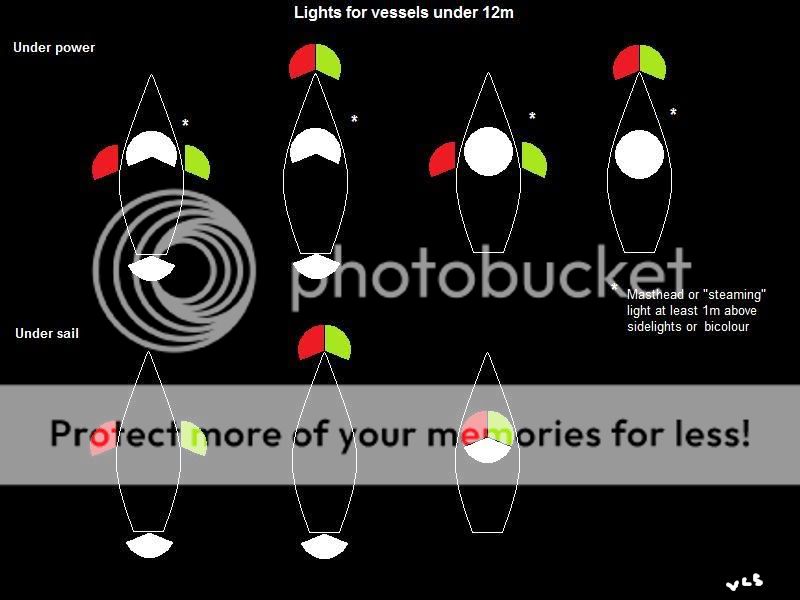
You may find the diagram below helpful. You should refer to the IRPCS for details of visible arcs and ranges.

It shows the legal combinations of the common lights for vessels of less than 12m LOA

Navigationlights.jpg


Discalimer to satisfy academic pedants and pedantic academics! It does not show the use of just an all-round white, which may be permitted for some craft under 7m LOA. It does not show the optional all-round red and green lights commonly used by large sailing vessels and it does not reflect the fact that some of the combinations may also be permitted for craft over 12m
 
Thanks Vic
I have studied your diagram several times but did not fancy hunting thru' all the old colreg threads yet again. So I am just about okay hoisting my anchor light up the spinnaker halyard bearing in mind its slight compromise being in front of the mast.
Have not found any LED port or starboard lights that seem as cheap as Olewills at the start of the thread........
 
Although not within the letter of the colregs, I used LED cycle lights on a 22 footer. They come in white and red, very cheaply from Halfords, and I painted the lens of a second white light to green. Batteries last about 12 hours. They have plastic jubilee clips that go onto the pushpit and pulpit and just snap on and off. For emergency use only, they were fine, and seemed very visible. Their arcs were broadly similar if the lights are angled carefully.
 
LED Stern light

I mentioned yesterday that I was trying out a home made LED stern light.
It worked brilliantly. So some details.
The source of the LEDs.. Cheapest is a string of white LED Christmas lights. The cost is a few pence per LED with 60 or so in a string. They come with a 24v AC transformer. I found that the string works in groups of 8 LEDs in series. So cut off a bunch of 8 at the far end of the string. So the lights are still usable for Christmas. You can buy individual LEDs from Maplins etc.Get best brightness type and note the rated current.
You need to run them in 2 groups of 4 in series off 12v. The LEDs drop about 2v per LED (bulb) and run at about 25 milliamps so you need a resistor of about 160 ohms for 12v operation or 240 ohms for running with engine charging (14v supply). One resistor in series with 4 LEDs so 2 resistors for 8 LEDs.

Now check the LED bulb type you have. Some have a fairly broad beam while mine were something like 30 degree focussed beam. Off the end. This is the more common type but some Christmas LEDs seem to have a flatted tip to spread light around more.
With a 30 degree LED bulb I got a 1 inch piece of 2 inch plastic pipe cut so that you have 180 degrees or less of pipe and drilled holes in the pipe to take the LED bulbs pushed through from the inside.
A stern light must have coverage over 135 degrees so you put two LEDs facing dead astern one above the other but with one angled to the left by 15 degrees and the other to the right 7.5 degrees. Another 2 holes are drilled for LEDs another 30 degrees to left and right.
Another 2 LEDs would be fitted a further 30 degree to the left and right of the first 4. However if you are sailing at a heel angle the narrow 30 degree beam might be pointing at the water one side and to the sky on the other. So I fitted 2 LEDs (each side) one facing up 15 degrees the other down 15 degrees each facing towards the side of the boat.ie 75 degees from dead astern. Make a diagram to check the angles as I may have the angles a bit confused.

The result when powered is an LED beam pretty close to or exceeding the coverage required for a stern light. The angles need only be approximate for good coverage.

As a temporary light I mounted mine in the lid of a small jam jar with 2 X 9V batteries. The lid had 2 bits of double sided velcro to attach it to the stern rail. However the whole would work well in the casing of a normal stern light holder.
The lens (jam jar) tending to scatter the light quite well. reports from, other boats indicates it is all very bright.
The same principal can be used to make an anchor light, steaming light or inside light. An anchor light using 8 LEDs in 360 degree azimuth might tend to not cover quite so well with each LED bulb covering 45 degrees so 12 LEDs would be better. Don't try to do Port and Starboard lights.
You should check the current flow through the groups of 4 LEDs and adjust the resistor to get about 25 milliamps through each LED.
something to fiddle with over dark winter. olewill
 
Navilight

Yes very neat however it would have to be mounted on the highest point on the boat. Mast top. So not easy to turn on with its internal batteries and it would not be suitable for a boat that heels as the beam of the lights is very narrow in the vertical plane.
ie 30 degree bulbs would be very dim if the boat is heeling more than 15 degrees. So IMHO only suitable for power boats canoes or dinghies. olewill
 
Doesn't have to be mast top. You can operate one as a bicolour and have it mounted on the pulpit, and then you just need a white at the transom..plus your mast top white. For an under 7m for occasional use its not a bad solution. As to brightness, well the number of crazed opaque UV damaged nav lights that I see on boats means they are probably not all that bad by comparison.

They do however seem to answer the need of the OP. There are better, more complicated solutions, but he knows that.

Tim
 
Fair point bbg. That route is my least preferred (but still an option) as it involves the mast and although a "trailer sailer" she spends the season on the mooring and I'm not going up the mast for any reason if there were a problem, also being 95% in the harbour deck lights are more effective for being seen.
Thanks for the reassurance on durability Vic
Your call, of course, but I don't see why you'd anticipate a problem. Of course you need access at the top of the mast to install, but once the lights are installed they should produce years of trouble-free use. Most boats have their lights at the top of the mast and have no problems.

This is not like an incandescent installation with a bulb that needs replacing from time to time. The LEDs should last until you sell the boat.

I know people have different opinions on whether deck- or mast-head lights are more visible, but I have never seen anything that even approaches research. What I would say is that purpose-built nav lights (either deck or mast level) are more likely to be brighter, and therefore more likely to be seen, than a home-built bodge.

Edit - just seen the navilight. If the OP doesn't want a "top of the mast" installation, that looks like a good solution. Together with the bracket so it can be mounted on the pulpit, that would meet the OP's needs. Might need one for the stern, as well, though.
 
Last edited:
Top