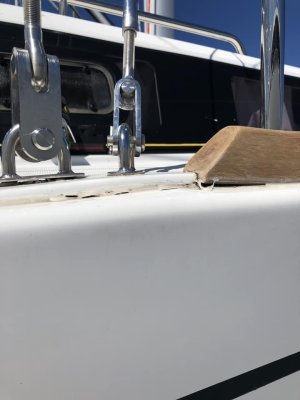
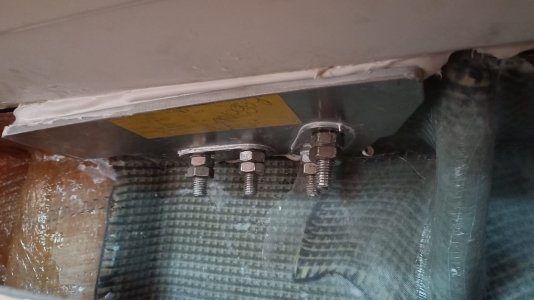
Taking a mould/template to fabricate stainless steel bracket

Thank you for all your input. The boat was manufactured ten years ago in late 2015 and launched in 2016.

There is no other reason than I took the covers off to inspect the "chain plates" and slightly horrified that the construction looked more meccano than a CE Class A sea going vessel. I haven't heard any instances of the deck separating or other issues relating to this construction and I believe Beneteau transfer a lot of their "First" boat tech across to the Oceanis so I should relax knowing it's been well built and is safe.

But the engineer inside me keeps shouting.
I’m all for you going for your instinct and reinforce.....as long as no engineer in the design process though that a little flexibility will make it stronger
 
It's the same as my boat's rigging attachments, that was built in '73. Over the decades the deck holes became oval and two of the shroud anchor points started to bulge on the deck. My deck is over 1" thick at the point where the shrouds pass through and significantly wider than yours. GRP typically has a lower compression strength than stainless steel.

Compression Strength
GRP estimate 70 MPa to 345 MPa
316 stainless steel estimate 170 MPa to 310 MPa

The compression strength figures are in excessive of 10000 psi, so pretty massive.

On my own boat stainless steel L brackets were fashioned for the lower aft shrouds and main shrouds and connected to bulkheads. When I bought the boat, the surveyor identified the L brackets had compressed bulkhead ply laminate for the aft lower shrouds (stay sail inner forestay support). That required repair to the bulkhead and fitting of a large stainless plate to distribute the forces over the ply panel.

All the other shroud penetrations were fitted with large stainless plates to spread the loads further under the deck shelf . deck joint (which is very thick).

It is a poor looking design and over the years compression might start to damage the laminate. It might not. L brackets may just act like levers and do more damage than good. If you were going to fit an L bracket, likely a longer bracket spreading the loads over a greater area of hull would be better.

The alternative is just to watch and manage any future deterioration if occurs.
 
Just make a plywood template to the correct shape. The holes in the stainless can be marked while in place. Add buttress plates at each end to remove any chance of distortion.
In that case you could just fiberglass the ply and you have your bracket
 
I would be more concerned with flexing and leaking before actual separation
Why?
Because A/leaks
B/ Salt water lying under U bolts and attacking the thread doesn’t end well
So it it ain’t flexing when you’re out sailing next, hard on the wind ( go put your hand against it all ) and there’s no tell tale water staining, relax.
These may be factory volume manufactured boats but the designer will have done their sums and know their material science.

Imo !
 
The trouble with these threads is that we have no idea if the location was especially beefed up. One might assume it is, beefed up, originally but the OP has already expressed concerns and making assumptions is not going to allow him to relax.

If you removed the 'U' bolts you could measure the laminate thickness.

Personally I'd assume it did not receive any special attention when the hull was fabricated - because any of the recommendations to reduce the concerns are not particularly difficult nor expensive.

Adding extra glass is an excellent idea - provided the extra glass adheres securely to the underlying structure - and I'm not sure 'we' can guarantee secure adhesion ('we' are not doing the work). The stainless 'L' bracket/chain plate will be secure and add strength (if that area needs to be strengthened.)

This thread is about allaying the OP's concerns......as simply and cheaply as possible.

Jonathan
A glass bracket will have its adhesion, plus the existing hull and deck through bolts holding it on. A stainless steel bracket will probably only have adhesion from something like sikaflex, so will be more dependent on the bolts, and will accordingly apply a more concentrated point load on the hull.

A simple stainless steel L-shaped bracket will probably have more rigidity than the same thing done in fibreglass, tending to better prevent upward flexing of the deck and working of the hull-deck joint, but (a) A simple L isn;t an efficient shape to resist that sort of movement, and (b) the main worry seems to be the chainplates pulling through the deck, which either should help prevent.

Adding a knee to a glass bracket, as I suggest above, should resist relative hull deck movement.

There does seem, however, to be a possibility that locally restraining relative hull deck movement, IF there is currently such movement, could put increased local stresses on this part of the hull, and on the fastenings.

Given (my) uncertainty on this point, a more flexible simple glass L-bracket, without the knee, or with only a partial knee/knees, might be the safer option.

If one fancied getting sophisticated/parenoid/ridiculous (and I probably would) one could perhaps link the shroud chainplate bolts with the leg support bolts, using a turnbuckle, to give in effect an Adjustably Dodgy Knee, providing some control over flexure of the fibreglass L, though of course it would be one thing to potentially have such control, and another to know what to do with it.

I might only do this if I had a spare couple of turnbuckles, since I'm a cheapskate.

I'd think the further the L extends laterally along the hull-deck join the less likely local flexing is to be an issue.
 
Last edited:
A glass bracket will have its adhesion, plus the existing hull and deck through bolts holding it on. A stainless steel bracket will probably only have adhesion from something like sikaflex, so will be more dependent on the bolts, and will accordingly apply a more concentrated point load on the hull.

A simple stainless steel L-shaped bracket will probably have more rigidity than the same thing done in fibreglass, tending to better prevent upward flexing of the deck and working of the hull-deck joint, but (a) A simple L isn;t an efficient shape to resist that sort of movement, and (b) the main worry seems to be the chainplates pulling through the deck, which either should help prevent.

Adding a knee to a glass bracket, as I suggest above, should resist relative hull deck movement.

There does seem, however, to be a possibility that locally restraining relative hull deck movement, IF there is currently such movement, could put increased local stresses on this part of the hull, and on the fastenings.

Given (my) uncertainty on this point, a more flexible simple glass L-bracket, without the knee, or with only a partial knee/knees, might be the safer option.

If one fancied getting sophisticated/parenoid/ridiculous (and I probably would) one could perhaps link the shroud chainplate bolts with the leg support bolts, using a turnbuckle, to give in effect an Adjustably Dodgy Knee, providing some control over flexure of the fibreglass L, though of course it would be one thing to potentially have such control, and another to know what to do with it.

I might only do this if I had a spare couple of turnbuckles, since I'm a cheapskate.

I'd think the further the L extends laterally along the hull-deck join the less likely local flexing is to be an issue.
 
There seems to be a continuing thread that steel is always better than fiberglass. Yes, and at the same time no. If tht were really true, I doubt we would have the fixation with chain plates that we do.

Which is stiffer, wood or steel? It's a trick question, because it depends entirely on how the thing is constructed. And that is at issue here. If the yacht had been designed for nice straight chain plate lines, yes, this reasoning is reasonable (though it could have been done in uni or carbon, which has been done many times). But it was not. the pathway is curved and the load will not be in straight line with the steel. It will be wanting to bend and will greatly depend on bolts.

Additional fiberglass layup, on the other hand, will conform.

But the "real" engineer looks at
  • Service history of the design. This is where scantling tables come from.
  • The layup, if ascertainable. Probably not.
  • And signs of movement or fatigue. I see none.
It's not impossible that by when removing hardware, drilling new holes, and redistributing stress, that you will make the situation worse.

I think this is a matter of fixating on something that scares us and that we also do not understand. Inspect (done) and then move on. At some point the bolts should probably be replaced, but only if water has leaked in, and if there are zero signs of movement, I doubt that is yet. But even then, a steel plate will not likely be indicated.
 
There seems to be a continuing thread that steel is always better than fiberglass. Yes, and at the same time no. If tht were really true, I doubt we would have the fixation with chain plates that we do.

Which is stiffer, wood or steel? It's a trick question, because it depends entirely on how the thing is constructed. And that is at issue here. If the yacht had been designed for nice straight chain plate lines, yes, this reasoning is reasonable (though it could have been done in uni or carbon, which has been done many times). But it was not. the pathway is curved and the load will not be in straight line with the steel. It will be wanting to bend and will greatly depend on bolts.

Additional fiberglass layup, on the other hand, will conform.

But the "real" engineer looks at
  • Service history of the design. This is where scantling tables come from.
  • The layup, if ascertainable. Probably not.
  • And signs of movement or fatigue. I see none.
It's not impossible that by when removing hardware, drilling new holes, and redistributing stress, that you will make the situation worse.

I think this is a matter of fixating on something that scares us and that we also do not understand. Inspect (done) and then move on. At some point the bolts should probably be replaced, but only if water has leaked in, and if there are zero signs of movement, I doubt that is yet. But even then, a steel plate will not likely be indicated.
Sounds a bit of a Trust the Experts line, which of course one has to do sometimes, but Id think a boat is something you interact with more directly. You want to actually Trust the Boat. Its personal

I''m not an engineer, but I dont like the look of this, and if it was my boat, I;d want to do something about that. Sounds like the OP may have a similar feeling.

And, Trite-but-true, if I had always Trusted the Experts, I would be dead
 
Sounds a bit of a Trust the Experts line, which of course one has to do sometimes, but Id think a boat is something you interact with more directly. You want to actually Trust the Boat. Its personal

I''m not an engineer, but I dont like the look of this, and if it was my boat, I;d want to do something about that. Sounds like the OP may have a similar feeling.

And, Trite-but-true, if I had always Trusted the Experts, I would be dead
Agree, I'd want to sleep at night and not have the issue constantly worrying me.

If it were me I'd have two 'L' brackets made with a welded knee. I'd join the new chainplate to the bolts used for drying out, making it one complicated piece (but I don't think its actually difficult to make sure everything matches). As I'd have to take the original bolts and backing plate out - I'd replace the bolts, now. I'd seat the new complicated chain plate on Sika, to fill the irregularities of the original layup. Without being stupid I'd make it quite big (possibly dictated by the current arrangement). I'd use 5mm stainless and have it polished before the final installation.

I'm sure this is over engineered - but I'd sleep soundly - and that's more important than having an engineer recommending something that I'm uncomfortable with.

I'd emphasise that making the bracket will not be complicated, make it initially from heavy card, then move to MDF - or maybe acrylic scrap (available free from the bin of a sign maker, and finally make it from stainless.

Then I'd forget about it and go sailing!, do some overnight anchoring and sleep well. I might replenish my malt and toast the team each night at anchor - and thank them for their advice and support :)


Well not quite, I'd check the modification regularly and then less and less regularly - and if the yacht is a keeper - I'd eventually forget about it.


But I would go through the rest of the yacht, especially the toe rail, deck to hull joint, and winch/windlass attachments.

Jonathan
 
Top