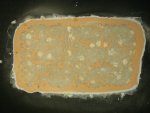
Tackling this hull post osmosis treatment

If the hull gel coat is red I would jet wash clean and then fill with epoxy thickened with a filling / fairing compound. The west one (brown colour) is easy to sand by the way. Do this until all the holes filled or you get fed up, prime if required, antifoul and then sail.

Edit bit - The West stuff is 407 Low Density Filler according to my old, possibly last century West System 'book'.

That stuff looks alright, £14 for 150g though. Probably better to buy the stuff in bulk and mix it up I imagine. There's a few other things around aswell isn't there. I'll get busy with research.
 
That stuff looks alright, £14 for 150g though. Probably better to buy the stuff in bulk and mix it up I imagine. There's a few other things around aswell isn't there. I'll get busy with research.
You only need to fill the holes so it will go a long way when 'spread' out. More to the point it is easy to sand, but hopefully you won't have to do much when applied correctly until my earlier attempts at fairing and filling ......
 
Welcome to the forum!
It looks to me as though the red is gelcoat (and it was common to use pigmented gelcoat below the waterline until it was realised the pigmented was more porous than clear) and the white material is a paint. There is still some blue antifouling on the red gelcoat in your first picture. It's clear there were plenty of blisters but whether from osmosis or poor layup I can't tell. Probably not very important at this stage anyway. What is clear is that they've been extensively opened and allowed to dry out - if that was necessary. My guess is they were scraped / sanded. Almost certainly not blasted in any way.
If you own the boat it can be dealt with but if you haven't paid out to buy it I fall into the camp of walking away and finding a simpler project.
Trying to fill or paint over all those opened blisters will be very difficult to do well as the hull stands now. You will need to remove the rest of the gelcoat, and along with it all the remaining paint. You can get it blasted - not soda as too mild and not beads as too aggressive. Walnut or some other medium aggressive aggregate will do the job quite quickly in skilled hands. Alternatively have it peeled. This is probably cheapest, quickest and cleanest for having it done professionally. You could grind it off yourself which would be cheap but very messy and hard work.
Once the gelcoat is off you will be left with a good surface to work on. Pressure wash with fresh water several times to get rid of all contamination. Coat with a solvent free epoxy and work the material well into the surface with a stippling action to seal the laminate. If you feel it has sealed well use a solvent containing epoxy for subsequent coats. If not sealed use a second coat of solvent free before moving to solvent based. Build up the epoxy to a minimum of 300 microns which will probably mean 6 coats. Don't count the solvent free in your thickness calculation as it will be too variable in film thickness over the uneven hull.
Unless you plan to get into racing I wouldn't bother filling but if you do, apply a solvent free epoxy filler after the sealer coat(s) . Don't use a polyester filler below the waterline. If you do decide to fill it will at least double the work you need to do in total, and probably more than that.
Only you can decide it the boat is worth all the time and money but if you go ahead don't try to do it with the surface in the condition shown in your first picture as you will form lots o air bubbles under the epoxy which will just burst and render your efforts pointless.
Good luck with whatever route you take. There are lots of 2nd hand boats out there that are very cheap!
 
If the boat is already yours, and you are interested to keep her, I suspect that also from an economical viewpoint it would be worth stripping all the gelcoat and do a proper paint job on bare fiberglass.
Aside from being the best solution from a technical viewpoint, I suspect that a half decent repair of that awful gelcoat wouldn't be much cheaper.

The only caveat is that before going that route, it's mandatory to strip some patches first, and check also the GRP conditions underneath.
If also the GRP would be badly affected by structural osmosis, possibly to the point of delaminating, the hull would be well beyond economical repair.
Which in a sense would be the easier alternative, because the most sensible choice in this case would be to do nothing at all, aside from enjoying the boat till she falls apart.
 
To fill the holes with an epoxy with low density filler will probably take 2 coats. Apply the first fill with a rubber squeegee and should almost fill the holes. Do ensure you leave none on the hull surface. Each hole will be slightly recessed. Once set, fill again using a hard plastic or metal scrapper. Now sand smooth using a 280 grit wet and dry paper the whole underwater section of the hull, then prime and antifoul. This will be the simplest and quickest way to start solving this problem. Just remember you will need to do repair work over the next few years, so if a hole was not properly cleaned, it will be fixed next time with the rest.
 
Welcome to the forum!
It looks to me as though the red is gelcoat (and it was common to use pigmented gelcoat below the waterline until it was realised the pigmented was more porous than clear) and the white material is a paint. There is still some blue antifouling on the red gelcoat in your first picture. It's clear there were plenty of blisters but whether from osmosis or poor layup I can't tell. Probably not very important at this stage anyway. What is clear is that they've been extensively opened and allowed to dry out - if that was necessary. My guess is they were scraped / sanded. Almost certainly not blasted in any way.
If you own the boat it can be dealt with but if you haven't paid out to buy it I fall into the camp of walking away and finding a simpler project.
Trying to fill or paint over all those opened blisters will be very difficult to do well as the hull stands now. You will need to remove the rest of the gelcoat, and along with it all the remaining paint. You can get it blasted - not soda as too mild and not beads as too aggressive. Walnut or some other medium aggressive aggregate will do the job quite quickly in skilled hands. Alternatively have it peeled. This is probably cheapest, quickest and cleanest for having it done professionally. You could grind it off yourself which would be cheap but very messy and hard work.
Once the gelcoat is off you will be left with a good surface to work on. Pressure wash with fresh water several times to get rid of all contamination. Coat with a solvent free epoxy and work the material well into the surface with a stippling action to seal the laminate. If you feel it has sealed well use a solvent containing epoxy for subsequent coats. If not sealed use a second coat of solvent free before moving to solvent based. Build up the epoxy to a minimum of 300 microns which will probably mean 6 coats. Don't count the solvent free in your thickness calculation as it will be too variable in film thickness over the uneven hull.
Unless you plan to get into racing I wouldn't bother filling but if you do, apply a solvent free epoxy filler after the sealer coat(s) . Don't use a polyester filler below the waterline. If you do decide to fill it will at least double the work you need to do in total, and probably more than that.
Only you can decide it the boat is worth all the time and money but if you go ahead don't try to do it with the surface in the condition shown in your first picture as you will form lots o air bubbles under the epoxy which will just burst and render your efforts pointless.
Good luck with whatever route you take. There are lots of 2nd hand boats out there that are very cheap!
Can I take it you’ve done all the above yourself recently. Or is this based on old information from 5 years ago +++
 
Absolutely do not do a full gelcoat peel on a Verl 27, which is actually quite a nice boat. The cost either in time and work or cash to pay someone else is more than the boat is worth unless aboslutely everything else is totally immaculate, and I suspect not. Fill the pockmarks, with an reasonably easy to sand filler, as Concerto and others say, and go sailing.
 
If the boat is already yours, and you are interested to keep her, I suspect that also from an economical viewpoint it would be worth stripping all the gelcoat and do a proper paint job on bare fiberglass.
Aside from being the best solution from a technical viewpoint, I suspect that a half decent repair of that awful gelcoat wouldn't be much cheaper.

The only caveat is that before going that route, it's mandatory to strip some patches first, and check also the GRP conditions underneath.
If also the GRP would be badly affected by structural osmosis, possibly to the point of delaminating, the hull would be well beyond economical repair.
Which in a sense would be the easier alternative, because the most sensible choice in this case would be to do nothing at all, aside from enjoying the boat till she falls apart.
I would t strip it back I’d have it ultra sounded for voids first then after you’ve found it to be solid just prep fill reprep coat then AF
 
Absolutely do not do a full gelcoat peel on a Verl 27, which is actually quite a nice boat.
You are saying that as if a nice boat wouldn't deserve the right job.
I can also imagine that it might not be economically worth, but if so, you could as well just put the cheapest antifoul you can find on the hull as she is, and save yourself the hassle of filling and sanding, for what, gaining 0.01 knots?
Besides, don't forget that a proper cleaning is essential for the filler to grip properly.
Good luck with that, on a gruyère cheese hull like this.
 
Can I take it you’ve done all the above yourself recently. Or is this based on old information from 5 years ago +++
Absolutely not done it myself recently. Based on information started gathering a lot more than 5 years ago up until the present time. Why do you ask?
 
Absolutely not done it myself recently. Based on information started gathering a lot more than 5 years ago up until the present time. Why do you ask?
I ask because I was wondering how you could give such an in-depth analogy of the problem without seeing the it. I’ve seen over the years a lot worse than this be fixed over a long weekend and gone on for years till they sold it on. The vast amount of remedies available today makes things possible.
 
. I’ve seen over the years a lot worse than this be fixed over a long weekend and gone on for years till they sold it on.

I would have to agree.
A friend bought a criminally cheap boat in portland. We turned up, looked at it on its mooring that it had been stationery on for 5 years, but was started occasionally.
He bought it as parts alone made it worth while.
We lifted, sprayed off then sailed it to portsmouth.
Once back out the water we saw it had blisters the size of dinner plates and was a foam core hull. Not sure how we didn't notice earlier .
My friend got the grinder out then refilled with I'm not sure filler and enjoyed it for many years.
He sold it after explaining what had been done and there wasnt really any noticable blisters!
 
First, I apologize for posting without reading all the post - too tired tonight, so the following may already have been said.
When I look at the first picture, I see o lot of small craters, but no blisters. The craters are also quite small for osmosis blisters. Could be that you are looking at a bad fairing jobb, where too much air has been mixed into the fairing compound. When you pressure wash hard the air bubbles tend to pop. In that case, clean the surface, fair the hull and be happy.
You have to take out your sander, find a suitable spot and get down through the layers. Blisters, if they are, of 4-6 mm are very shallow, likely between paint layers. Remember, if you paint on a contaminated surface, it may also give blisters when submerges. Sand carefully to the bottom of the craters. Do you then see paint or GRP? If GRP, how does it look?

I have attached a picture from a hull with a lot of small osmosis blisters. The sanded area is about 12x20cm, yellow GC, white primer, black AF. The pale craters in the GRP is where the blister were. Outside the craters the hull is in very good condition.

DSCN6242.JPG
 
I ask because I was wondering how you could give such an in-depth analogy of the problem without seeing the it. I’ve seen over the years a lot worse than this be fixed over a long weekend and gone on for years till they sold it on. The vast amount of remedies available today makes things possible.
[/QUOTE

Fair enough
Most of my working life in the marine coatings business, some of them dealing with yacht paints. I've seen more than my fair share of osmosis and other hull problems. Twice on my own boats.
Do I know everything about this problem? No, of course not, and I started by saying "it looks to me". I have seen far too many botched jobs where owners have spent a lot of time and money and found it wasted so I was giving my opinion of how to do the most basic job but with a high chance of success.
In this case I think trapping air bubbles under any filler or coating is very high due to the uneven nature of many of the voids. When coatings are not fully adhered to the substrate there is a high chance of early blistering and detachment. In other words all the work is wasted.
The OP is, of course, free to take or ignore what I advise just as he is with any of the other replies, but some of those replies / advice carry a far higher chance of failure if followed. All in my opinion of course!
 
Thanks again everyone.

Not everyone has to agree but I did ask for people's thoughts and got them, so they're all welcome.
 
We could have be more helpful quicker if you had mentioned you owned a Verl 27 and avoided comments including mine about running away. Generally the more information you divulge in the initial post will give the best and fastest results.

Hope your repairs go well and you are sailing soon.
 
Top