Tackling this hull post osmosis treatment

Avoid sealing the whole hull in epoxy coats as that will make the current situation worse.
You will have to ask for advice as to which additive to thicken up the epoxy for filling and sanding would be best.
In this economic environment walk away....................

what part of the question is that an answer too the guy asked shat it was or how to fix it.
 
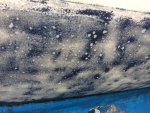
That looks more like a building that has been riddled with automatic weapons, as guardian has said walk away you will fined a much better boat that costs less than fixing that one up!
 
That looks more like a building that has been riddled with automatic weapons, as guardian has said walk away you will fined a much better boat that costs less than fixing that one up!
It’s been bead blasted that’s all. And if he got it at a good price at 2k and spends 1k in it he’s got a bargain.
 
what part of the question is that an answer too the guy asked shat it was or how to fix it.
I spent two years of my life and countless thousands of pounds doing what he's asking advice on, seriously walk away.........................just walk away.
 
Could you tell him what the problem is as that could would help him make an informed decision. I’m not having a go just curious how you could tell him to walk away when you haven’t seen the problem. Just a photo of some bead blasting.
 
I have spent the past 5 years renovating my boat, so I agree with guardian............don't walk but run away fast.

You would need some exceptional reason to want to take it on. It must be very cheap and located close to you and in a cheap (preferably free) place to work on it, you must have lots of spare time and no family commitments, and a large budget for work. You still have not said what type of yacht it is, but I am guessing about 26ft long. In this size range there are thousands of boats for sale in better condition, so this one must be in exceptional condition everywhere else to consider it. You have not mentioned your DIY skills as household ones are so different from working on a boat. In my time I have helped fit out a 34ft hull and build two 30ft yachts in glassfibre from plans using a male mould so required fully fairing the hull to get smooth. So please listen to those who are trying to help you.

Check out this PowerPoint presentation I made in January, https://wiki.westerly-owners.co.uk/images/3/3f/Concerto.pdf and guardian's web link. My boat has micro blisters in the underwater section of the hull which I fixed, then refixed, then refixed and know I will still have to do for a number of years to come. Both guardian and myself may be wanting old boats in excellent condition, but we both have the knowledge and skills to do it. It certainly is a lot of hard work and expense. One adverse point is I now suffer from vibration finger from using power tools for so long, so cannot use most power tools for more than a few hours a day.

If you want to go sailing, then buy a boat in better condition that needs minimal work and can be used as soon as we are out of lockdown.
 
OP is asking for advice on how to do a good job on the hull. Fair enough but what he actually does is another question. Presumably he bought the boat very cheap for a price it is actually worth. In which case it would not justify a huge effort to make it perfect. No boat has ever foundered from the pox. OP will actually end up starting to do a good job and get frustrated and end up just covering it all up. That is actually a reasonable approach. There is a good case for getting the boat into service to enjoy it. So maybe a bit of filler here and there as seems right then a/f paint and go sailing ol'will
 
I read it that he already owns the boat .
No fairing is needed as the hull shape is not being removed, just filling lots of small holes.
If he was a plasterer he could fill and sand in a weekend.
A flawless finish is not needed. £500-£600 ? Filler, sanding discs, primer, antifoul, sailing ! (And a fair few hrs)
 
I read it that he already owns the boat .
No fairing is needed as the hull shape is not being removed, just filling lots of small holes.
If he was a plasterer he could fill and sand in a weekend.
A flawless finish is not needed. £500-£600 ? Filler, sanding discs, primer, antifoul, sailing ! (And a fair few hrs)

Thanks Rappey, perhaps my use of the word fairing is a bit wrong there.

The hull shape is fine etc and if I can just scrape some decent filler over it and sand it in more than happy to.

My question should have been more clear for any confusion previously. If I was to fill in those shotholes (careful typing on phone), what could I pay most mind to, to ensure some good adherence?

Or does it stick like it would to the proverbial blanket? Would a coat of resin before help?

Thanks.
 
"Presumably he bought the boat very cheap"

But as mentioned here and everywhere else even a boat going free can still be too dear given its age, condition and secondhand value, FWIW here are your options as i see it:

a) live with the blisters & go sailing £0
b) fill and fair blisters with watertite or equivalent (as above) £500
c) (I took this one) Gel peel and hot wash till the numbers come down then sheath in bi-ax cloth & epoxy x2 then barrier coat x 5-7 (between 1- 2.5 years of your life depending how stubborn your boat is at 'drying' and about £3 - 4k in tools & materials for a 26 footer. Not to mention renting/building a shed to control temps and humidity for the duration of the job, another £2-3k and that's doing it all yourself.

At best, looking at the pics your gelcoat (as mentioned above) has failed and the blisters are 'surface' at worst waters in the laminate, hence the 'walk away' comment. Go to Nigel Clegg's excellent site and download the PDF's freely available on osmosis this will help you understand whats going on with your hull.

But for my money given the potential deflationary collapse we're heading for here and elsewhere post covid any money spent now could well be regretted later, & as many will tell you here boats have a nasty habit of costing a lot more than was budgeted for so unless there's any localised softness of the hulls laminate, i.e you can push it in ( physical deterioration of the skin) option a' your best bet.

A good book (which i should've read before i did what i did); Hugo Du Plessis' Fibreglass Boats
 
"Presumably he bought the boat very cheap"

But as mentioned here and everywhere else even a boat going free can still be too dear given its age, condition and secondhand value, FWIW here are your options as i see it:

a) live with the blisters & go sailing £0
b) fill and fair blisters with watertite or equivalent (as above) £500
c) (I took this one) Gel peel and hot wash till the numbers come down then sheath in bi-ax cloth & epoxy x2 then barrier coat x 5-7 (between 1- 2.5 years of your life depending how stubborn your boat is at 'drying' and about £3 - 4k in tools & materials for a 26 footer. Not to mention renting/building a shed to control temps and humidity for the duration of the job, another £2-3k and that's doing it all yourself.

At best, looking at the pics your gelcoat (as mentioned above) has failed and the blisters are 'surface' at worst waters in the laminate, hence the 'walk away' comment. Go to Nigel Clegg's excellent site and download the PDF's freely available on osmosis this will help you understand whats going on with your hull.

But for my money given the potential deflationary collapse we're heading for here and elsewhere post covid any money spent now could well be regretted later, & as many will tell you here boats have a nasty habit of costing a lot more than was budgeted for so unless there's any localised softness of the hulls laminate, i.e you can push it in ( physical deterioration of the skin) option a' your best bet.

A good book (which i should've read before i did what i did); Hugo Du Plessis' Fibreglass Boats

Thanks guardian,

It sounds like you must have really wanted the boat for option C, I bet that kept you busy.

At the risk of sounding like I'm teaching granny to suck eggs. Going back to a few points on here. Two of them specifically stand out for me is not seeing any evidence of osmosis treatment and the holes looking like it's just been shot blasted. I'd also read elsewhere re. blasting a hull that you should prepare to see "voids" where it has dug material out.

Again, I would defer to the knowledge on this forum, however it does sound like I'd be going for option B? I appreciate everyone's comments regarding should I/shouldn't I. I will be doing it.

Thanks again.
 
An epoxy filler or thickened epoxy should stick like the proverbial. As for what to use to thicken it, there are several alternatives, but I'd use microballoons as they're easier to sand than most of the alternatives.

If it's your boat slap on some filler and a coat of antifoul and go sailing. I she isn't yours and you can walk away, I'd do it. There may not be many boats about at the moment, but I reckon there'll be a good few coming on the market as lockdown lifts, and you'll find something that'll cost no more in money and a lot less in aggro.
 
Ground mine out 2 years ago and epoxy filled them ( pic ), before 2 pack and anti-foul. On lift late last year there are maybe 20 new / missed ones.
 

Attachments

  • IMG_3041s.jpg
    IMG_3041s.jpg
    324.6 KB · Views: 35
Thanks guardian,

It sounds like you must have really wanted the boat for option C, I bet that kept you busy.

At the risk of sounding like I'm teaching granny to suck eggs. Going back to a few points on here. Two of them specifically stand out for me is not seeing any evidence of osmosis treatment and the holes looking like it's just been shot blasted. I'd also read elsewhere re. blasting a hull that you should prepare to see "voids" where it has dug material out.

Again, I would defer to the knowledge on this forum, however it does sound like I'd be going for option B? I appreciate everyone's comments regarding should I/shouldn't I. I will be doing it.

Thanks again.
Not really. I massively underestimated the amount of work a peel would create, plus i was into doing things 'properly' back then, now i'm semi skint most of time its amazing how you find alternative ways of remedying problems. Now if i had my time again i would never undertake such destructive costly work as a full gelpeel and repair especially now given the near freefall in secondhand values of boats. In heinsight, after reading Hugo's book i should have peeled locally, in my boats case just the keel stubs.

Sailing and boats make little financial sense when the goings good but nowadays its financial suicide to throw money at them. Good luck with your boat and keep the questions & pics coming.

Cheers
 
. I massively underestimated the amount of work
Isn't that a statement most of us would admit to when tackling any boat job ? ?
One prices up the time and cost and afterwards realise but can't figure out how it costs 3 times more and as long?

Occasionally though a job goes quicker and easier than ever expected.
I had a very worn rudder on a long keel (bushings) and was not looking forward to it at all. Turns out I fixed it in one tide on a grid, mainly due to superb design and ease of removal and replacement of parts ? (and living across the road so I could fabricate bushes in shed)
 
If the hull gel coat is red I would jet wash clean and then fill with epoxy thickened with a filling / fairing compound. The west one (brown colour) is easy to sand by the way. Do this until all the holes filled or you get fed up, prime if required, antifoul and then sail.

Edit bit - The West stuff is 407 Low Density Filler according to my old, possibly last century West System 'book'.
 
Last edited:
Top