Switch panel wiring question

alahol2

Well-Known Member
Joined
22 Apr 2004
Messages
6,127
Location
Portchester, Solent
www.troppo.co.uk
I'm in the process of installing a new switch/fuse panel to replace the motley assortment of swiches that have grown over the years. I've managed to trace and label all the wires behind the panel. I now have a neat bundle of 'negatives' and a bundle of 'positives'.
All the 'negatives' will go to a busbar of some type (still to be sourced).
The question relates to the best/'proper' way to attach several positive wires to one switch (spade connector). Do I join them with a choc block/butt splice/solder and run one wire to the switch or maybe use a 'christmas tree' of piggy back spade connectors or... what?
The circuits in question are house lights, lower nav lights, 12V power sockets, instruments etc.

Any ideas gratefully received.
 
2 wires in 1 crimp is sort of ok
1 level of piggy back spades is sort of ok.

The list of circuits you mention seem a bit strange to all be sharing one distribution point.

Most ethical (from a wiring perspective) would be busbars for each of the circuits to be shared.

do you have room and budget for a row of din rail? that will neatly:
tidy the incoming wires
provide a tidy negative bus bar
provide the option to daisy chain (with busbar) any or even all positive feeds.
allow you to make a switch panel with wiring harness that will be easy to maintain.
 
Not used them myself but Wago connectors get a good write up here. 5 way from Screwfix (stock number 38224) or three way if that sufficient. Also not certain about your grouping system. As Dougal suggests DIN rail or bus bars (suitably insulated/protected) also good idea, but perhaps more than you need ? Avoid anything that resembles a Christmas tree !
 
2 wires in 1 crimp is sort of ok
1 level of piggy back spades is sort of ok.

The list of circuits you mention seem a bit strange to all be sharing one distribution point.

Bad explanation from me... House lights have about 7 or 8 wires which will go to 2 switches; lower nav lights, 3 wires to one switch; 12v power sockets, 3 wires to one switch; instruments 2 (or 3 or 4) wires to one switch.

Space is very restricted behind the panel so Din rail is a non-starter. The 5-way Wagos might do for the circuits mentioned, is there a way to fix them down? I suppose a dab of Sikaflex would hold them in place.
 
Thanks all. I went and bought a bag of 5-way Wago 221 lever connectors this morning. Didn't realise how tiny they are. They will be good for the multiple wire circuits. I think, as I had to buy 25 of the things, I'll stick a row onto a bit of wood and wire it up as a negative busbar. They are rated at 32A so should be fine.
I think, by the time I push all the wires back in behind the panel it's still going to look a bit like a rat's nest, but maybe a houseproud rat.
 
I have a DIN rail system, and confess I don't really understand it.
I would appreciate any pointers as to articles/ publications explaining it. Thanks.
 
My limited knowledge, so use with care, is that DIN rail is just a standard bit of rail onto which you can mount components (switches, breakers, fuse holders, connectors etc) that have been designed for such mounting. I don't think it imposes any particular 'system' of wiring.
eg... https://www.auberinc.com/index.php?main_page=index&cPath=46 ...selected at random.
 
Last edited:
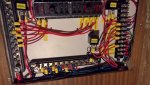
Yes... it looked rather like that in my head. The reality is not going to be quite so fine. Nice work.

Old cables (on the left) have crimped rings on them - that way you can get more then one on the same terminal.
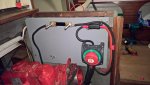
+ve Bus on the left - Down stream of a master fuse on the other side - see second picture.
-ve Bus along the bottom.
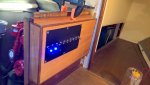
My only issue is that the LED's on the switches are far too bright - need to get some resistors.
Andrew

Terminal blocks were from 12 Volt Planet
If you sign up to their news letter you get 10% discount most months.
 
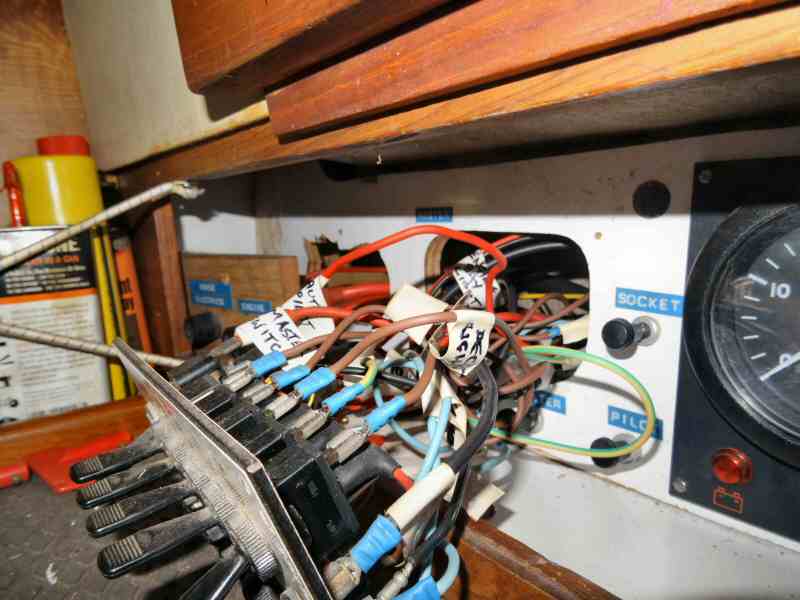
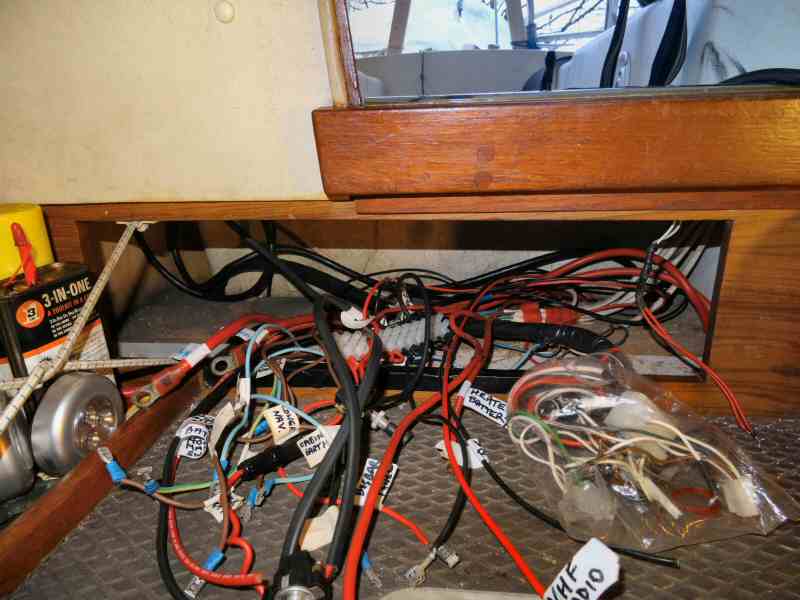
In mitigation I submit a couple of 'before' pics. All the wiring is in the slot under the bridgedeck which is rather narrow. It is almost impossible to use busbars that are screwed to the base because you can't see what you are doing when trying to attach wires. The wires need to be long enough to pull the switch panel(s) out onto the cabin step to do any work.
I may or may not submit any 'after' photos because it is still not going to look anything like the photos of some of the superb wiring I've seen on here.:o

WIRES1.JPG


WIRES2.JPG
 
In mitigation I submit a couple of 'before' pics. All the wiring is in the slot under the bridgedeck which is rather narrow. It is almost impossible to use busbars that are screwed to the base because you can't see what you are doing when trying to attach wires. The wires need to be long enough to pull the switch panel(s) out onto the cabin step to do any work.
I may or may not submit any 'after' photos because it is still not going to look anything like the photos of some of the superb wiring I've seen on here.:o

WIRES1.JPG


WIRES2.JPG

Nicely colour coded I see. :)
 
You should at least be able to go forward, safe in the knowledge that it won't look worse when you are finished :)

Pic 1 ; make all of the wires the same length so you have a neat loom, cable tied together. Use some neater labeling.

A lot of the crimping looks poor, buy a set of ratchet crimps. Use insulated terminals.

Pic 2 ; Lose the choc blocks, tidy the wiring and make into a loom, better labeling again.
 
Nicely colour coded I see. :)

But at least most of the wires are identified, which is a big improvement compared with many boats.

If I had any comment, it might be to question whether some things need switches. For example, there's apparently a "socket" switch. Why? If the socket feed is fused it doesn't need a switch. If something is plugged in, it uses power. If nothing's plugged in, there's no power used. What's the point of a switch?
 
Pic 1 ; make all of the wires the same length so you have a neat loom, cable tied together. Use some neater labeling.

A lot of the crimping looks poor, buy a set of ratchet crimps. Use insulated terminals.

Pic 2 ; Lose the choc blocks, tidy the wiring and make into a loom, better labeling again.

I'm using ratchet crimpers to extend some wires and to replace all the existing crimp terminals. I'm trying to make a loom, so far I've got all the negatives and all the positives cable tied. Chock blocks have gone and I'm using the Wago 221 connectors for a negative 'busbar' and to combine circuits. Neater labelling will have to wait until my wife opens her Christmas present (a Brother 'garden' labeller).

But at least most of the wires are identified, which is a big improvement compared with many boats.

If I had any comment, it might be to question whether some things need switches. For example, there's apparently a "socket" switch. Why? If the socket feed is fused it doesn't need a switch. If something is plugged in, it uses power. If nothing's plugged in, there's no power used. What's the point of a switch?

The 'socket' switch actually switched both the socket which has a bright Led that shows it's powered and a strip light that illuminates the switch panels under the bridge deck. I have now separately switched the light so it will be attached to one of the 'cabin' master switches. The three sets of sockets around the boat (all with indicator lights) will go to one of the switches on the panel.

Grateful for all comments, thanks.
 
Top