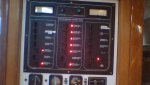
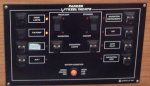
Switch panel - What do you have?

carl170

Well-Known Member
Joined
13 Nov 2003
Messages
235
halcyon23.blogspot.co.uk
Hi.

I am needing a new electric switch panel. I have looked through a few ebay listings and really not too sure what type to go for?. Or how many switches? There seem to be so many with different switch types, fuses, circuit breakers, cigarette lighters, USB sockets etc

What electrics do you have onboard? Does anyone use 12+ switch versions?

Are there any types to avoid? Does one type of switch fail before any other?

Sorry for the probable mundane-ness of this question!

Regards

Carl
 
I looked around a couple months ago and came to the conclusion that building my own was probably the only way to get what I wanted.

I will probably go with a sheet of acrylic and build up a board from that, adding LED rocker switches with a removable panel cut out from it with a surface mounted rack of fuses clearly labelled.
I need to have a mix of 12V and 240V switches too, plus bilge pump overrides etc - so making my own was the way ahead.

I costed it up at about £50 plus my time. All outbound connections ending up on a chocolate block bar which fed the appliance it was aimed at. Obviously having a negative bus bar and separating the 12V and 240V.

A local sign shop can router the panel for me and supply small vinyl letters which I would stick on.
 
I got a local sign maker to etch mine then I fitted switches and circuit breakers myself. I got those from CPC.

IMG_2084.jpg
 
I've done two custom-engraved panels in different boats (apologies to regulars who've seen them several times before :) ).

This was the first one. It includes a bank of switches, the engine controls transplanted from the original Yanmar panel (and with the useless and pointless key-lock replaced with a switch), and a little drawer for spare fuses, all combined on one big panel:

6BD5BA81-2A66-46BB-BFC0-84A4358E2F43-2977-000005729F5A249B.jpg


On the new boat, I used the same supplier but split things across several panels. Most of them are installed at the chart table:

FA134E57-C458-43E0-B24F-8F321FBCA412_zpsa7n6w6ow.jpg


There are also several smaller panels spread around the boat:

A9677D81-C969-484B-B933-647E94957253_zpsxn3bvqih.jpg


7D769453-2EEC-48C9-99DC-980822DBAB19_zpsbpqegvdy.jpg


5C287DF5-1AAF-4F29-9370-63F1346B5C81_zpsmujf4zog.jpg


I create the files in Omnigraffle, using the datasheets for the components to lay out the holes and cutouts to 0.1mm tolerance. Then I send them to Andrews and Arnold (an ISP with an odd sideline in engraving) to be laser-etched and cut, and a couple of days later they send me the panels. All the components snap or bolt snugly into their holes, giving a really nice result.

The only problem is that using anything less on the boat now feels wrong :)

Pete
 
I spent ages scouring ebay considering replacing my whole switch panel but then managed to just track down some old or rather brand new imperial size fuse holders so was able to use the existing Macwester Marine original switch panel. Saved me a lot of work & I now have recognisable features rather than stock labels for all sorts of odd features. It is also simple strait forward & gimmick free :encouragement:
 
Another point to consider is whether you actually need a panel switch for each thing on your boat. All wiring should be appropriately fused, but if the device itself has an on/off switch, and there's a battery master that de-energises all the wiring, what's the point of an additional switch near the chart table (or wherever)?

My electrics panel is in the bottom-left of the chart table pic above. It has two rows of switches, the top one for "operational" things and the bottom for "domestic". The pic's a bit small to read the labels, but they are:

Top row:
  • Navtex
  • Chart Nav (this is a Yeoman plotter and the old-school Garmin GPS that works with it)
  • Plotter/Radar
  • Radio & AIS
  • Instruments and Autopilot
With the exception of the Navtex if in use, these all get turned off when anchored or moored at the end of the day. Which ones get turned on depends on the type of sailing (just instruments and radio for local pottering, up to chart nav if crossing the Channel. Navtex if away for more than a weekend).

Bottom row:
  • 12v and USB sockets (because I might not know what someone has left plugged in in one of the cabins)
  • Water pumps (in case they become noisy at night, or if the tank is empty and the pump runs continuously)
  • Cabin lights (so that I can turn them all on with one switch when we come back from the pub. And ensure they're not accidentally on in daylight).
The Cabin Lights switch has a small LED (with a large resistor in series to make it very dim) so that it can be found easily in the dark.

There are some spare switches for future expansion, of course.

Anyway, the point is that lots of other things are powered via the fusebox but not switched at the panel:
  • Gas alarm (always on)
  • Bilge pump (switch near the pump, it's a big one and the distance to the panel and back would mean volt drop and heavy cables)
  • Fridge (already has its own switch)
  • Engine bay lights (not on the cabin lights switch because I still want them during the day, they come on when the engine bay doors are opened)
  • Heater (because it can be damaged by sudden loss of power while running)
  • Nav lights (have their own dedicated switch on deck, where you need it)
  • Deck sockets (likewise)
  • Float switch to warn when the hot water overflow bottle is full


Most of the circuits are fused via one of these on the back of the panel:

$(KGrHqF,!rMFF+p-kGhEBRh,6szWqw~~60_35.JPG


There's also a small 4-way box near the batteries for some things where it would have been perverse to run wiring all the way to the main fusebox and back again.

Both of them take automotive blade fuses which are easy to work with and available anywhere.

Pete
 
Last edited:
Aurai

Underwent an electrical refit and I bought a "professional" switch panel like the Blue Sea equipment that is relatively expensive but gave us a lot of confidence in its quality. I admire anyone who has the skill for their own build and see some very fine work. For us, the risk of poor workmanship is a fear, that stops us trying, one day?

The build quality of your panel is worth looking at and marine environments soon find you out. With the Blue Sea type board you get matching circuit breakers, so all you do is list your circuits, rate them for amps and ordering/fitting becomes straightforward.

One "mistake" made was to opt for two many breakers and not realising that many circuits are so low amps that full circuit breakers are OTT. Typically, lighting circuits can be fused, if you were looking to keep costs under control. It is not unusual to have a fuse panel and a circuit breaker panel adjacent. Keeping our panel as one with all circuit breakers does give us a neat finish that we value.

On the subject of fuses, items like VHF, AIS, Navtex, GPS, are usually fused and motoring type blade fuses in a holder, also by Blue Sea, was the neat solution for us.

The bought in panels also mean you can get made to measure back covers, again a neat finish.

Finally, if you wish to pm me, very happy to discuss details of your proposed work and give you the benefit of our learnings!

Cheers
 
Last edited:
I’m sure circuit breakers have advantages, but I’ve found simple fused panels with toggle switches fine and cost-effective – and I’ve had just one fuse blow in about 7 years. I did, however, print and laminate my own labels – I think they look better than those supplied with simple ready-made panels and I could customize them and include the fuse rating, which is helpful.

Two things I would advise, whichever type of panel you chose: (i) Check the adequacy of the main power cables to the panel – new, or higher-powered, appliances and instruments may have been added over the years, and (ii) if there isn’t one already, put a suitably-rated large fuse in the panel supply, as close as possible to its take-off from the battery bank.

As Pete says, if you don’t need panel switches those fuse units using automotive blade fuses can be very convenient. I did consider them, but did need some switches anyway and found it simpler to replace the panels rather than do away with them (and I’d then have had to replace the entire teak panels on which they were mounted because of the gaping holes they’d have left behind).
 
Last edited:
At the other extrewme of simplicity. I have a small black plastic box glued to the inside of the bulkhead just inside the main hatch. So accessible from the cockpit. It has 2 switches one for nav lights and one for cabin light. It also has 2 "banana" sockets to take the solar panel connection for charging. Or an outlet for anything else.
There is one fuse in line with the positive and at the battery. Very simple. VHF is connected via it sown fuse relying on the on off switch on the volume control. This works well as I cana dvise passengers "In an emergency turn the radio on with the volume switch, press the mike button and yell "help""

As an interesting aside. I do "fire and safety inspections" for boats in our marina. One requirement is for switch panel material to be 'fireproof". I don't know how many commercial switch panels are fire proof or resistant. Or just how important this is. No mine is not. But with a 5amp fuse for everything I can't see a problem. olewill
 
Beware the cheap eBay ones (and indeed, some of the slightly-less-cheap chandlery ones)! The bulbs in the illuminated rocker switches fail quite regularly and the cut-outs in the switch panels are JUST SLIGHTLY diffferent to the sizes of pretty much any similar looking replacement switches I've ever been able to find!
 
Bah, thanks very much for all your replies but this might all be irrelevant anyway. I just measured the gap where I was going to install the panel and have found there is only 35mm space. I had quickly measured from the outside and didn't realise where the bulkhead stopped!

Does anyone have any external switch panels (or ideas where I could mount a panel!). It might have to be somewhere unusual, but I cannot see where I am going to put one!

Cheers

Carl
 
Beware the cheap eBay ones (and indeed, some of the slightly-less-cheap chandlery ones)! The bulbs in the illuminated rocker switches fail quite regularly and the cut-outs in the switch panels are JUST SLIGHTLY diffferent to the sizes of pretty much any similar looking replacement switches I've ever been able to find!

Also be aware that luminated rocker switches often use neon lights, which consume significantly more power than LEDs. I decided to use none luminated switches to avoid unnessecary current draw when replacing our panel.
 
Having nowhere i could usefully panel mount i built a wooden box with a black hinged front cover.
The front cover has switches and glass fuses as well as a voltmeter with pushbutton. (I dont need a fancy electronic battery controller thingy.)
There is a busbar for all the negatives in the base of the box and each of the positives is landed on a brass screw set through a UHMWPE strip to make a terminal post which is easy to add to.
The UHMWPE strip was actually a 20 mm wide piece of a bread cutting board.
I used a goodly sized cable from Battery to box but with a blade fuse adjacent to the battery. If that cable pair got shorted out between the battery and the box a fuse in the box wouldn't help.
One other tip is to have two separate circuits for cabin lighting. If you do blow a fuse you will still have some light in the boat to see what you are doing!
Cheers
 
Keep you awake if you sleep in the saloon, too :)

Pete
Don't remind me!!! Mrs Avocet and I enjoyed many happy times on the boat and when our beloved daughter was born, we thought we'd do the same. As a baby, one of her first words was "light" (or "ite" as she originally pronounced it). I still remember the night we TRIED to spend on the boat with her on the cabin sole, wide awake, pointing at the switches on the switch panel and saying "ite", "ite", "ite"! excitedly, while both her parents secretly contemplated ways of disposing of her overboard and making it look like a terrible accident! Around midnight, I think we finally cracked, went ashore andd looked for a hotel! (We did bring the baby with us, I hasten to add, though it was tempting to leave her on the boat with her "ites")!
 
Don't remind me!!! Mrs Avocet and I enjoyed many happy times on the boat and when our beloved daughter was born, we thought we'd do the same. As a baby, one of her first words was "light" (or "ite" as she originally pronounced it). I still remember the night we TRIED to spend on the boat with her on the cabin sole, wide awake, pointing at the switches on the switch panel and saying "ite", "ite", "ite"! excitedly, while both her parents secretly contemplated ways of disposing of her overboard and making it look like a terrible accident! Around midnight, I think we finally cracked, went ashore andd looked for a hotel! (We did bring the baby with us, I hasten to add, though it was tempting to leave her on the boat with her "ites")!

A roll of PVC tape can come in very handy at times like these.

(To cover the lights, not the baby :D)

Pete
 
Top