Swinging mooring - Single handed

Lots of good advice above. I always swim down and check the state of the chain and ground tackle on unknown moorings too.

 
I am always impressed with how simple you all make it sound. Minimal tide / wind in your world and moorings which have no shallows or other boats around to drift in to! The OP’s approach has essentially worked for me in the past - not always first time. An escape plan is essential.
Just takes a bit of practice. The Exe estuary can have a few knots running and if you have never been aground in the estury then you are lucky (or more likely not telling the truth).
 
I motor up to the pick-up buoy, when level with the cockpit pick it up and walk forward as the boat falls back on the tide. Just a matter pulling until the eye of the mooring can be placed over the cleat.
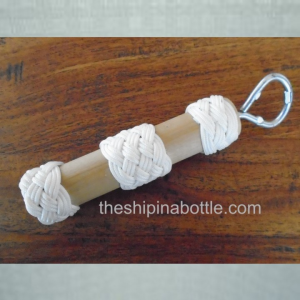
I used to do that by routine (I still might on occasion if conditions are very benign), particularly when I had tiny boats - 16 and 17 footers) - that were very easy to pull around. I would catch the buoy with the boat hook from the cockpit, then simply walk the buoy forward to the bow (actually walk the boat backwards past the buoy) with the boathook, and then secure the buoy properly.

One day I picked up my home mooring, but the typically strong tide somehow whipped the boat side on to the tide, and I was left hanging on to one end of the boat hook, the other trapped with me unable to push it forward to detach it from the buoy's ring and start again. It was a toss up whether first my arm would be pulled out of its socket, me be pulled out of the cockpit, the hook be pulled off the end of the boathook, or the whole thing torn from my hands.

Ordinarily I would have let it go, and hoped the boathook might somehow stay attached to the buoy, rather than be shot out to sea by the tide, but I was particularly attached to that specific boathook, which had been made by the previous owner. It was nicely varnished wood, much shorter than a standard boathook (which there would be nowhere to store in a 16' 3" boat), and had very pleasing traditional 'ornamental' cordwork hand grips (something like in this pic - can't remember the proper term).
1755091191660.png

I can't even remember now what the outcome was, but I'll never forget the predicament!

Just takes a bit of practice. The Exe estuary can have a few knots running and if you have never been aground in the estury then you are lucky (or more likely not telling the truth).

It was indeed on the Exe - off Cockwood - that happened!

I think the only time I went aground in the Exe - honest! - (though my first boat there drew only a few inches with the centre-plate up, I later had a 1.2 m fixed keel there) was when my little centre-boarder had a drying mooring in a little side channel among the reeds right up by the Retreat boatyard. Leaving that on one occasion I strayed and got stuck in the mud for a while. Attempts to haul myself off by throwing the anchor forward failed, and had to wait for the tide to rise to get off.

On another occasion I didn't actually go aground, but somehow arrived back one day too late to get to that mooring, which was only accessible at the top of the tide. I was due to play a gig in Bristol that evening, and it was hugely frustrating to have sit and wait for hours, knowing that I'd be late for the gig. (This was long before mobile phones, so no way of contacting my bandmates.) At long last I was able to get to my mooring, row my tender over to the Retreat boatyard, put it away, race up the M5, get home, quickly change clothes (no time for a shower), load my gear into the car and dash across town to the wine bar on Whiteladies Road we were playing.

To my horror, on arrival I found the band had already started playing. The trumpet player had somehow conjured up a bass, and was standing in for me on that. They were just about to play one of my favourite numbers, so I borrowed his bass and played that number, praying that I wouldn't get a ticket on my car, temporarily parked on double yellows on the main road outside with hazard lights on. When that number ended, I handed that bass back to the trumpet player, hauled my own gear in, went and found somewhere to park the car and ran back to take my rightful place in the band. And they say sailing is relaxing!
 
I've always refrained from doing that.
I must admit I'm a bit paranoid about not being able to pick up the mooring in time and the buoy passing under the boat and possible getting caught on the keel or prop.
Been there, done that: moored by the keel. Now try to never let the buoy go aft of the (deep bulbed) keel. I'm really not THAT bad a boat handler, but once the wind gets up singlehanded on a modern 35-footer I can sometimes take several goes to walk forward (at my age I don't sprint) and get the pickup buoy aboard before the bow blows off one way or an another.

If genuinely windy and singlehanded I rig 2 lines in advance. One to a stern cleat, the other from bow fairlead to stern, and reverse up to the pickup buoy. Modern boats behave impeccably stern dead into wind. Attach stern cleat line. Transfer load to long line from bow. Drop stern line, go to bow and pull in FAST and cleat rope as temporary fix. Too many close-packed moorings to let her go back far. I typically end up with the nearest boat within inches of me if I'm slow. Don't have the leisure time of LittleSister or Ridgy who clearly
have a much better spaced out mooring.

Finish with rope drum on windlass if needed, then a final burst ahead to get the chain in and on the bow.

I'm contemplating making a 'stand up stick' buoy.....
 
I am always impressed with how simple you all make it sound. Minimal tide / wind in your world and moorings which have no shallows or other boats around to drift in to! The OP’s approach has essentially worked for me in the past - not always first time. An escape plan is essential.
The one I pick up when solo is a club mooring in the Solent, near Yarmouth pier head. Not short of tide or wind, and far from always co operative. It takes me less than 5 seconds to get the pickup with the boathook, from leaving the helm, and maybe another 5 to put the loop over a bow cleat. I wouldn’t attempt it on a strong flood tide and a NE wind, but any other condition I’d consider leaving the harbour in is fine. Even our light, flighty boat doesn’t do much in 5 seconds. I do get to put the pickup between the hull and the outrigger, in front of the front beam, which I suppose gives me options of where to grab it from. I do get some practice though, the XOD moorings are just inside the cruiser ones. Every time we sail we have to sail back onto a mooring. Use makes master, I suppose. I haven’t tried sailing the tri onto that mooring mind you. I have a feeling there'd be tears before tea time…
 
I have been using mooring for 20 years or so and never had any real trouble picking it up using a pick up buoy on a few meters of line.

UNTIL this year when I bought a new boat.. so far it has been a nightmare..every time..

On two occasions I lost the boat hook over the side and on another I lost the top of my boat hook with the fancy clip for holding my fancy releasable magic hook😭

On each occasion the sweeping brush and a more careful approach worked...

My new plan is to use the careful slow studied approach first in future..

Moral of the story ..different approaches work for different boats and conditions and have a spare boat hook...
 
Approaching my mooring I check how the neighbouring boats are lying as wind +/- tide means 'head to wind' isn't always the correct approach.
Always pull the pick-up line with the boathook rather then use it as a lever to get the line on board. And if it's a telescopic boathook make damn sure it's screwed together securely. And carry a spare boathook. In case you, or a crew member, forget either of those tips.
 
I have a length of 14mm polyester with 1m of 6mm chain spliced in the middle. Loop on one end of the rope, onto boat cleat. The rope with chain is easily thrown to lasso the mooring buoy, and the chain sinks it, so as to give chain on chain, underneath the buoy. Use from aft/midships if singlehanding.
1m of chain is sufficient to take the chafe, chain on chain, and not abrade the buoy.

I use this when providers of invariably overpriced "visitors moorings" are too mean/inconsiderate to provide any form of pickup buoys. Some authorities hereabouts even top their "hippo type" visitors moorings with small D shackles, rather than larger bows, seemingly to make life that bit more "sporty" for visitors?

No risk of loosing your fancy buoy catcher boat hook etc, especially if you are only carrying one...as I now know...

Once secure to buoy chain, I can then work a rope or chain thru the central buoy top shackle at my leisure.
 
Last edited:
Approaching my mooring I check how the neighbouring boats are lying as wind +/- tide means 'head to wind' isn't always the correct approach.
Always pull the pick-up line with the boathook rather then use it as a lever to get the line on board. And if it's a telescopic boathook make damn sure it's screwed together securely. And carry a spare boathook. In case you, or a crew member, forget either of those tips.
The hybrid approach, taking account of both wind snd tide is the key to success. Our club moorings have ‘Marksman’ the clubs big RIB, which seems to have the same characteristics as us. Line up with that and it’ll be a job well done. Pick a neighbouring boat like your own.
 
I wrote above about problems with the bow blowing off before I could get from cockpit to the bow. My previous boat was a heavy long-keeler with hank on sails, and picking up a buoy was really easy - the boat more or less stayed put in the water once stopped.

Now with a modern fin-keeler with a rolled genoa for extra windage forward, and a really narrow keel, the bow blows off really fast. On my mooring, if I went forward far enough to get the mooring buoy level with the cockpit I would hit the boat on the next windward mooring. They are really spaced pretty tightly.

I manage, but bow pickup sometimes takes 2 or 3 goes if singlehanded, and if really windy backing up to the mooring under engine is pretty much the only way. With a crew it's easy, power up to the mooring and stop with a good burst astern as soon as the crew has the pickup buoy in hand.
 
I used to have a line cleated at the bow and running back to the cockpit, outside the guard rails, with a big carabiner on the end. I'd pick up either the buoy or the short floating grab-rope from the cockpit and clip on the carabiner (the grab rope had a loop on the end).
At that point I was attached securely and could relax, engine off or into neutral (or drop sails if I'd sailed in), then head forwards and haul the thing in.
This was single-handing a small, lively boat in a very tidal river so it didn't do to walk away from the helm without being secured to something!
 
I used to have a line cleated at the bow and running back to the cockpit, outside the guard rails, with a big carabiner on the end. I'd pick up either the buoy or the short floating grab-rope from the cockpit and clip on the carabiner (the grab rope had a loop on the end).
At that point I was attached securely and could relax, engine off or into neutral (or drop sails if I'd sailed in), then head forwards and haul the thing in.
This was single-handing a small, lively boat in a very tidal river so it didn't do to walk away from the helm without being secured to something!
Sounds like that wouldn't work for the OP as the moorings are so tightly packed together, with extra rope might hit boat behind.
Re bow blowing off, putting the bow just to windward (ie not going head on to wind) can help as bow blows down onto buoy as walk forward.

Well all good theory, just heading in to look for a visitor mooring so let's hope my solo efforts dont fail 😀
 
My home mooring has a floating pickup line with a loop on the end.
I attach a line to the bow long enough to reach the cockpit that has a large snap hook on it.
I just motor along side, head to wind, by the cockpit and pick it up and clip it on. Then reverse back a bit, walk forward and pull it in.
The buoy is always visible to me and I don't have to leave the helm until attached. No chance of any mishaps.
That’s exactly what I do!👍
 
Sounds like that wouldn't work for the OP as the moorings are so tightly packed together, with extra rope might hit boat behind.
Re bow blowing off, putting the bow just to windward (ie not going head on to wind) can help as bow blows down onto buoy as walk forward.

Well all good theory, just heading in to look for a visitor mooring so let's hope my solo efforts dont fail 😀
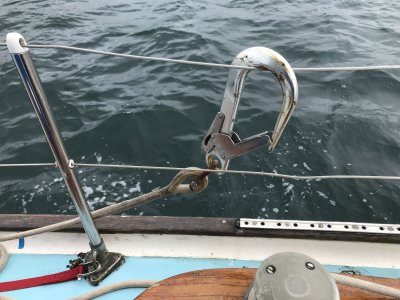
Rope goes forward from the cockpit to a block on the bow then back along the outside to the shackle/clip.
Hook in then take up the slack as the boat falls back.
Simple.
 
I like the idea of a chain weighted line and the pulley block at the bow.
Perhaps a long line with chain in the middle. One end attached at the bow, then brought back to cockpit with plenty of slack to the chain for throwing over the buoy. Then back to the bow, through the block and back to the cockpit and cleated off.
Then motor forward against tide to move slowly across to the buoy about miships. ( can't see the buoy from the bow)
When close , engine to neutral. Take line and throw over buoy. Back to cockpit. Take in line. Transfer mooring line to bow cleat and remove long line.
Boat 35 ft fin keel.
Problem was strong wind on the beam blowing bow off.
Also a rudder lock would be good.
 
I wrote above about problems with the bow blowing off before I could get from cockpit to the bow. My previous boat was a heavy long-keeler with hank on sails, and picking up a buoy was really easy - the boat more or less stayed put in the water once stopped.

Now with a modern fin-keeler with a rolled genoa for extra windage forward, and a really narrow keel, the bow blows off really fast. On my mooring, if I went forward far enough to get the mooring buoy level with the cockpit I would hit the boat on the next windward mooring. They are really spaced pretty tightly.

I manage, but bow pickup sometimes takes 2 or 3 goes if singlehanded, and if really windy backing up to the mooring under engine is pretty much the only way. With a crew it's easy, power up to the mooring and stop with a good burst astern as soon as the crew has the pickup buoy in hand.
It can involve a bit of luck, especially if the tide is uncooperative, but basically it’s a matter of letting the bow blow off but in the direction of your choice, bringing your boat onto the buoy at just the right point to pick it up easily, perhaps.
 
Sounds like that wouldn't work for the OP as the moorings are so tightly packed together, with extra rope might hit boat behind.
Re bow blowing off, putting the bow just to windward (ie not going head on to wind) can help as bow blows down onto buoy as walk forward.

Well all good theory, just heading in to look for a visitor mooring so let's hope my solo efforts dont fail 😀
An update. So stopped at buoy, walked forward and hooked pickup buoy first time. Good so far,
Then found that the lightweight pick up rope was actually tied off in a bundle to the shackle on top of the buoy so could not be lifted.
These moorings require your own ropes threaded through the shackle on top so had prepared second boat hook, the Hook and Moor, with a rope attached, so quickly threaded this through and we were moored. Absolutely brilliant pole (as along as ….j
Tried to thread second rope and pole jammed. So had to use dinghy to thread second mooring rope.
Fortunately it wasn’t windy.
 
I have a length of 14mm polyester with 1m of 6mm chain spliced in the middle. Loop on one end of the rope, onto boat cleat. The rope with chain is easily thrown to lasso the mooring buoy, and the chain sinks it, so as to give chain on chain, underneath the buoy. Use from aft/midships if singlehanding.
1m of chain is sufficient to take the chafe, chain on chain, and not abrade the buoy.

I use this when providers of invariably overpriced "visitors moorings" are too mean/inconsiderate to provide any form of pickup buoys. Some authorities hereabouts even top their "hippo type" visitors moorings with small D shackles, rather than larger bows, seemingly to make life that bit more "sporty" for visitors?

No risk of loosing your fancy buoy catcher boat hook etc, especially if you are only carrying one...as I now know...

Once secure to buoy chain, I can then work a rope or chain thru the central buoy top shackle at my leisure.
You are the worse type of visitor. Quite happy to damage the mooring and complain about the price. Typical
 
Top