Sunbeam II RDF??

teensailer

Member
Joined
11 Jan 2026
Messages
25
Visit site
Hi folks, I have just kindly been offered to look through somebody’s boat jumble cupboard whilst picking up a pilot book and grabbed a few bits that looked interesting.
Anyway, they offered for me to take an old sunbeam II RDF that they weren’t even sure how or whether it worked. I took it as I currently have no navigation/position finding stuff for the big boat.
I was just wondering whether this is something outdated that no one uses anymore or whether it could actually be helpful, and if so how do I use it?
Thanks
 
I'm not sure the marine radio beacons are still transmitting. There may be some air navigation ones but the ones that provided the coverage we used to rely on while sailing I believe are gone.

A modern almanac or a copy of ALRS should confirm.

Edit: Having looked at the chapter headings in ALRS I can't see any reference to the old (LF/MF) beacons.
 
Last edited:
Good 'conversation piece' and for display on the mantle ...

But as to useful ? not much use nowadays.

I can remember as a young lad - playing with Fathers "Roberts RDF' radio with the long scanner type antenna on top. Then he got hold of a Seafix RDF ... many years later - I had a Seafix on my first boat ...
 
I still have the seafix that came with the boat but never got on with it. I later had a Lokata with a digital display that was great and enabled me to find the Azores without any difficiulty. All obsolete now so perhaps a museum might be interested.
 
Stick it on Ebay:

Radio Direction Finder Seafarer Seabeam II Sailing Navigation Marine Aircraft | eBay UK

More seriously, the aero beacons always worked easiest. You found a signal from an airfield (the Seabeam II was good because you could key in the frequency digital fashion) pointed the unit and then swung it across the horizon till you got a direction in the earphones - the thing also had an small visual readout. You then took a bearing and you could plot a position line. If you were lucky you could find another beacon and get another position from that.
One additional use was to get the Long Wave BBC weather forecast on it.
They never functioned brilliantly well even when the dedicated marine beacons were in operation. You would need 8 AA batteries to get it going and it probably needs work on the switches/contacts.

The compass on top was good quality so you could detach it and make a useful hand bearing compass.

.
 
Even in their heyday (60s or 70s!) they were of limited use. The coverage of suitable beacons was inadequate in many places. We sailed out of Dunbar up the east coast of Scotland and there was only one or maybe two usable beacons - not enough for a fix, but one did come in useful when we found ourselves in fog - our course was such that the bearings provided a useful check on the speed over the ground. Probably the South Coast had better coverage, given the greater concentration of shipping and aircraft.
 
More seriously, the aero beacons always worked easiest. You found a signal from an airfield (the Seabeam II was good because you could key in the frequency digital fashion) pointed the unit and then swung it across the horizon till you got a direction in the earphones - the thing also had an small visual readout. You then took a bearing and you could plot a position line. If you were lucky you could find another beacon and get another position from that.
There were a few problems when using aero NDBs. Firstly they were/are low power, short range aids to enable aircraft to land so pretty useless at sea (although the Alderney one was useful). Even the en-route ones had limited range. Secondly to plot a PL as you suggest you'd need a chart covering the airfield's location (and specifically, the location of the transmitting antenna).
 
Last edited:
Yes, It was all pretty useless. The only thing I recall is getting a vague idea of where Guernsey was, which we knew anyway. Plus the ability to home in on Plymouth which I never needed in anger.
 
As said aviation beacons are being dismantled. Even here AM radio stations are disappearing going to VHF FM. Our local ABC (think BBC) is shutting down the 55kw AM to move to VHF FM. Yet another AM beacon not available. Your RDF IMHO would not have a place on a boat.
I suggest OP get in to GPS in some form just so much better more accurate than RDF or dedrecconing. Even a simple hand held GPS if it has correct way points will get you safe in a fog. ol'will
 
Anybody remember the Pilot Pal Radio? Had one on the boat I picked up from Sardinia in 69. The ferrite rod antenna on the top rotated to take bearings. Prob we had, no info on where the the stations were, ,so little use.

Did use a Seafix a few times, quite good.
 
Anybody remember the Pilot Pal Radio? Had one on the boat I picked up from Sardinia in 69. The ferrite rod antenna on the top rotated to take bearings. Prob we had, no info on where the the stations were, ,so little use.

Did use a Seafix a few times, quite good.

The Pilot Pal sounds similar to the Roberts ...

Radio was just like a standard transitor radio of that era ... with a rectangular box antenna that rotated on top ... the antenna was same length / width as the main radio case ...

Antenna not only gave you the direction of the NULL signal ... but also worked for standard radio broadcasts such as radio 1 ... 4 etc. But it had no compass to give you bearing ... you had to use a separate compass.
 
The Pilot Pal sounds similar to the Roberts ...

Radio was just like a standard transitor radio of that era ... with a rectangular box antenna that rotated on top ... the antenna was same length / width as the main radio case ...

Antenna not only gave you the direction of the NULL signal ... but also worked for standard radio broadcasts such as radio 1 ... 4 etc. But it had no compass to give you bearing ... you had to use a separate compass.
Yep, but it was aimed at yachties. I associate Roberts with 'slightly' classy home radios; nice cases.
 
Wow! Thanks for all the replies.

I gather they seem fairly useless today and even if your GPS dies and it’s foggy or dark couldn’t you just get a bearing of lights or if it’s foggy and your close enough in to worry wouldn’t you hear the fog signals?

I don’t know all that much but this just seemed the logical way to deal with such scenarios without the faff of finding a beacon and plotting on the chart.
 
In the immortal words of Albert Steptoe "I ain't dead yet!"


View attachment 206023
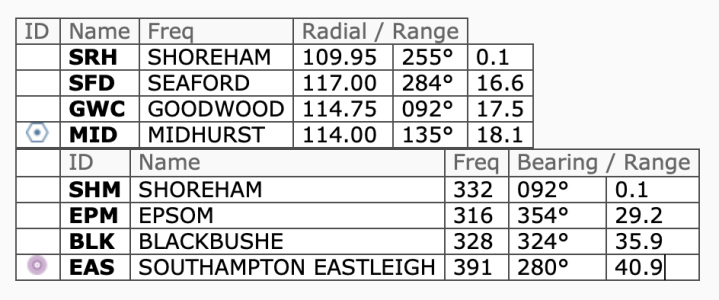
These charts may have some confusion for many. The top chart is not relevant to the discussion on RDF the bottom chart may be.
The topp chart relates to aviation use of VOR visual Omni Range at VHF with amplitude modulation in the frequency range 108 to 118 mhz (117.95 actually) Although the top of the list Shoreham I think if my memory is correct is an error of frequency being in the lower range used for ILS (instrument landing systems.
The VOR has a peculiar signal as recived by the aircraft dpending on location as described by a compass radial from the transmitter. Hence on radial 255 degrees means that the aircaft is 255 degrees from the transmitter and the transmitter is also 75 degrees true heading from aircraft. A vey complex active radar system is used called DME (Distancee Measuring Equipment ) to find distance to the colocated DME transmitter. All very interesting and accurate (although not as easy as GPS) However in practice instrument procedures for an arrival at an aerodrome are not based on identifying where you are on a map but of following particular radial to a particular range then turn etc
Now the second chart does seem to relate to RDF or for aviation ADF (Automatic Direction Finding) The radio is tuned to the beacon or radio transmitter AM band 200 to 400 for NDB (Non Directional Beacon transmitting a morse code identification) or 520 to 1700khz for radio stations (not so safe as identification therefor location is not so clear) The dial will show relative heading from aircraft to beacon. However most larger aircraft have a RMI (radio Magnetic Indicator) Which has a scale rotating to magnetic heading form flux gate. The pointer can be switched from ADF (dual systems usually) to VOR (dual systems usually) So ADF can give effectively a radial from transmitter and VOR can give effectively a relative heading to transmitter. (beacon)
As for the range listed on the second chart that can only be calculated from a map and with no where near that accuracy. So all very confusing.
Now my knowledge of these things relates back 25 years then as an engineer (regulator) and as with boating GPS has changed things rapidly. ADF in planes may soon if not already disappear and RDF in boats is almost forgotten. ol'will
 
Top